

Perfume is expensive because the price is made up of far more than just the scent itself. Rare raw materials such as oud or jasmine, years of formula development, safety tests, luxury bottles, media campaigns with celebrities, and the margins of middlemen all add up in the amount you pay at the checkout. With many well-known brands, the fragrance oil itself represents only a small part of that final price. How much you pay for quality versus how much for image varies greatly from brand to brand and from bottle to bottle.
In short:
- The high price of perfume is determined mainly by expensive ingredients, extensive development, and marketing—not by the scent itself.
- Rare ingredients such as oud can cost up to € 180,000 per kilo, which strongly affects the price.
- Production and transportation costs, plus margins in the supply chain, cause the price to rise significantly—even when production costs fall.
- A large part of the selling price goes to luxury packaging and advertising campaigns, not to the fragrance oil itself.
- A good candidate for purchase is a perfume with a high concentration, rare ingredients, and long-lasting wear—not the most expensive bottle.
Table of contents
- Ingredients and concentration: which raw materials make perfume expensive?
- Development and testing: years of work and hidden costs
- Packaging and marketing: the visible part of the price
- Production, distribution and inflation: the invisible supply-chain costs
- Psychology of luxury: why price reflects emotion and status
- When is a high price worth it? a checklist for buyers
- Smart buying: practical tips to save money without compromising on scent
- Personal note: how I, as an author, look at price and fragrance
- Affordable and still concentrated: the Pureparfum alternative
- Sources
Ingredients and concentration: which raw materials make perfume expensive?
Some raw materials are literally more valuable than gold by weight. Oud, the resin of the agar tree, can in some markets reach € 180,000 per kilo, and that price tag ultimately ends up with you. Jasmine has to be hand-picked, often early in the morning before the flowers lose their scent. Rose oil from Bulgaria or Turkey requires thousands of kilos of flower petals for just a handful of milliliters of oil.
The concentration of perfume oil in the bottle also determines much of the price and how long it lasts on your skin:
- Eau de toilette typically contains 5 to 15% perfume oil and smells for a few hours.
- Eau de parfum contains 15 to 20% and usually lasts about half a day.
- Extrait de parfum goes toward 20 to 30% and can last all day.
There’s a catch: for perfume, legally only allergens are required on the label, not the full composition or the exact concentration percentage. So you often buy based on trust, not transparency.
Development and testing: years of work and hidden costs
Making a fragrance doesn’t take weeks, but years. A perfumer experiments with hundreds of versions before one remains that goes to market, and that process involves substantial costs that aren’t visible on the label.
- Formula development often takes two to five years, from the first sketch to a fragrance ready for sale.
- Every adjustment to a formula requires new safety and stability tests, mandated by European cosmetic regulations.
- Failed formulas that never reach the store are included in the cost price of the fragrances that do make it.
Brands deliberately spend years on research and safety testing before a bottle reaches the shelves, and that investment has to be recouped somewhere. That “somewhere” is your purchase price.
Packaging and marketing: the visible part of the price
With many well-known perfumes, the biggest part of your money doesn’t go to the scent, but to the presentation around it. Research by KRO-NCRV shows that the juice itself sometimes represents only a small percentage of the selling price, while packaging, marketing, and distribution take the rest.
- Heavily cut glass, gilded cap work, and lacquered boxes can together cost more than the oil inside.
- Celebrity campaigns and large advertising budgets easily run into the millions.
- Brands consciously sell a sense of status, not just a fragrance. More about why luxury packaging actually adds value can be found with specialized packaging experts.
Production, distribution and inflation: the invisible supply-chain costs
The route from factory to store shelf also costs money, and those costs have risen significantly in recent years. Raw materials such as glass and cardboard became more expensive, transportation costs increased as well, and that fed directly into the prices you see in the store today.
Number to remember: general inflation figures from the CBS about 2024 show that higher material and energy costs are broadly working through into retail, including perfume.
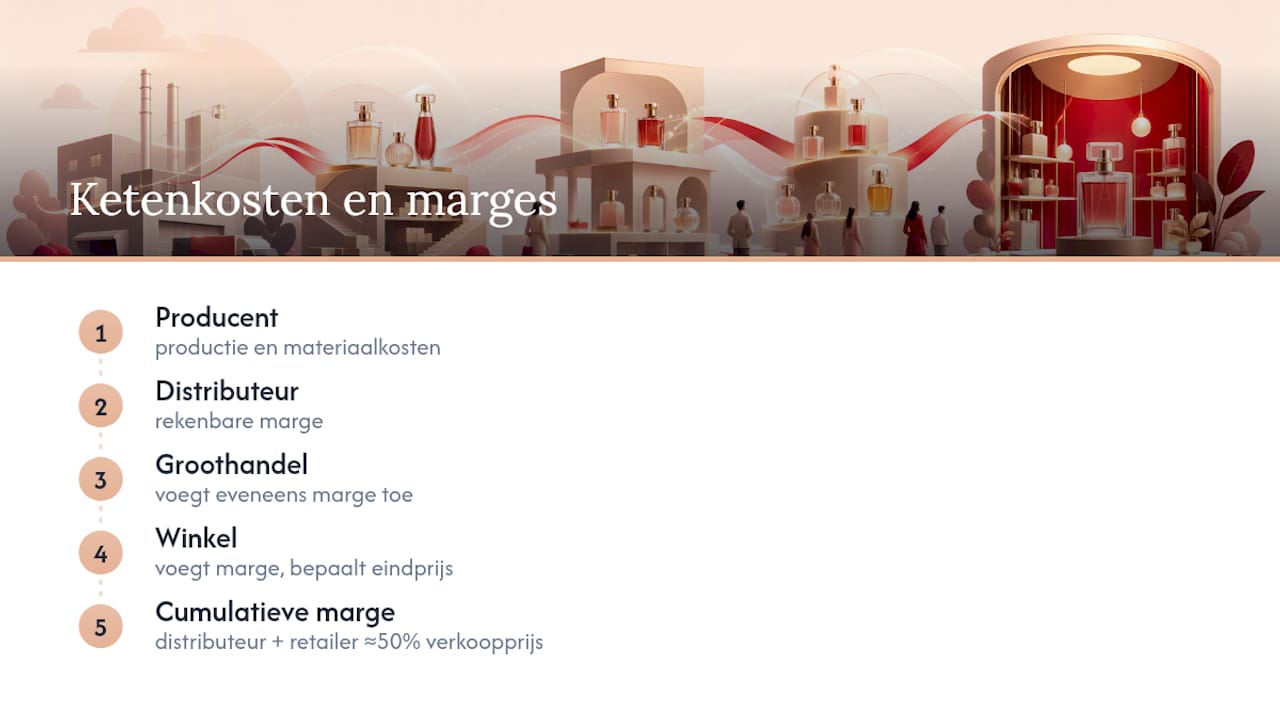
In addition, a bottle passes through multiple links before it ends up with you: producer, distributor, wholesaler, and store. Each link charges a margin, and for luxury perfume the combined margin of distributor and retailer can rise to about half of the selling price. Even if production costs decrease, brands rarely lower the price. A lower price would damage the luxury image, and that image is exactly what customers often pay for.
Psychology of luxury: why price reflects emotion and status
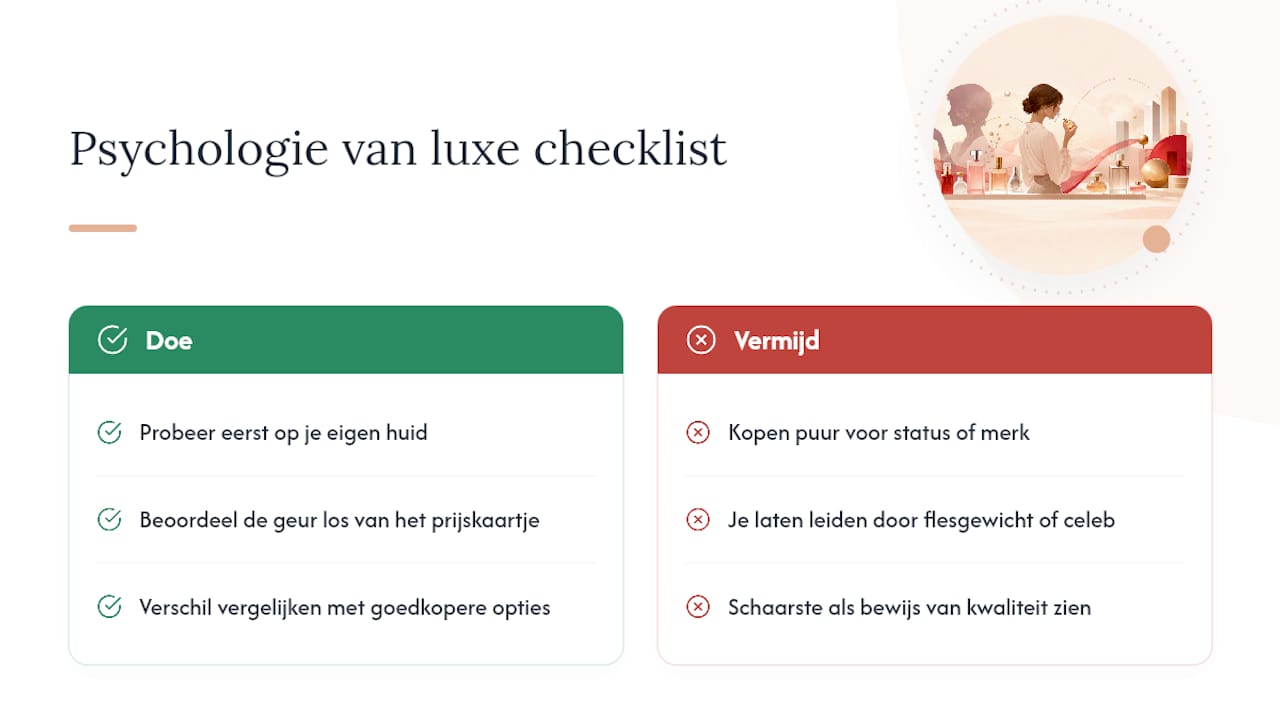
A high price sometimes sells better than a low one, and that’s not a coincidence. Art historian Sofie Albrecht points out that consumers often pay for status, not purely for fragrance performance. As also De Morgen aptly summarizes: we buy too much with our eyes instead of our nose.
A heavy bottle and a famous face on the advertisement influence your buying behavior more than you think. Scarcity strengthens that effect: a limited edition feels more exclusive, even if the scent itself is comparable to a cheaper alternative. So always test first on your own skin before the price tag colors your judgment.
When is a high price worth it? a checklist for buyers
Not every expensive fragrance is a waste of money, and not every cheap fragrance is a bad buy. The difference lies in where your money goes.
- Check the concentration. An extrait or eau de parfum with a high oil percentage justifies a higher price more readily than an eau de toilette.
- Watch for rare ingredients. Natural absolutes of jasmine, rose, or oud are more expensive to obtain than synthetic molecules, and that difference is noticeable in the intensity.
- Ask about longevity on the skin. A fragrance that lasts eight hours offers more value per euro than one that disappears after two hours.
- Be critical of showy packaging. A heavy bottle without a clearly stronger scent experience mainly pays for image, not quality.
Pro tip: In the store, always ask for the concentration in percentages. A seller who doesn’t know or avoids it is probably selling you a story rather than a fragrance.
Smart buying: practical tips to save money without compromising on scent
You don’t have to pay the full price to find a fragrance that truly suits you.
- Buy a small size or a test set first before investing in a large bottle that you might not fully use up.
- Choose refillable bottles or high concentrations: you pay less per use moment because you need to spray less often.
- Consider high-quality synthetic alternatives. Modern fragrance molecules often perform surprisingly close to natural absolutes, at a fraction of the cost.
- Always check the production date and shelf life. Perfume slowly loses intensity, and a bottle that has been sitting on the shelf for years is worth less than the price suggests.
Pro tip: Keep your perfume out of direct sunlight and at room temperature. Heat and light break down fragrance molecules faster, so your expensive bottle loses its strength sooner.
Personal note: how I, as an author, look at price and fragrance
Price says less about quality than most people think. I believe your nose should always have the final say, not the packaging or the face on the advertisement. Some brands show that a high oil concentration can be achieved without a fancy bottle or a million-dollar campaign. So test first, buy afterwards, and never let yourself be convinced by a price tag alone.
— J
Affordable and still concentrated: the Pureparfum alternative
You’ve now seen where the money in an expensive bottle goes exactly: mostly to packaging, campaigns, and middlemen—not to the fragrance oil itself. Pureparfum flips that logic. We use a higher oil concentration than many competing scents in the same price range, and we intentionally leave out expensive packaging and marketing budgets. In addition, our perfumes are fully vegan and animal-friendly, so you don’t pay for something you don’t stand behind.
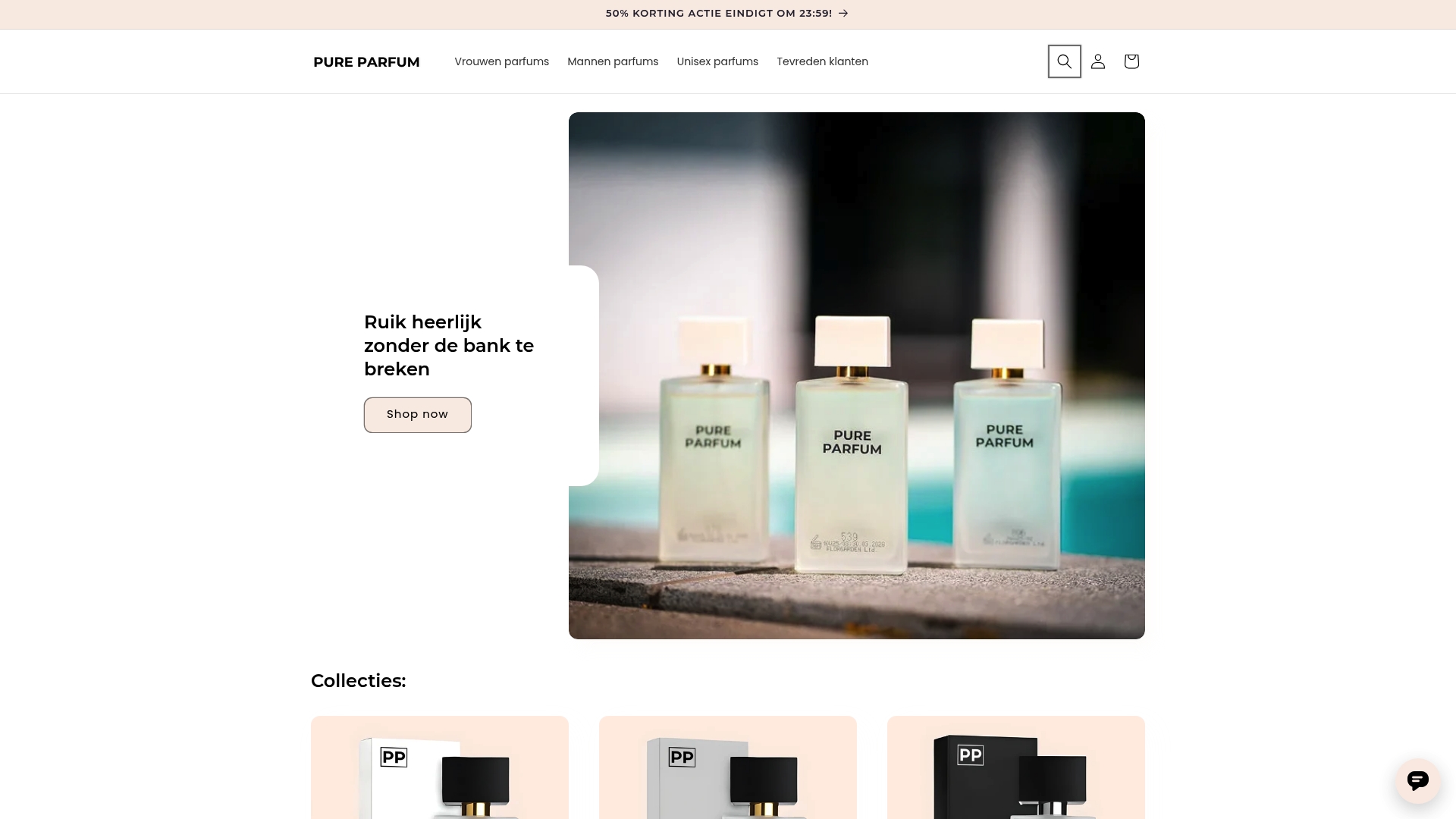
Want to experience it for yourself without immediately buying a full bottle? The 30ml x4 perfume set lets you try multiple fragrances at a low entry price. Looking for a concentrated bundle to last you a long time? Then check out the 3x100ml perfume bundle. Both options give you the chance to judge for yourself whether you’d rather pay for fragrance intensity than for an expensive cap.
Sources
These sources support the key facts in this article:
- Why perfume is so expensive: ‘Years of research and lab work come before’ | VRT NWS
- Does expensive perfume really differ from cheap perfume? | KRO-NCRV
- Why perfume prices have risen in recent years - Indeflatie
- Why perfume prices peak: ‘We buy too much with our eyes instead of our nose’ | De Morgen
- The Dutch economy in 2024 — inflation | CBS