


A vegan perfume is a fragrance without a single ingredient of animal origin: no natural musk, no ambergris, no castoreum, no beeswax or honey, and no derivatives of them either. That makes vegan different from cruelty-free (not tested on animals) and from natural (made from natural raw materials). In this article you’ll read what can be in an ordinary perfume, which plant-based and synthetic alternatives perfumery uses, how to recognize a vegan fragrance, and what the law in the Netherlands and the EU does and does not regulate.
Briefly summarized
- Vegan means: no animal ingredients in the formula and no animals used in production.
- Cruelty-free means: not tested on animals. A cruelty-free perfume can still contain beeswax, milk, or honey.
- Vegan is not the same as natural. Vegan perfume often combines plant-based raw materials with safe synthetic molecules, such as substitutes for musk and ambergris.
- On the label you often see only the word "parfum", and that says nothing about the origin of the fragrance ingredients. So choose a brand that says explicitly that its fragrances are vegan, or look for a vegan certification mark.
- A vegan perfume can smell just as rich and long-lasting as a classic designer fragrance: the scent depends on the composition and the concentration of perfume oil, not on animal raw materials.
Table of contents
- What vegan means in perfume
- Which animal ingredients can be in perfume
- Vegan, cruelty-free, and natural: three different promises
- How to recognize a vegan perfume
- What the law regulates, and what it doesn’t
- Does a vegan perfume smell different?
- Our view on vegan perfume
- Vegan perfume at Pure Parfum
- Frequently asked questions
- Sources
What vegan means in perfume
The word vegan comes from food, but in cosmetics it means more than just "no meat". The Dutch Association for Veganism describes vegan cosmetics as products for which no animals were used: there are no animal ingredients in them, the product and ingredients were not tested on animals, and no animals were used in making or distributing them.

For perfume, that comes down to a clear rule: the formula contains nothing of animal origin. That excludes the well-known animal raw materials, but also the less visible ones. Bezzia mentions honey, beeswax, milk, and lanolin as well as secretions such as natural musk and ambergris. What remains is a palette of plant-based ingredients, safe synthetic molecules, and raw materials made with biotechnology.
That last point is important to understand. A vegan perfume is not a “limited” perfume. Almost every fragrance note that used to come from an animal, such as the warm, skin-like depth of musk, the salty and sweet character of ambergris, or the leathery tone of castoreum, now has an alternative made without animals. So the perfumer has the same tools, only from a different source.
If you want the basics clear first, such as the difference between eau de parfum and eau de toilette or what "extrait" means, read our explanation of perfumery terms and labels.
Which animal ingredients can be in perfume
Most people assume perfume is mainly made from flowers and herbs. That is partly true, but classic perfumery has always also used animal raw materials, precisely for their depth and staying power on the skin. Ethical Consumer lists the animal ingredients in cosmetics. These are the ingredients you most often encounter in and around perfume:
| Ingredient | Origin | Role in the fragrance | Vegan alternative |
|---|---|---|---|
| Musk (natural) | Gland of the musk deer | Warm, skin-like, long-lasting | Synthetic musk, plant-based ambrette |
| Ambergris | From the intestines of sperm whales | Salty, sweet, fixes the fragrance | Ambroxan, cetalox |
| Castoreum | Glands of beavers | Leathery, smoky | Synthetic leather and birch tar notes |
| Civet | Glands of civet cats | Sharp, animalic, sensual | Synthetic animalic accents |
| Beeswax and honey | Bees | Sweet, waxy, also in solid perfumes | Plant waxes, synthetic honey notes |
| Lanolin | Sheep’s wool | Conditioning, in creams and balms | Plant oils and butters |
| Carmine | Crushed cochineal insects | Red colorant | Plant-based or synthetic colorant |
A few of these raw materials deserve extra explanation.
Musk
Musk is the best-known animal note. The Green List writes that animal musk has been replaced by synthetic variants. These substitutes come in many types, from soft and clean to warm and sensual. You can read more about that in our article about perfume without animal musk.
Castoreum
Castoreum, also called beaver castor in Dutch, is obtained from beavers. The Dutch Association for Veganism explains that the extract can appear not only in perfume but also as an aroma in food. According to The Green List, beavers are killed for this raw material. Castoreum gives a leathery, slightly smoky tone, which in vegan perfumes is built using other raw materials.
Ambergris
Ambergris is a waxy by-product of sperm whales and for a long time was one of the most expensive raw materials in perfumery. Perfumers now mainly work with ambroxan or cetalox, molecules that naturally occur in ambergris and are recreated in a laboratory. So a warm, amber-like base no longer requires a sperm whale.
Vegan, cruelty-free, and natural: three different promises
These three terms are often used interchangeably, but they promise different things. The Green List sums it up: a product can be vegan and cruelty-free, one of the two, or neither.
| Term | What it promises | What it does not promise |
|---|---|---|
| Vegan | No animal ingredients, no animals used in production | That all raw materials are natural |
| Cruelty-free | Not tested on animals | That it contains no beeswax, milk, honey, or collagen |
| Natural | Raw materials from nature | That there is nothing animal-derived in it, because honey and musk are also natural |
Vegan and cruelty-free
Cruelty-free is about testing, vegan is about ingredients. So a cruelty-free perfume can still contain beeswax, lanolin, milk, honey, or collagen. In the EU, since 2013 cosmetics whose ingredients have been tested on animals from that year onward may no longer be placed on the market, writes the Dutch Association for Veganism. Substances already used in cosmetics before 2013 may at some point have been tested on animals. To learn how to recognize brands that truly work without animal testing, read our piece about perfume without animal testing.
Vegan and natural
This is where the biggest misconception lies. Many people think vegan perfume has to be "100% natural". That is not true: Bezzia emphasizes that vegan means “without animal ingredients,” not “completely natural.” A natural perfume with honey or real musk is not vegan. A vegan perfume can combine plant oils with molecules from the lab.
Synthetic may sound less appealing to some, but in perfume it is often exactly what makes a vegan fragrance possible: synthetic musk and ambroxan replace raw materials that would otherwise require animals. You can read the full story in natural vs synthetic fragrance.

How to recognize a vegan perfume
Finding an animal ingredient on the packaging is harder than you might think. These steps will help.
- Read the ingredient list, but know what it doesn’t tell you. In Europe, a cosmetic product must list its ingredients on the label, but not where those substances come from. The word "parfum" on the list stands for unspecified fragrance ingredients, and according to the Dutch Association for Veganism, that can also include castoreum.
- Look for an explicit vegan promise from the brand. Ethical Consumer uses a simple rule of thumb: if a brand does not explicitly say a product is vegan, assume it may contain animal raw materials. Conversely, a brand that clearly states it for each fragrance or for the entire range makes your choice easy.
- Look for certifications. Well-known vegan logos are The Vegan Society sunflower, the V-Label, the PETA logo for vegan products, and the heart from vegan.org. The V-Label comes in two versions: only with the addition "Vegan" underneath is the product suitable for vegans. The V-Label also certifies cosmetics and personal care products. More explanation can be found in our overview of vegan certifications for cosmetics.
- Watch out for confusing words. "Natural," "clean," or "green" say nothing about animal ingredients. "Cruelty-free" alone is also no guarantee that a fragrance is vegan.
- Ask if in doubt. A brand that works vegan can tell you without hesitation which raw materials it uses for musk or amber notes.
What the law regulates, and what it doesn’t
In the EU, much is regulated for cosmetics: which substances are allowed, what must appear on the label, and that animal testing for cosmetics is no longer allowed. What is not defined is the meaning of the word vegan itself. The Belgian organization BeVegan points out that terms like "vegan" and "plant-based" are not yet legally protected.
For you as a buyer, that means two things. A brand that works vegan does so out of its own conviction and takes responsibility for it. And it pays to choose a brand that is open about it: one that not only puts the word vegan on a bottle, but explains what it means for its fragrances.
Also keep in mind that vegan says nothing about how your skin reacts to a fragrance. Plant-based raw materials, like synthetic fragrance ingredients, can contain allergens. If you have sensitive skin or eczema, read our article about allergens in perfume. If you have reacted to fragrances before, consult your doctor or dermatologist before applying a new fragrance to your skin.
Does a vegan perfume smell different?
No, not if the composition is good. This is the question we hear most often, and the answer lies in how perfume is made. A fragrance consists of top notes you smell right away, heart notes that come forward after fifteen minutes to half an hour, and base notes that remain on the skin for hours. It was precisely in that base that animal raw materials were used before, because they helped hold the fragrance.
Modern vegan alternatives do that job just as well. Ambroxan gives a warm, slightly salty depth. Synthetic musk makes a fragrance soft, clean, or sensually rich. Plant-based raw materials such as vanilla, sandalwood, vetiver, patchouli, and ambrette seed provide warmth and woody depth.
How long a fragrance lasts mainly depends on two things:
- The concentration of perfume oil. The more fragrance oil relative to alcohol, the longer and more intense the scent. Read about the difference between fragrance forms in perfume oil vs perfume.
- How you apply it. Spray on warm, lightly moisturized skin, such as wrists, neck, and behind the ears, and do not rub afterward. An unscented or matching body lotion helps the fragrance last longer.
Our view on vegan perfume
We believe you should not have to choose between a fragrance you love and a fragrance that required no animal. That is why all our fragrances are vegan and our products are animal-friendly, for women, men, and unisex.
Our perfumes are inspired by well-known designer fragrances. What makes us different is not what we leave out of the scent, but what we leave out of the cost: no expensive marketing campaigns, no luxury packaging. That money goes into what you actually smell.
We work with a high concentration of perfume oil. As a result, our customers experience a long-lasting fragrance, because there is more oil in it than in many other scents. For us, that is the essence of vegan perfume: a fragrance that lasts all day, made without animal raw materials and at a fair price.
Vegan is not a marketing word on the label for us. It is the foundation of every fragrance we make, and the thousands of positive reviews from our customers show that a vegan perfume can be just as seductive as the designer original.
J
Vegan perfume at Pure Parfum
Looking for a vegan perfume that smells like your favorite designer fragrance, without the price tag? At Pure Parfum, all fragrances are vegan and animal-friendly, with a high concentration of perfume oil for a long-lasting scent.
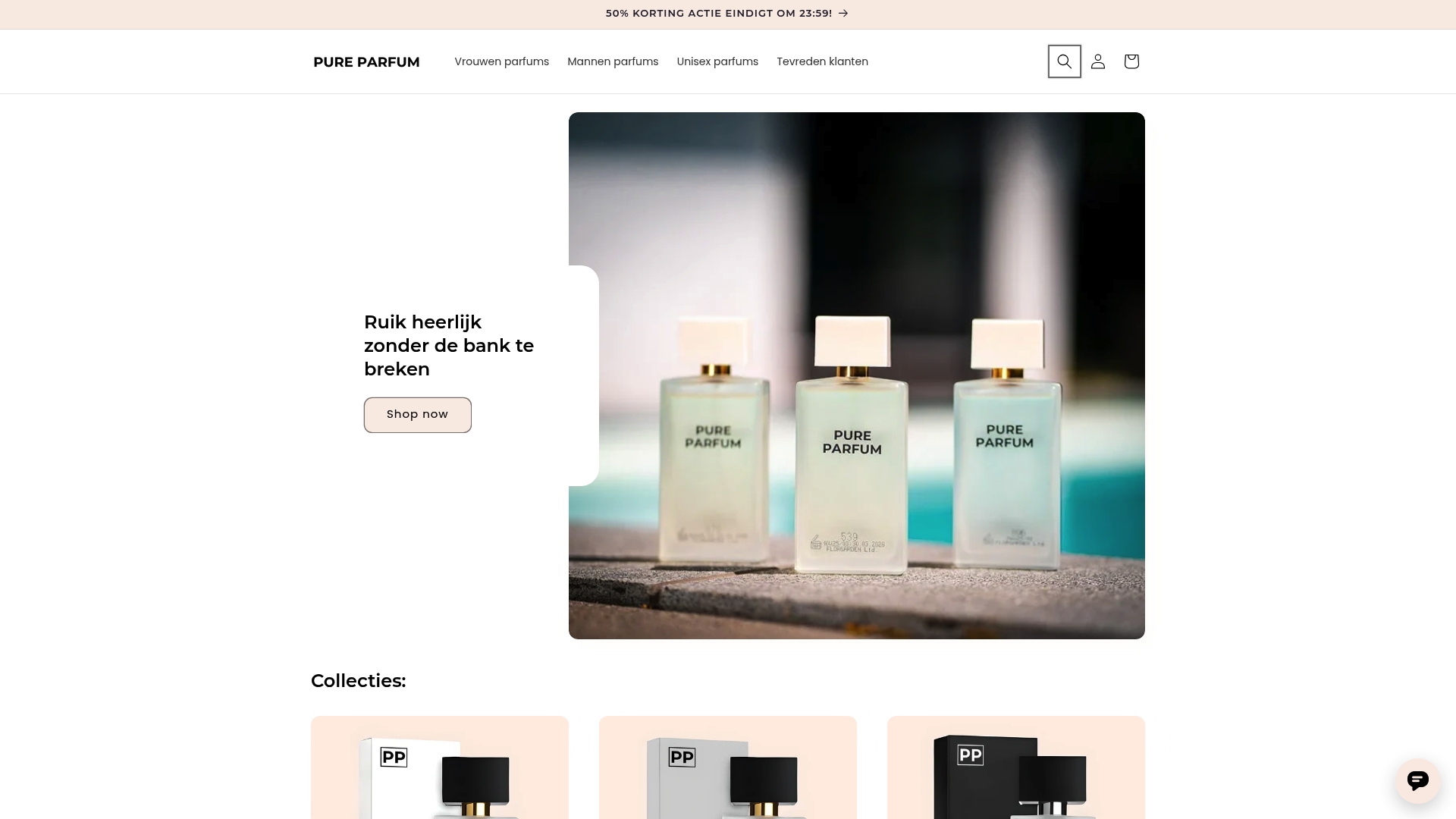
Discover our vegan perfumes for women, men’s perfumes or unisex perfumes. If you want to layer your scent, also take a look at our scented body care with hand cream, body lotion, and body wash.
Frequently asked questions
What is perfume, exactly?
Perfume is a mixture of fragrance ingredients, usually dissolved in alcohol, that you apply to the skin or clothing. The fragrance ingredients can be plant-based, synthetic, or animal-derived. In a vegan perfume, they come exclusively from plant-based and synthetic sources.
Is vegan perfume the same as cruelty-free perfume?
No. Cruelty-free means a product was not tested on animals, while vegan means it contains no animal ingredients. A cruelty-free perfume can therefore still contain, for example, beeswax or honey.
Which perfume can you smell all day?
A fragrance with a high concentration of perfume oil and a solid base of woody, amber-like, or musky notes lasts the longest. Apply it to warm, hydrated skin and do not rub afterward. That works just as well with vegan perfume, in which modern molecules like ambroxan and synthetic musk hold the scent.
Does every perfume contain animal musk?
No. Most modern perfumes use synthetic musk instead of animal musk. However, other animal raw materials, such as castoreum, can still occur in perfumes, and you won’t always see that on the label because it often just says "parfum." So choose a brand that explicitly says its fragrances are vegan.
Sources
- Dutch Association for Veganism: Cosmetics
- Dutch Association for Veganism: Is castoreum vegan?
- Dutch Association for Veganism: Vegan certification marks list
- Ethical Consumer: Animal products in cosmetics
- Bezzia: What are vegan perfumes?
- The Green List: Vegan perfume? Why not all fragrances are vegan
- The Green List: What is the difference between vegan and cruelty-free?
- NewBeauty: The Fascinating World of Animalic Fragrances, Explained
- BeVegan: Vegan, veggie, vegan, or plant-based?
- The Dutch Vegetarian Society: V-Label for cosmetics