


Do you want a vegan body care product that truly hydrates and whose fragrance lasts for more than two hours? Choose a formula rich in shea butter, plant oils, or hyaluronic acid, paired with a vegan scented oil designed to cling to nourished skin. It’s this combination—deep hydration plus olfactory fixation—that makes all the difference between a product that smells good for a short time and a trail that follows you all day.
In practice, your choice depends on what you need right now:
- Light texture and fast absorption : scented body milk or shower gel—perfect for the morning.
- Intense comfort for very dry skin : dry oil or body butter—apply in the evening.
- A subtle scented touch : body mist, to spray as a complement to your fragrance.
Pro tip : For a complete and affordable routine, Pure Parfum offers scented vegan body care (lotion, shower gel, hand cream) and discovery sets designed to test several scents before investing in a full-size product.
Key points
An effective routine for scented vegan body care relies on combining a rich moisturizing base with a vegan scented oil verified by INCI reading or a recognized label.
| Point | Details |
|---|---|
| Prioritize hydration | A base with shea butter, argan oil, or hyaluronic acid holds the fragrance on the skin better. |
| Check the INCI systematically | Watch out for beeswax, lanolin, carmine, or collagen—even in a product labeled “vegan.” |
| Apply in the right order | Shower, moisturize on damp skin, then apply fragrance to pulse points to extend wear. |
| Test before investing | A discovery set reduces the risk of disappointment with a large, unsuitable size. |
| Choose Pure Parfum to get started | Pure Parfum’s body range and discovery sets cover vegan shower gel, lotion, and hand cream at an accessible price. |
Table of contents
- Which families of scented vegan body care should you choose?
- How to recognize a truly vegan and cruelty-free product?
- Which moisturizing ingredients help extend fragrance wear?
- How to make a fragrance last longer on the skin?
- What vegan scented routine should you follow every day?
- Do scented vegan body care products have a reduced environmental impact?
- Natural or synthetic fragrance: what’s the difference in vegan care?
- Sensitive skin: what precautions should you take with scented vegan care?
- Author’s perspective: why this approach really works
- The Pure Parfum range for a complete vegan scented routine
- Frequently asked questions about scented vegan body care
- Sources
Which families of scented vegan body care should you choose?
The market for scented vegan body care is divided into several families, each meeting a different need for texture and olfactory intensity. Understanding these differences helps you avoid buying a product that doesn’t suit your skin or your routine.
Body milks and lotions remain the most versatile base. Fast absorption, smooth texture, moderate fragrance: they work for everyday use, morning or evening, on normal skin as well as slightly dry skin. For example, a milk enriched with monoi hydrates deeply while leaving behind a sunny scent that lingers without weighing down the skin, as shown by Evoluderm’s monoi-based formula from Tahiti.
Dry oils absorb quickly but offer richer comfort, ideal for the end of the day or for very dry skin. Body butters, which are denser, target rough areas (elbows, knees, heels) and leave a more noticeable scented veil. Scented shower gels provide the first olfactory layer of the day, while scented hand creams help refresh the scent between applications without having to start over. Finally, body mists serve as a light finishing touch—perfect as a complement to a more concentrated fragrance.
To organize your choice :
- In the morning, opt for a light shower gel and a light body milk.
- During the day, a body mist or scented hand cream is enough to revive the trail.
- In the evening, a dry oil or body butter repairs and perfumes deeply.
Pro tip : Always keep a travel size (30 to 50 ml) in your bag. It’s often this small gesture that truly extends fragrance wear between full applications.
How to recognize a truly vegan and cruelty-free product?
A product can display “vegan” without official certification, and conversely, a certified product may not match exactly what you expect. The only reliable method is to cross-check several clues rather than relying on a single word on the label.
Here’s the checklist to follow before every purchase :
- Look for explicit mentions of “vegan” and “cruelty-free” on the packaging or product sheet.
- Look for a recognized label: Vegan Society, Leaping Bunny, COSMOS, or Ecocert strengthen the credibility of the claim.
- Read the INCI list and track the most common animal-origin ingredients: Cera Alba (beeswax), Lanolin (lanolin), Carmine (carmin, often derived from cochineal), Collagen (collagen, generally animal), or squalane derived from shark liver.
- Check for the statement “dermatologically tested,” a complementary safety indicator, especially useful for reactive skin.
- Consult customer reviews and product ratings, which often reveal tolerance or wear issues not mentioned on the product page.
The absence of a label doesn’t automatically mean a product isn’t vegan. Many small brands simply haven’t gone through the costly and lengthy certification process. In that case, careful reading of the INCI remains your best tool: the absence of animal waxes, lanolin, or carmine in the ingredient list is already strong evidence—even without an official stamp.
Pro tip : Install an INCI decoding app on your phone and get into the habit of scanning the label before you pay. In less than two minutes, you can confirm or rule out a product without hesitation.
To go further, specialized shops like Official Vegan Shop offer direct filters by label, making it easier to search when you’re comparing multiple references at once.
Which moisturizing ingredients help extend fragrance wear?
Well-hydrated skin holds onto fragrance molecules better than dry skin, which lets the scent evaporate faster. It’s a simple principle that’s often overlooked: the most effective “fixative” isn’t always in the perfume bottle—it’s in the care you apply right before.
Several ingredients play this base, film-forming, nourishing role :
- Shea butter, rich and occlusive, forms a protective film that slows the evaporation of odor molecules.
- Argan oil, lighter, nourishes without excess greasiness and suits combination skin.
- Tahiti monoi, made by macerating tiaré flowers in coconut oil, hydrates while adding its own signature scent.
- Glycerin, a powerful humectant, captures ambient moisture to keep skin supple all day.
- Hyaluronic acid, in the form of sodium hyaluronate, retains water deeply without a greasy effect.
Formulas that combine these actives—such as those offered by Caudalie with its nourishing body lotion—pair intense nourishment with a non-greasy texture, precisely the duo you want for everyday use without weighing down the skin.
On the label, an ingredient’s position in the INCI list indicates its concentration: the earlier it appears, the higher its proportion. So a shea butter listed in fifth position will carry more weight in the formula than a plant extract mentioned at the end of the list.
Pro tip : Always apply your moisturizing care a few minutes before your fragrance—never at the same time. Penetration time changes everything in how the fragrance sets on your skin.
How to make a fragrance last longer on the skin?
Fragrance longevity depends as much on skin preparation as on the product itself. Here’s the sequence that works best, in order :
- Take a shower with a scented shower gel from the same olfactory family as the fragrance you want, to lay down a first subtle layer.
- Apply a moisturizing base (body milk or dry oil) to skin that’s still slightly damp, when absorption is at its best.
- Layer a body mist or a concentrated fragrance once the skin has absorbed well, focusing on pulse points: wrists, nape of the neck, the inner elbows, and behind the knees.
- Optionally finish with a touch of scented hand cream, convenient for reapplying during the day without starting over.
This technique, called “layering,” works because each layer holds onto fragrance molecules a little more than the previous one.
Two technical details often make a big difference. Avoid vigorously rubbing the skin after application—this breaks up odor molecules and speeds up their dispersion. Also keep your products away from heat and direct sunlight, two factors that degrade scented oils even before you open the bottle.

Pro tip : Pair products from the same olfactory family—shower gel, then body milk, then fragrance—rather than mixing different scents. The final trail becomes more coherent and lasts longer.
What vegan scented routine should you follow every day?
An effective routine doesn’t require ten different products. Three to four well-chosen references are enough to cover the entire day, as long as you follow the application order.
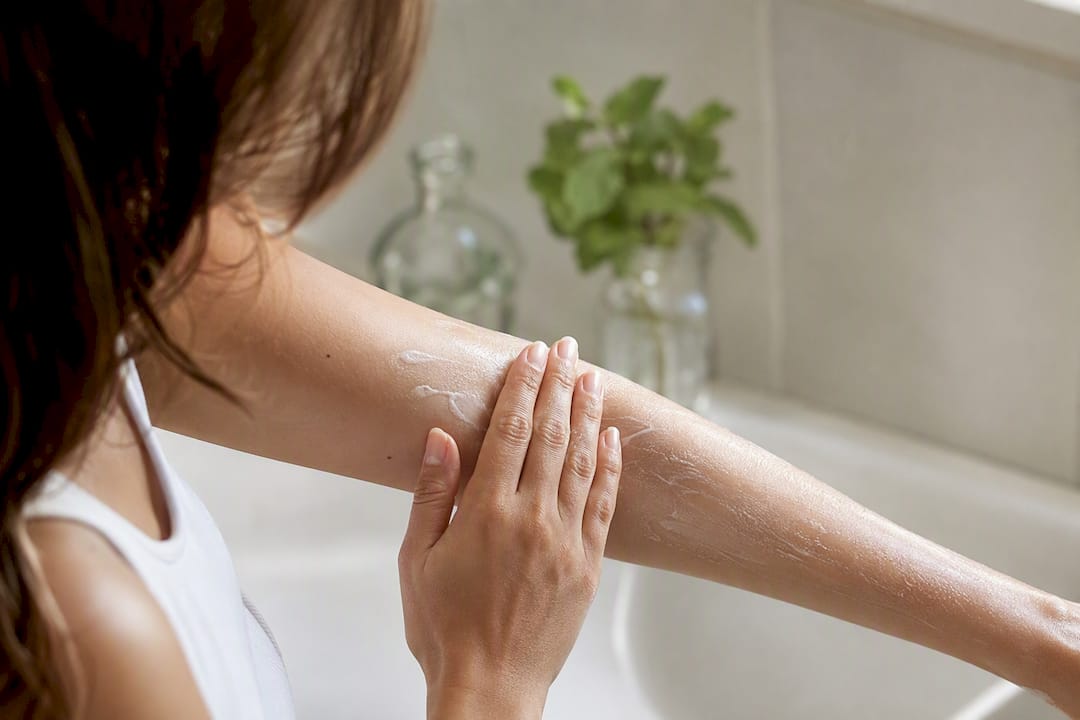
In the morning, start with a scented shower gel that gently cleans while laying down a light olfactory base. Follow with a hydrating body lotion on still-damp skin to maximize absorption of nourishing actives. This step nourishes your skin all day and prepares the ground for your fragrance.
During the day, a scented hand cream helps revive the trail without having to bring out the perfume bottle. It’s a quick, discreet gesture—especially useful after repeated hand washing.
In the evening, use a dry oil or a richer butter to repair skin stressed by the day, followed by a concentrated fragrance on pulse points.
To build this routine without multiplying failed trials, a discovery set is the most rational option. It lets you test several scents and textures before committing to a full-size product, significantly reducing the risk of disappointment at purchase.
Here’s how to put your routine together :
- Choose a shower gel and a lotion from the same olfactory range.
- Add a hand cream for touch-ups during the day.
- Finish with a concentrated fragrance or a mist for the evening.
Pro tip : Try a discovery set first before investing in a large size. You’ll avoid buying 200 ml of a scent that, in the end, doesn’t convince you over time.
Do scented vegan body care products have a reduced environmental impact?
A vegan body care product eliminates, by definition, animal-origin ingredients, which reduces pressure on certain intensive farming sectors historically used in cosmetics (lanolin, collagen, beeswax). This doesn’t automatically make a product eco-friendly, but it removes one link in the impact chain.
Real durability depends mainly on other factors: the origin of plant oils (responsible farming or not), packaging (recyclable, refillable, overwrapped), and transport. Shea butter from fair cooperatives doesn’t have the same track record as an inexpensive petrochemical derivative, even if both can technically be called vegan.
Simplified packaging, without unnecessary gift boxes or double wrapping, reduces waste and the final cost for consumers—a choice that many independent brands now openly embrace instead of funding expensive marketing. It’s also a direct economic argument: less packaging often means less margin captured by the container rather than by the product itself.
Generous sizes and multi-scent sets also play a role: by avoiding impulsive purchases of bottles that end up unused, they limit waste at the household level. A product you use all the way to the end remains, by far, the most sustainable action a consumer can take.
Natural or synthetic fragrance: what’s the difference in vegan care?
A fragrance can be vegan without being natural, and natural without being vegan. These two concepts sometimes overlap, but they follow different logics: one concerns whether the components are of animal origin, the other concerns the chemical nature of the fragrance itself (plant extract or a synthesized molecule).
Synthetic fragrances, for their part, allow perfect reproducibility of a scent from one bottle to another and often last longer on the skin, thanks to molecules designed specifically for longevity.
In vegan body care, the key isn’t to systematically choose natural over synthetic, but to verify that both options respect the absence of animal testing and animal-origin components. A well-formulated vegan scented oil made with synthetics can absolutely outperform a natural essential oil in terms of wear and stability, while remaining just as respectful of animals.
The ideal often remains a compromise: a hydrating plant-based base paired with a vegan scented oil, whether it’s naturally derived or synthetic, as long as its composition is transparent and verifiable on the label.
Sensitive skin: what precautions should you take with scented vegan care?
Sensitive skin sometimes reacts to fragrances, whether they are vegan or not. The vegan nature of a product doesn’t guarantee hypoallergenic properties: the two criteria are independent and must be checked separately.
Before adopting a new scented care product, do a patch test in the elbow crease and wait 24 to 48 hours before applying it to the entire body. Prefer formulas that explicitly mention “dermatologically tested”—a marker that, without being an absolute guarantee, indicates at least a minimal assessment of skin tolerance, as recommended in the product information on usage precautions.
Also check the list of declared allergens, which is mandatory on the packaging: linalool, limonene, citronellol, and geraniol are among the fragrance compounds most often responsible for skin reactions. Reactive skin generally tolerates lower fragrance concentrations better, such as those found in body milks, rather than very concentrated oils or mists applied in multiple layers.
If you experience redness, itching, or a tight feeling after application, stop using the product immediately. If symptoms persist, consult a dermatologist rather than trying more scented products in the hope of better tolerance.
Author’s perspective: why this approach really works
I’ve seen too many people give up on vegan scented care after disappointment—often because they bought a product without a sufficiently rich moisturizing base. Fragrance alone never lasts well on dry skin, vegan or not. It’s the combination of hydration plus scented oil that makes all the difference, and that’s exactly what labels and INCI reading allow you to verify before purchase, not after disappointment. Always test with a discovery format before committing to a large bottle: it’s the most honest way to judge real wear on your skin, not someone else’s.
The Pure Parfum range for a complete vegan scented routine
Building a coherent routine rarely requires more than three well-chosen products: a shower gel, a hydrating lotion, and a touch of fragrance to set everything in place. Pure Parfum offers exactly this logic with a scented shower gel, a body lotion, and a scented hand cream—each formulated with vegan scented oils and not tested on animals.
To discover several scents without committing to a large size right away, the 4 x 30 ml set is the most rational option: it lets you compare different olfactory families at a lower cost before choosing your definitive signature. Those who already know which direction they prefer can go straight for the 3 x 100 ml bundle, which is more cost-effective over time than buying individually.
Without expensive marketing or unnecessary packaging, Pure Parfum focuses its budget on the quality of its scented oils rather than on packaging—explaining why its prices are significantly more accessible than those of big houses for a comparable olfactory experience. Start with a discovery set: it’s the easiest way to know whether a scent suits you before investing more.
Frequently asked questions about scented vegan body care
Does vegan body care last as long as classic care? Yes, as long as the formula combines a rich moisturizing base with a well-dosed scented oil. The vegan origin doesn’t affect fragrance longevity—what matters is the quality of the formulation.
How can I tell if a fragrance in a care product is vegan? Check the explicit statement on the packaging, look for a label like Vegan Society or Leaping Bunny, and read the INCI list to rule out the presence of animal musk or animal-origin derivatives.
Are scented vegan body care products suitable for sensitive skin? Most are, but prioritize mentions of “dermatologically tested” and always do a patch test before the first full application.
Do you need a label to be sure a product is cruelty-free? A label makes verification easier, but its absence doesn’t automatically mean the opposite. The manufacturer’s statement and careful INCI reading remain valid complementary evidence.
What’s the best application order to extend fragrance wear? Shower, then apply lotion on damp skin, then apply fragrance or mist to pulse points. This order maximizes the fixation of odor molecules on the skin.
Sources
- Caudalie — Hyaluronic nourishing body lotion product page
- Evoluderm — Lait Corps Hydratant Monoï à la Folie