

Sillage is the scent trail that a perfume leaves in the air, even after the wearer has already walked past. So it’s not about how strongly a fragrance smells on the skin, and it’s also not about how long that scent lasts. Sillage is all about diffusion: how much space a scent takes up and how long it lingers after you. For those who wear perfume and for those who notice it, that trail largely determines the first impression.
In short:
- A higher perfume concentration and heavier ingredients increase the scent trail, making your sillage last longer and feel more powerful.
- Skin chemistry, temperature, and the environment influence how the scent spreads and how it’s perceived, so it can always vary by person and situation.
- In public spaces, a subtle sillage is better; in social or evening settings, a stronger scent trail helps you stand out.
- Passage tests and adding layers of body lotion or perfume to clothing help you assess and strengthen your sillage safely and effectively.
- An excessive number of sprays doesn’t always increase the trail due to skin and conditions factors, so adjust the dosage to the situation.
Table of contents
- What is sillage? Pronunciation, origin, and meaning
- Sillage versus projection: where’s the difference?
- What determines how far a fragrance reaches?
- Strong or subtle sillage: what fits the occasion?
- How do you test sillage and strengthen it safely?
- Why Pure Parfum is for anyone who wants to know more about sillage
- Why most people misjudge sillage
- Sources
What is sillage? Pronunciation, origin, and meaning
The word comes directly from French and literally means “wake” or “trail,” like a boat leaves behind on the water. You pronounce it as “see-zhahzh,” with the emphasis on the second syllable. Perfume experts use the term to describe how much scent someone leaves in the room and whether that scent can still be smelled after the person has already left, as also explained on Pro Fragrantia.
Imagine a colleague who has just left the elevator. Do you still catch a hint of her perfume a few seconds later? Then that scent has sillage. If the fragrance disappears as soon as she walks out the door, it’s just a strong but short-lived impression with no trail. That distinction between “present on the skin” and “present in the room” is exactly what sillage means.
Sillage versus projection: where’s the difference?
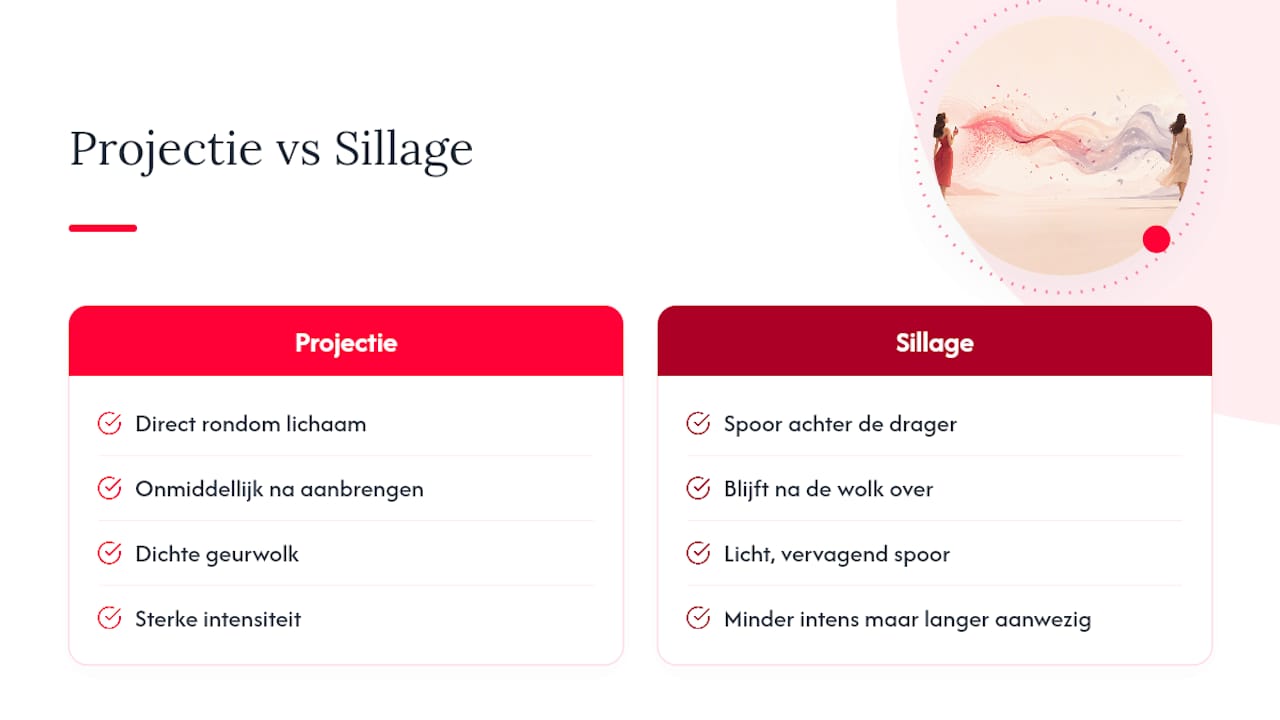
Projection is the immediate scent cloud around your body, right after applying. Sillage is what remains after that cloud: the trail left behind when you walk through a space. Think of the difference between an elevator and a hallway. In the elevator, everyone can smell your perfume right away—that’s projection at its strongest. If you then walk through a long hallway, sillage is what people behind you can still pick up.
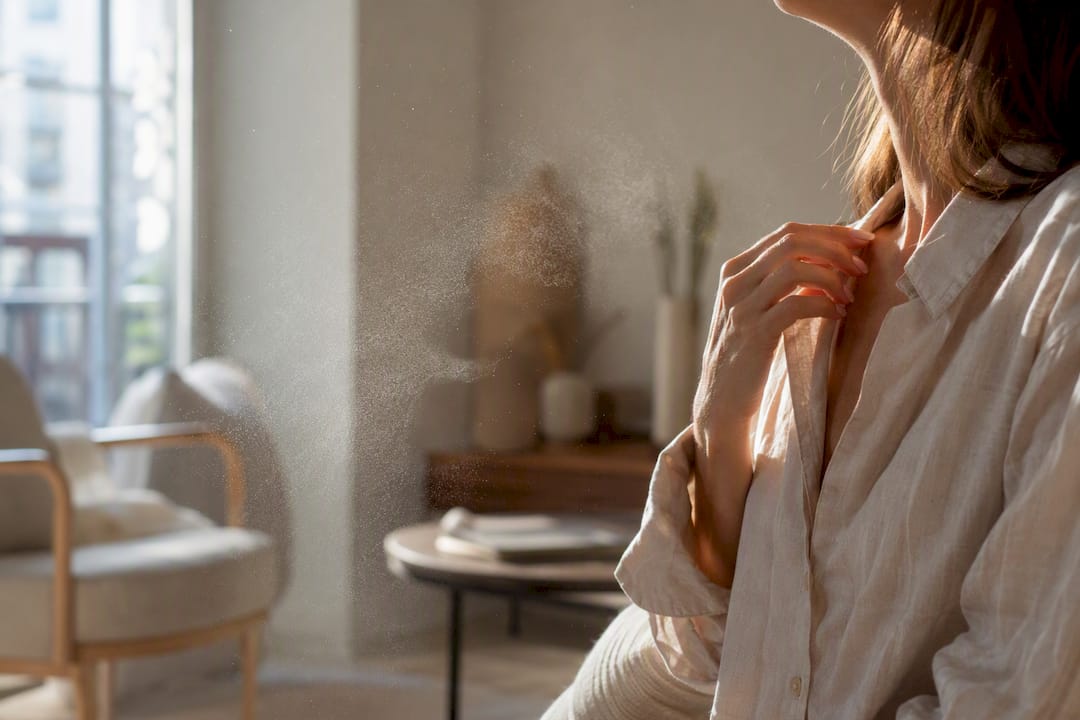
They’re related, but they aren’t experienced the same way. A perfume can have strong projection but little sillage, for example with light citrus fragrances that evaporate quickly. Conversely, there are scents with modest projection that still leave a trail for a long time, often thanks to heavier base notes. Mixing up these two terms often leads to the wrong result when trying a new perfume.
What determines how far a fragrance reaches?
Sillage is largely driven by molecular volatility: some fragrance molecules evaporate extremely fast and spread widely, while others stay close to the skin, as shown by research into the chemistry behind sillage). Top, heart, and base notes evaporate in that order: citrus and spices fly off within minutes, floral and spicy heart notes last for hours, and base notes with resins or woods can sometimes be detectable for an entire day.
A number of factors together determine how far your scent reaches:
- Concentration of perfume oil: a higher oil concentration means more fragrance molecules per spray, and therefore typically more sillage.
- Type of ingredients: resins, musc-like binding agents, and certain woody or chypre components significantly increase the scent trail, as also described by Ensie.
- Skin chemistry: hydration, pH level, and your skin’s microbiome influence how quickly fragrance molecules evaporate.
- Body warmth: warmer skin boosts evaporation and therefore sillage.
- Environment: dry air, wind, and heated spaces speed up diffusion, while humid or cold air keeps a scent closer to you.
- Clothing: fabric holds fragrance molecules longer than bare skin, which makes a scent release more slowly but last longer.
Pro tip: Apply your perfume to hydrated skin. Dry skin absorbs fragrance molecules faster, so your sillage becomes noticeably weaker after just an hour.
Strong or subtle sillage: what fits the occasion?
Not every situation calls for the same scent trail. An overpowering sillage in a small meeting room backfires, while the same intensity on a summer terrace feels just right.
- Choose a stronger sillage for evening parties, outdoor settings, concerts, and dates where you want to be consciously seen and smelled.
- Choose a subtler, velvety-soft sillage at the office, on public transport, or during meetings, where other people’s sensitivity to fragrance also plays a role.
- Adjust the dosage to the space: one to two sprays on wrists and the neck are usually enough indoors, while outdoors you may need three to four sprays to achieve the same effect.
As a rule of thumb: the smaller and more enclosed the space, the more restrained you should be with sillage. That’s also why formal and private environments typically call for a subtler fragrance, as comes through in Ensie’s explanation.
How do you test sillage and strengthen it safely?
The simplest way to judge sillage is the passage test: spray your perfume, walk through a room, and ask someone a few meters behind you whether they can still pick up the scent. A second method is the clothing-air test: spray a piece of clothing, hang it up for a few hours, and then smell whether the trail is still there without holding the item. This kind of simple test method is also recommended in the explanation on Webwoordenboek.
If you want to strengthen your sillage, layering works best:
- Start with a scented body lotion or body wash in the same fragrance family as your perfume.
- Then spray the perfume itself on your wrists, neck, and behind your ears, where body heat speeds up evaporation.
- If desired, add a drop of perfume oil to your clothing for a longer-lasting base note.
Pro tip: Never test a new fragrance only on a strip of paper in the store. Spray it on your wrist, wait twenty minutes, and only then assess the sillage, because paper gives a completely different evaporation pattern than skin.
When combining products on your skin: people with sensitive skin or known allergies would do well to try a small test area first, especially with concentrated perfume oils.
Why Pure Parfum is for anyone who wants to know more about sillage
At Pureparfum, everything revolves around a higher oil concentration—the exact factor that experts say is most decisive for a long-lasting, recognizable scent trail. Our vegan and animal-friendly perfumes are designed to make that trail happen without the high price of luxury packaging and marketing. Thousands of customers rate this approach positively, which directly matches what you read above about concentration and ingredients.
Want to experience how sillage works across different fragrance profiles? A perfume bundle with three 100 ml bottles gives you the space to experiment with dosage and layering, without immediately committing to just one scent.
Why most people misjudge sillage
The biggest misconception about sillage is that more sprays automatically mean more scent trail. That’s true, but only to a point. I keep seeing the same pattern: people double their dose because a fragrance “doesn’t linger,” while the problem is often with their skin type or the application spot—not with the amount.
What stands out to me is how little attention skin condition gets in the average perfume explanation. The same bottle smells completely different on dry winter skin than on well-hydrated summer skin, and that difference in sillage is often bigger than the difference between two totally different perfumes. If you’re serious about fragrance, you’d be better off investing in a good body lotion than buying an extra bottle of perfume.
There’s also a social side that’s often overlooked. Strong sillage is often seen as confident or attractive, but in shared spaces it can just as easily come across as intrusive. The best sillage isn’t necessarily the strongest—it’s the sillage that fits where you are. That requires a bit of self-reflection, which most fragrance guides prefer to skip in favor of a simple “more is better” message.
— J
Sources
For those who want to dig deeper: Pro Fragrantia clearly explains the French origin and the practical meaning of sillage. The Wikipedia page on sillage goes deeper into the chemistry behind molecular volatility and skin chemistry. Ensie describes which ingredients strengthen sillage, and Webwoordenboek offers simple test methods for home use.
- Perfume: what is sillage? – PRO FRAGRANTIA
- Sillage - the meaning according to Redactie Ensie
- What does sillage mean? — Webwoordenboek