


Yes, cruelty-free perfume exists, but a mention on the packaging is not a guarantee. Only independent certifications such as Leaping Bunny and the Vegan Trademark, or a transparent statement from the supplier, give you real certainty. The EU ban on animal testing helps, but it has exceptions under REACH. At Pure Parfum, we offer vegan and cruelty-friendly perfumes as a direct, verifiable option.
In short:
- Leaping Bunny also checks suppliers and requires annual re-confirmation; the Vegan Trademark excludes animal ingredients and animal testing, while PETA mainly collects self-declarations.
- Since 2013, in the EU no cosmetics tested on animals may be sold, but REACH can still require animal testing for general chemical safety dossiers.
- In addition to certifications, check the full ingredients list and request supplier statements and the date when the brand’s new animal tests stopped; beeswax and lanolin are animal-derived, but not automatically tested on animals.
- Vegan and cruelty-free are separate guarantees: a perfume may contain no animal ingredients while the ingredients were nonetheless tested on animals, or vice versa.
Table of contents
- How do you check whether a perfume is truly cruelty-free?
- What exactly do Leaping Bunny, the Vegan Trademark, and PETA guarantee?
- What does the EU ban from 2013 cover, and what doesn’t?
- What to look for when choosing a cruelty-friendly perfume
- Why you can trust this information
- What types of cruelty-free and vegan perfumes exist?
- How did cruelty-free perfumes come about?
- What impact does cruelty-free perfume have on the environment and animal welfare?
- What kinds of animal testing occur in the cosmetics industry?
- Which alternative testing methods replace animal testing?
- Where does cruelty-free perfume go from here?
- Trying cruelty-friendly perfume: this is how you start with Pure Parfum
- Frequently asked questions
- Sources
How do you check whether a perfume is truly cruelty-free?
A claim on a bottle means little as long as you can’t verify it yourself. Follow this order before you add a perfume to your shopping cart.
- Look for a recognized certification on the packaging or product page, such as the Leaping Bunny logo or the Vegan Trademark from The Vegan Society.
- Check the ingredient list (INCI) for animal-derived substances such as beeswax, civet, or musk—often hidden under Latin names.
- Read the brand’s statement about its supply chain: does the brand explicitly say that suppliers do not test either?
- Be critical of vague claims. “Cruelty-free” without mentioning an audit process or certification is a marketing term, not a guarantee.
- Ask if you’re unsure. An email to customer service asking for certification data or the brand’s cut-off date often provides clarity right away.
When checking the ingredient list, pay attention specifically to these points:
- Animal extracts sometimes appear under chemical or Latin names, not their usual name.
- A brand that publishes its full ingredient list gives you more confidence than a brand that only claims “natural.”
- Beeswax and lanolin are animal-derived, but not always tested on animals—so check separately for cruelty-free and for vegan.
Pro tip: If you’re unsure, always ask for the brand’s exact cut-off date: this is the date after which no new animal tests were allowed to take place, and a serious brand knows this number by heart.
If you want to do this faster, it’s worth using a fixed checklist for every new brand you consider. Our own explanation of how to check cruelty-free certifications within 10 minutes uses exactly these four steps, so you don’t have to figure out what to look for from scratch every time. If you specifically want to avoid animal musk, our blog about perfume without animal musk goes deeper into which substance names you need to recognize.
What exactly do Leaping Bunny, the Vegan Trademark, and PETA guarantee?
Not every certification means the same thing, and the difference is more important than most shoppers think.
- Leaping Bunny uses an international corporate standard: brands must prove that they and all their suppliers do not carry out new animal testing, with a fixed cut-off date and annual re-confirmation through audits. More than 2,300 brands are affiliated in the United States and Canada, according to Leaping Bunny itself.
- The Vegan Trademark from The Vegan Society guarantees something different: no animal ingredients and no testing by or on behalf of the manufacturer on humans or animals. Worldwide, this label carries more than 70,000 registered products, according to The Vegan Society.
- PETA’s “Beauty Without Bunnies” list compiles self-reported statements from brands, without PETA auditing every supplier the way Leaping Bunny does. It’s a useful starting point, but it’s less strictly controlled than formal certification.
More than 70,000 products worldwide carry the Vegan Trademark, showing how widely this specific guarantee is already spread within cosmetics and personal care.
A certification isn’t always enough. A brand can be certified vegan and cruelty-free for its perfume line, but at the same time use ingredients that are tested on animals elsewhere, outside cosmetics regulations, for chemical safety purposes. That’s why it remains useful to look not only at the certification, but also at the ingredient list itself.
What does the EU ban from 2013 cover, and what doesn’t?
European regulation is stricter than in many other regions, but it isn’t airtight. The ban was introduced in phases.
| Year | Measure |
|---|---|
| 2004 | Ban on animal testing of finished cosmetic products in the EU |
| 2009 | Ban on animal testing of cosmetic ingredients |
| 2013 | Full marketing ban: products tested outside the EU can no longer be sold |
This timeline comes directly from the official documentation of the European Commission. Since the beginning of 2013, an EU ban has applied to placing on the market cosmetic products or ingredients that have been tested on animals, regardless of where in the world that testing took place.
However, there are important loopholes in this system. The interaction between the Cosmetics Regulation and the broader chemicals legislation REACH can mean that an ingredient that is also used outside cosmetics still has to be tested on animals for general safety dossiers, as even the EU analyses themselves confirm. Concretely, that means a perfume legally sold in the EU may still contain an ingredient whose safety data was collected through animal testing outside the cosmetics sector. So, marketability in the EU is not an absolute guarantee of a fully cruelty-free process—which makes the importance of additional certifications only bigger.
What to look for when choosing a cruelty-friendly perfume
With so many claims on the market, a fixed order of priorities helps you make decisions quickly.
Set your priorities like this: first the certification, then the brand’s transparency, then the ingredient list, and only after that the price and packaging. A nice bottle without certification tells you nothing about the process behind the product.
- Ask for samples before you buy a full bottle, especially with a new scent.
- Don’t test more than two or three fragrances per session: your nose gets tired quickly.
- Choose a bundle when you want to try multiple scents anyway; that is often cheaper than individual bottles.
- Check the return policy and whether there is a sample policy before you check out.
We deliberately focus our own lines on these criteria. We use vegan and cruelty-friendly recipes and aim for a higher concentration of perfume oil, which contributes to a longer-lasting scent experience. By saving on expensive packaging and marketing costs, we strive for affordable prices without sacrificing fragrance quality. Also read our blog about choosing sustainable perfume based on lasting power if packaging plays a role in your considerations.
Why you can trust this information
Reliable information about cruelty-free perfume requires a combination of brand claims you can verify and sources that are independent of the seller.
- At Pure Parfum, we sell only vegan and cruelty-friendly perfumes, clearly shown on our website.
- Every claim in this article about certifications and regulations can be traced directly back to the official source—such as Leaping Bunny or the European Commission—rather than to our own interpretation.
- By saving on unnecessary packaging and marketing costs, we aim for affordable products without sacrificing the concentration of perfume oil.
- For practical verification, we refer to our own checklist for checking cruelty-free certifications, written from the same perspective as this article.
What types of cruelty-free and vegan perfumes exist?
Within the cruelty-free perfume category, you’ll roughly find a few recognizable types, without having to search for specific brand names. Vegan eau de parfum with a high concentration of perfume oil is popular among shoppers looking for long-lasting scent, without animal-derived components such as musk or civet. Natural perfumes based on plant extracts target buyers who want to avoid chemical substances as much as possible, even though “natural” remains a term without a fixed legal definition.
Pharamone perfumes form a separate category: these promise an additional attraction effect, but they deserve the same certification checks as any other fragrance. Unisex lines are gaining ground because they use one formulation suitable for a broader audience, which also improves production efficiency. In addition, there are bundles of multiple smaller bottles, intended for people who want to try different scents before purchasing a full-size bottle.
Our own explanation of the best untested perfumes of 2026 goes deeper into how these categories relate to each other and which features you can expect with each type.
How did cruelty-free perfumes come about?
The movement against animal testing in cosmetics began in the 1980s and 1990s, when animal welfare organizations in Europe and the United States started putting pressure on manufacturers. Leaping Bunny emerged at the time as a joint initiative from various animal welfare groups that wanted to provide one recognizable, controlled label instead of dozens of separate, uncontrolled claims.
The European Union followed with legislation that became stricter step by step: first a ban on testing finished products in 2004, then on ingredients in 2009, and ultimately a full marketing ban in 2013. This legal development ran alongside a growing consumer demand for vegan and cruelty-friendly alternatives.

Perfume houses responded with adjusted formulations: synthetic musk replaced animal civet and ambergris, and plant-based waxy substances replaced beeswax in certain formulas. What started as a niche market for conscious consumers is now a steady segment within the perfume industry.
What impact does cruelty-free perfume have on the environment and animal welfare?
The direct effect on animal welfare is clearest: fewer animal tests means fewer animals exposed to skin, eye, or toxicity tests for cosmetic purposes. Synthetic alternatives to animal-derived materials such as musk and civet also reduce the demand for hunting or keeping the animals from which these substances were traditionally obtained.
The environmental impact is less straightforward. Synthetic musk can, depending on how it is produced, bring its own environmental challenges, while plant-derived materials require land use and water. So vegan doesn’t automatically mean a perfume has the smallest possible ecological footprint—it primarily means that there are no animal-derived ingredients in it.
What is clear, though, is that brands that consciously choose vegan formulations and cruelty-friendly production processes often also take a more critical look at their broader supply chain. In practice, these two things often go together, though that isn’t a guarantee.
What kinds of animal testing occur in the cosmetics industry?
Before the EU ban took effect, various testing methods were common within the cosmetics industry. Skin irritation tests applied substances to shaved rabbit skin to measure reactions. Eye irritation tests, including the well-known Draize test, were used to determine whether a substance could cause harm to the eye.
Toxicity tests went further and examined the effects of repeated exposure over the longer term, often using rodents. Some tests focused specifically on allergic reactions or on whether a substance could be carcinogenic. These test methods were applied to both finished products and individual ingredients, before phased EU legislation step by step prohibited them for the cosmetics sector.
Outside the EU, some markets still have less strict rules, meaning a product tested there in theory can still make its way to other markets unless local regulations explicitly block it.
Which alternative testing methods replace animal testing?
Reducing animal testing went hand in hand with the development of alternative testing methods that work without live animals. In-vitro tests use human skin cells or tissue models in a laboratory environment to measure irritation or toxicity, without involving an animal.
Reconstructed skin models, built from human cells, simulate how real skin responds to a substance and are now widely used for safety testing. Computer models and so-called QSAR predictions (quantitative structure-activity relationship) make it possible to predict—based on a substance’s chemical structure—how it is likely to behave, even before it is physically tested.
In addition, some laboratories use organ-on-a-chip technology: small chips with human cells that mimic how an organ behaves. These methods don’t fully replace animal testing everywhere, but together they form the main scientific foundation that brands can build on to develop safe products without animals.
Where does cruelty-free perfume go from here?
Certifications and transparency will become even more important in the coming years, not less. As more brands label themselves vegan without supporting evidence, the difference between a genuinely controlled label and a loose marketing claim will become sharper for anyone paying close attention.
I expect that alternative testing methods, such as in-vitro models and computer simulations, will continue to grow within the entire cosmetics sector in the coming years, including beyond the EU. That puts extra pressure on brands to make their entire supply chain traceable, not just the end product.
For you as a buyer, the key message remains simple: don’t be guided by a word on a bottle, but by the certification and documentation behind it.
— J
Trying cruelty-friendly perfume: this is how you start with Pure Parfum
We make choosing a cruelty-friendly perfume easy by combining vegan formulations, a higher concentration of perfume oil, and affordable pricing, without passing on the costs of expensive packaging or marketing.
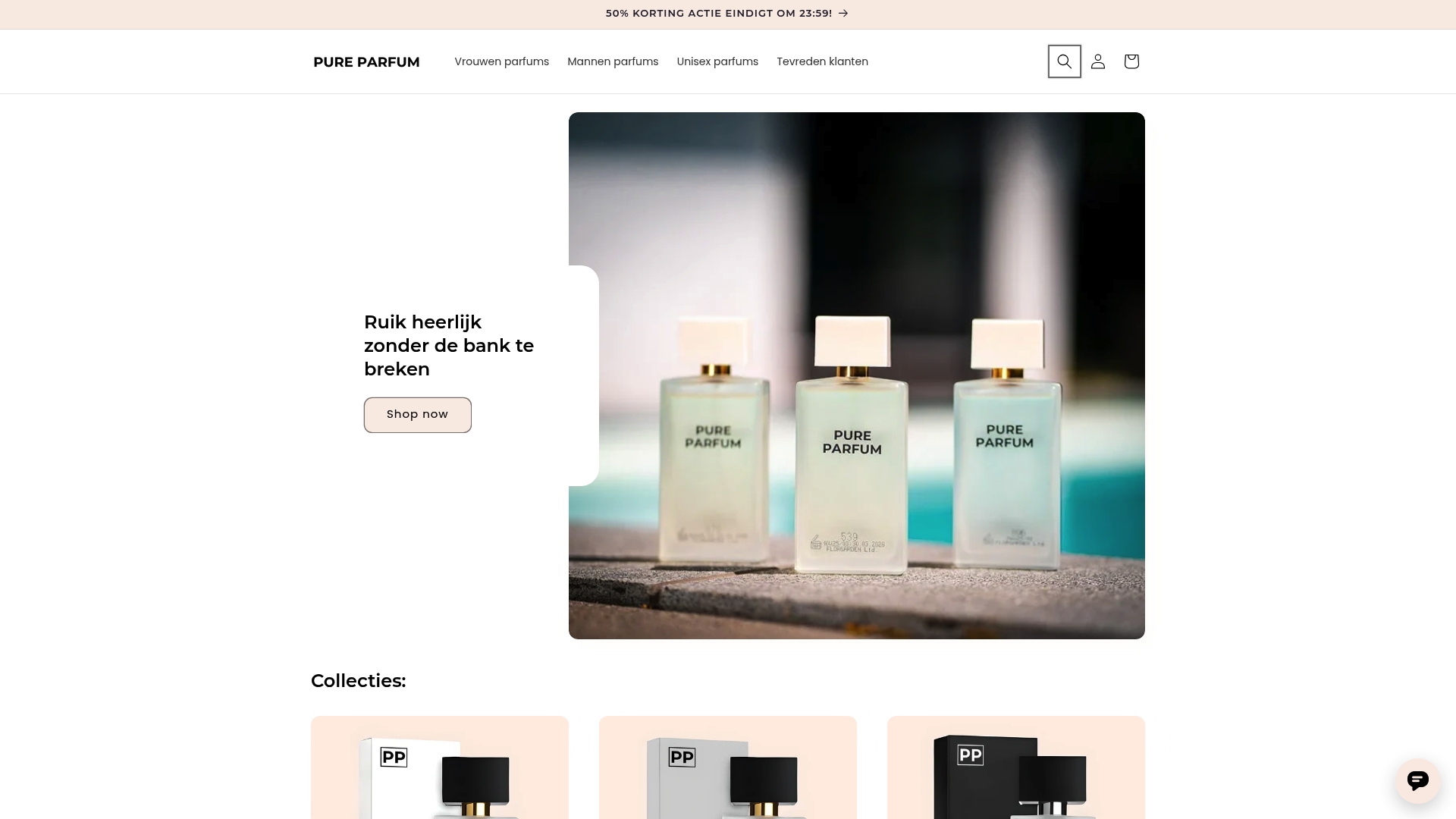
Want to get acquainted before buying a full bottle? You can do that in different ways.
- Check out our women’s perfumes or men’s perfumes for the full collection.
- Start with a 30ml x4 perfume set to test multiple scents at once.
- Choose a 3x100ml perfume bundle when you already know which scents appeal to you.
- Round out your routine with vegan body care, such as hand cream or body lotion in the same scent line.
Frequently asked questions
Which brands don’t test on animals?
A brand doesn’t test on animals when it carries a recognized certification, such as Leaping Bunny or the Vegan Trademark of The Vegan Society, with a fixed cut-off date for both the brand and its suppliers. Always check this on the product page or packaging instead of relying on a general brand claim. We only offer vegan and cruelty-friendly perfumes in our range.
Is Chanel cruelty-free?
Chanel is not on the public list of Leaping Bunny-certified brands and does not carry a Vegan Trademark, which means there is no independent, audited guarantee available through these two best-known certifications. For an up-to-date, verified status, consult the brand itself or the official database of Leaping Bunny.
Has Dior been tested on animals?
Just like Chanel, Dior is not on the recognized lists of Leaping Bunny or the Vegan Trademark, so no independent certification is available to confirm cruelty-free status. Within the EU, the 2013 marketing ban applies, but it doesn’t cover every possible animal test that could happen elsewhere in the supply chain.
Are Kruidvat products cruelty-free?
The status of individual Kruidvat products varies by line and is not centrally confirmed through a certification such as Leaping Bunny or the Vegan Trademark. Therefore, check the packaging and ingredient list for each product, or ask customer service for certification data for the specific item you’re considering.
What is the difference between vegan and cruelty-free perfume?
Cruelty-free means the product and its ingredients have not been tested on animals, while vegan means no animal-derived ingredients were used, such as beeswax or musk. A perfume can be cruelty-free without being vegan, or vice versa—so check both aspects separately via the ingredient list and the certification.
Sources
- Ban on animal testing - Internal Market, Industry, Entrepreneurship and SMEs
- The Vegan Trademark standards | The Vegan Society
- Leaping Bunny - frequently asked questions