


Perfume is made for adult skin. So with babies and toddlers, you do not spray anything on their skin, and with young children too, caution is the safest choice. From primary school age, a mild scent on clothing is possible, and teenagers can gradually discover their own fragrance. Do you like wearing perfume yourself? Then as a parent you do not have to stop. With a few fixed habits, you keep your scent to yourself and your child stays mostly out of the way. At Pure Parfum, we make vegan, cruelty-free perfumes inspired by well-known designer scents, for women, men, and unisex. In this article, you will read how to wear them with peace of mind in a home with children.
In brief
- Babies and toddlers: no perfume on the skin. Baby skin is much thinner than adult skin, and fragrance substances are among the best-known causes of allergy in personal care products.
- There is no fixed starting age. The younger the child, the more cautious you should be. With an older child, start with a light scent on clothing, not on the skin.
- You can keep wearing perfume. Spray on places where your child does not rest their face, let it dry first, and keep the bottle out of reach.
- Read the label. European rules increasingly require fragrance allergens to be listed on the packaging, so you can make targeted choices.
- Red patches, itching, or shortness of breath? Stop using the fragrance and consult your GP.
Table of contents
- Why a child’s skin reacts differently to fragrance
- From what age can a child wear perfume?
- Wearing perfume when you have a baby or toddler
- What the label tells you: European rules
- How to introduce perfume to an older child or teenager
- When it is better to stop for a while
- A scent for yourself, without a high price
- Our view on perfume in a home with children
- Frequently asked questions
- Sources
Why a child’s skin reacts differently to fragrance
Adult skin is a strong barrier. With a baby, that is not yet the case. Baby skin is about five times thinner than adult skin, and the protective layer is still developing. Substances you hardly notice can penetrate a baby’s skin more easily.
In addition, young children come into contact with cosmetics relatively often. Research by the Dutch Food and Consumer Product Safety Authority (NVWA, the product safety regulator) showed that children up to 4 years old are overrepresented in exposure to cosmetics, across all product categories. Think of wipes, bubble bath, creams, and soap: it all adds up.
Two concepts help explain the risk:
- Sensitization means that the body “learns” to react overly strongly to a substance. This often happens unnoticed. According to the NVWA, sensitization can already result from early exposure, through products such as baby wipes or soap, while symptoms may only appear years later.
- Contact allergy is the reaction that follows: a red, itchy patch of skin where the substance touched the skin. Such an allergy can last a long time, so prevention is the best approach.
The same NVWA report also mentions the airways. Developing an allergy by inhaling fragrance is rare, but scents can trigger an asthma attack in children with asthma. If your child has asthma or sensitive skin, it is wise to keep extra distance between fragrance and child.
Important to know: for the skin, it makes no difference whether a fragrance substance comes from a plant or is made in a lab. Essential oils such as lavender or citrus also contain known allergens. You can read the difference between both types of fragrance in our article on natural and synthetic fragrance. So a “natural” children’s perfume or a homemade scent with oils is not automatically gentler.
From what age can a child wear perfume?
There is no official age at which perfume suddenly becomes “allowed.” But there is a clear line: the younger the child, the thinner the skin and the greater the chance that a fragrance substance will cause sensitivity. A practical guideline:
| Age | What makes sense | Why |
|---|---|---|
| 0 to 2 years | No perfume, not even “baby perfume.” Choose care products without added fragrance. | Thin skin, barrier still developing, highest chance of sensitization. |
| 2 to 6 years | Preferably still no fragrance. Does your child want to “smell like mom or dad”? One light spray on a comfort cloth or jacket, never on skin or face. | Young children rub their eyes and put things in their mouths. Some substances are not legally allowed in products for children under 6 years old. |
| 6 to 12 years | Occasionally a light, fresh scent on clothing, for example for a party. | The skin is more robust, but daily perfuming is still not necessary. |
| From 12 years | An own fragrance is possible, in moderation: one or two sprays, on clothing or on a spot where the skin is not irritated. | Teenagers want their own identity. This also teaches them how to use perfume properly. |
This table is a safe lower limit, not a law. If your child has eczema, a known allergy, or asthma, move everything up a notch and first ask your GP or health clinic for advice.
Wearing perfume when you have a baby or toddler
Many parents wonder whether they should stop wearing their own perfume now that they have a baby. That is not necessary. Newborn babies do not need to be exposed to perfume, and that is exactly what these habits ensure: you wear your scent, and your baby does not get it on their skin.
- Spray away from your child. Apply perfume in the bathroom or bedroom, not while holding your baby or standing next to the playpen.
- Let it dry first. Wait a few minutes before picking up your child. The alcohol evaporates and the scent settles.
- Choose places where your child does not lie. Your neck and chest are exactly where a baby rests their face. Wrists, behind the knees, or the underside of your hair are more practical. You can read more about the difference between skin and fabric in perfume on clothing or skin.
- Use a modest amount. Two sprays are enough. A scent that lasts a long time means you do not need to reapply during the day.
- Wash your hands after spraying, especially before feeding a bottle, changing a diaper, or applying cream.
- Store the bottle high up and closed. Perfume contains a lot of alcohol and is not meant to be swallowed or sprayed into the eyes. Did your child swallow some or get it in their eyes? Call your GP or the out-of-hours doctor immediately.
- Keep the baby room fragrance-free. No perfume on bedding, stuffed animals, or in the air around the crib.
The second part of the puzzle is your baby’s own care. Choose bath products, creams, and wipes without added fragrance, because that is where most daily exposure comes from. If you are still shopping for your baby’s arrival, a baby essentials checklist helps you consciously choose mild, fragrance-free basics.
Are you still pregnant and unsure about your own fragrance? Then also read perfume during pregnancy.
What the label tells you: European rules
Cosmetics in the European Union must be safe before they are placed on the market, and the rules are becoming stricter. For parents, the label is especially interesting.
More fragrance allergens on the packaging. With Regulation (EU) 2023/1545, the European Commission expanded the list of fragrance allergens that must be stated separately on the label by 56 substances, on top of the 24 that were already mandatory. Manufacturers get a transition period: three years for new products and five years for products already on sale. So during 2026 and 2028, you will see more and more names on the packaging. That is not a sign that perfume is becoming more dangerous, but that you can better see what is in it.

Stricter limits for young children. The same regulation restricts certain substances in products for children. For example, methyl salicylate may not be used in products for children under 6 years old, except in toothpaste. That clearly shows that lawmakers see young children as a separate, vulnerable group.
What you can do yourself. Check the ingredients list (under “INCI,” the European standard names for ingredients). Fragrance allergens are listed there under their own names, such as linalool, limonene, or citral. If your child has already been diagnosed with an allergy to a specific substance, look for that name on the label. We explain how to read such a list quickly in reading perfume ingredients, and which substances most often cause reactions in allergens in perfume.
How to introduce perfume to an older child or teenager
Around the start of secondary school, many children want their own fragrance. That is a good moment to teach them properly. Here is how to approach it:
- Choose a light scent together. Teenagers often choose fresh, fruity, or soft floral fragrances. Let your child smell it on a paper test strip or on a sleeve, not immediately on the skin.
- Start on clothing. One spray on a scarf, the collar of a jacket, or the inside of a sweater. That way you can see whether the scent suits them without the skin being directly exposed.
- Then do a small skin test. Spray a little on the inside of the forearm and watch for 48 hours to see whether redness, bumps, or itching appear.
- Teach the basics: one or two sprays, do not rub, do not apply to damaged or freshly shaved skin, and never toward the eyes or face.
- No perfume on eczema or acne. Fragrance substances enter irritated skin more easily. Tips for sensitive skin can be found in perfume for sensitive skin.
- Agree on when to use it. For school, a light scent is fine, but not for PE class or in a classroom where a classmate has asthma.
This way, perfume becomes something your child enjoys, and they also learn how to wear a fragrance without overburdening the skin.
When it is better to stop for a while
Watch for these signs, in your child and in yourself if you often hold your child:
- Redness, flaking, bumps, or itching where the fragrance touched the skin, sometimes only after one or two days.
- Worsening eczema, especially on the neck, cheeks, or in the elbow creases.
- Coughing, wheezing, or shortness of breath in children with asthma when fragrance is in the room.
- Watery or red eyes after spraying near your child.
Then stop using the fragrance and contact your GP. If necessary, they can refer you to a dermatologist for a patch test: a test in which small amounts of substances are applied to the back to see what the skin reacts to. In the event of sudden severe shortness of breath, call emergency services immediately.
According to researchers in youth health care, there is a need for objective information for parents about care products for children. If you are unsure what your child tolerates, the child health clinic and youth doctor are good places to discuss it.
A scent for yourself, without a high price
Your child gets a fragrance-free start, and you still smell like your favorite scent. At Pure Parfum, you will find perfumes inspired by well-known designer fragrances, for women, men, and unisex. All scents are vegan and cruelty-free, and because we do not spend money on expensive marketing and luxury packaging, you pay for the fragrance itself.
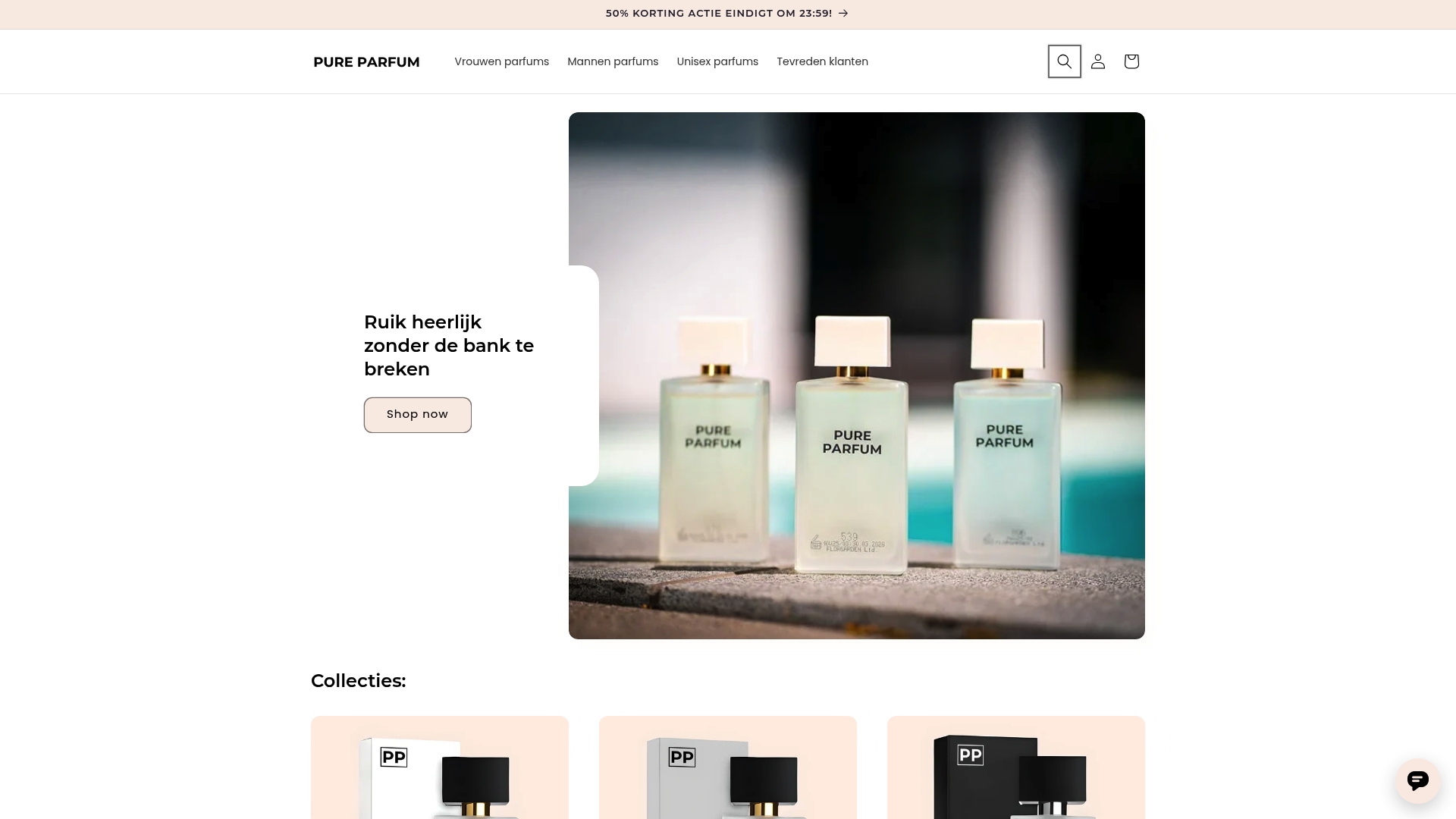
Our perfumes have a high concentration of perfume oil for a scent that lasts a long time. Discover the collections women’s perfumes, men’s perfumes, or unisex perfumes.
Our view on perfume in a home with children
We love fragrance, and we believe you do not have to stop using it when you become a parent. A perfume says something about who you are. Especially in a busy period with a baby or young children, that moment in front of the mirror can be a little piece of “me time.”
At the same time, a child’s skin is not adult skin. That is why our advice is clear: perfume is for you, not for your baby. Spray consciously, let it dry, and keep the bottle out of reach. Then both of you can enjoy it.
Choosing consciously is part of that. That is why we make vegan, cruelty-free perfumes and put our budget into the scent instead of packaging and advertising. A fragrance with lots of perfume oil that lasts all day means less re-spraying. That is nice for you, and it keeps the scent around your child limited.
J
Frequently asked questions
Can babies tolerate perfume?
A baby has much thinner skin than an adult, and fragrance substances are a known cause of allergy in care products. So do not spray anything on your baby’s skin, clothes, or bedding. You can wear your own perfume, as long as you spray from a distance, let it dry, and wash your hands before caring for your baby.
From what age can a child wear perfume?
There is no legal minimum age. Under 2 years old, do not use perfume; up to age 6, it is best to stay fragrance-free. From primary school age, a light scent on clothing is possible, and from around 12 years old, a teenager can wear their own fragrance in moderation.
Is a special children’s perfume safer?
A children’s perfume is often milder and sometimes alcohol-free, but it can still contain fragrance allergens. Natural essential oils can also cause allergies. So always check the ingredients list and follow the same rules: little, on clothing, and not for young children.
Can I spray perfume in the child’s room?
Preferably not. A child’s room, and especially the area around the crib, is best kept fragrance-free. In children with asthma, scents in the air can trigger symptoms.
Why should you not rub in perfume?
Rubbing can irritate sensitive skin and disrupt the way a fragrance develops on the skin. Spray and let it dry naturally, both for yourself and for a teenager who is just starting with perfume.
Sources
- Ouders van Nu: Check the label, baby care products
- NVWA: Source document State of Product Safety 2016
- NVWA: Risks of non-food consumer products 2021
- EUR-Lex: Regulation (EU) 2023/1545
- Official Journal of the EU: Regulation (EU) 2023/1545 (pdf)
- Journal of Youth Health Care: Over-the-counter care products for baby skin