

Perfume terms cover three key things: the concentration in the bottle, how the scent develops in layers, and how the fragrance behaves on your skin. Without those three pieces of context, you’re standing in the store with your eyes covered. The terms you should know right away: EDP (eau de parfum), EDT (eau de toilette), top notes, heart notes, base notes, and sillage. Each of these concepts comes up as soon as you test a fragrance or read a review.
- EDP and EDT tell you something about strength and longevity
- Top notes, heart notes, and base notes describe a fragrance’s timeline
- Sillage is about the scent trail you leave behind, not how much you spray
Next, we explain each component separately, with concrete examples and testing tips.
Table of contents
- Perfume terms about concentration: what the labels mean
- The scent pyramid: how top notes, heart notes, and base notes work
- Recognizing fragrance families: from floral to gourmand
- Sillage and projection: what do those performance terms mean?
- Handy glossary: perfume terms you often come across
- How to test and choose a perfume in practice
- What Pure Parfum offers those who want to apply these terms
- Testing and choosing only works with the right basic knowledge
- Where most perfume guides miss the mark
- Sources
Perfume terms about concentration: what the labels mean
The concentration of perfume oil determines how intense a scent smells and how long it lasts. More oil usually means a stronger, longer-lasting fragrance, but it’s not the only factor: the ingredients themselves also play a role.
- Extrait de parfum: the highest concentration, often 20 to 40% perfume oil; heavy and long-lasting.
- Eau de parfum (EDP): typically 15 to 20% oil; the usual balance between intensity and price.
- Eau de toilette (EDT): lighter, usually 5 to 15%, suitable for daytime.
- Eau de cologne (EDC): even lighter, around 2 to 4%, evaporates quickly.
- Eau fraîche: the lowest concentration, mainly intended as a refreshing pick-me-up.
For everyday use in the office, an EDT often feels nicer, because you’re not filling the whole room. For a night out or a cold winter day, you’ll more likely choose an EDP or extrait, which better withstand the cold and the passage of time. Popular consumer guides recommend EDP for longer wear and EDT for daytime, and that advice holds up well in practice.
The scent pyramid: how top notes, heart notes, and base notes work
A perfume isn’t a fixed thing. It changes throughout the day, and that’s due to the structure in three layers that together form the scent pyramid.
- Top notes: the first impression, often citrus or herbal; usually only noticeable for about 10 to 30 minutes.
- Heart notes: the heart of the fragrance, often floral or spicy; it determines the true character.
- Base notes: woody or musky tones that last the longest and form the signature.
If you judge right after the first spray, you miss most of the story. Top notes disappear incredibly fast and tell you little about how a fragrance ultimately settles on your skin. So wait long enough before you really assess the heart and base notes—this is what practical advice about fragrance notes shows.
Pro tip: Spray a perfume on your wrist in the morning and smell it once every hour. That way you can see for yourself how the layer shifts from fresh to warm.

Recognizing fragrance families: from floral to gourmand
Fragrance families are the fastest way to determine whether a perfume matches your taste. Each family has a few recognizable notes that keep coming back.
- Floral: rose, jasmine, peony. Popular in spring scents and classic women’s perfumes.
- Woody: sandalwood, cedarwood, vetiver. Works well in autumn and winter, also unisex.
- Fougère: lavender, clove, moss. The base of many classic men’s fragrances.
- Chypre: bergamot, patchouli, oakmoss. Earthy and refined, popular in evening scents.
- Oriental: amber, clove, vanilla. Warm and heavy, suits cold weather.
- Gourmand: caramel, cocoa, praline. Sweet and approachable, loved by a younger audience.
A light floral or citrus scent fits better with a summer workday. An oriental or woody fragrance comes into its own better on a winter evening, when the cold removes the fleeting top notes faster and the heavier base notes stay on longer.
Sillage and projection: what do those performance terms mean?
Sillage is the scent trail that remains when you leave a room. Projection is how far the fragrance spreads from your skin at that moment. They’re two different things: a perfume can project strongly but leave little sillage behind, or vice versa.
- Ingredients like woody and musky materials usually create more sillage than light citrus notes.
- A higher concentration (EDP vs. EDT) typically strengthens both projection and sillage.
- Skin type, temperature, and humidity affect how a fragrance spreads.
Sillage is mainly determined by the fragrance’s composition itself, not simply by how much you spray, as explanations about sillage show. Want to stand out at a party? Choose a scent with strong base notes. Working in a small office? Then a subtler sillage is more pleasant for the colleagues around you.
Handy glossary: perfume terms you often come across
This short word list helps you understand labels and reviews faster, based on the extensive Delacourte perfume lexicon.
- Accord: a combination of notes that together form one recognizable scent impression.
- Absolue: a strongly concentrated extract, often from flowers, obtained without heating.
- Concrete: a waxy intermediate product before the absolue, used in extraction.
- Enfleurage: a traditional extraction method in which flowers release their scent into fat.
- Aldehydes: synthetic substances that give a fresh, sometimes soapy effect.
- Flanker: a new variant of an existing, popular perfume.
- Round: a fragrance in which the notes blend harmoniously into each other, without sharp edges.
- Gourmand: a fragrance family with sweet, edible tones such as vanilla or caramel.
- Chypre: a fragrance style based on bergamot, moss, and woody tones (see the families above).
- Skin scent: a subtle scent that stays close to the skin, with minimal sillage.
- Longevity: the English term for longevity, how long a fragrance remains wearable.
- Vintage: an older formula or bottle, often with different raw materials than the current version.
On labels of perfume products, it’s often simply written “parfum” as a collective term for fragrance ingredients, and some people may react allergically to it. It’s worth remembering this for sensitive skin.
How to test and choose a perfume in practice
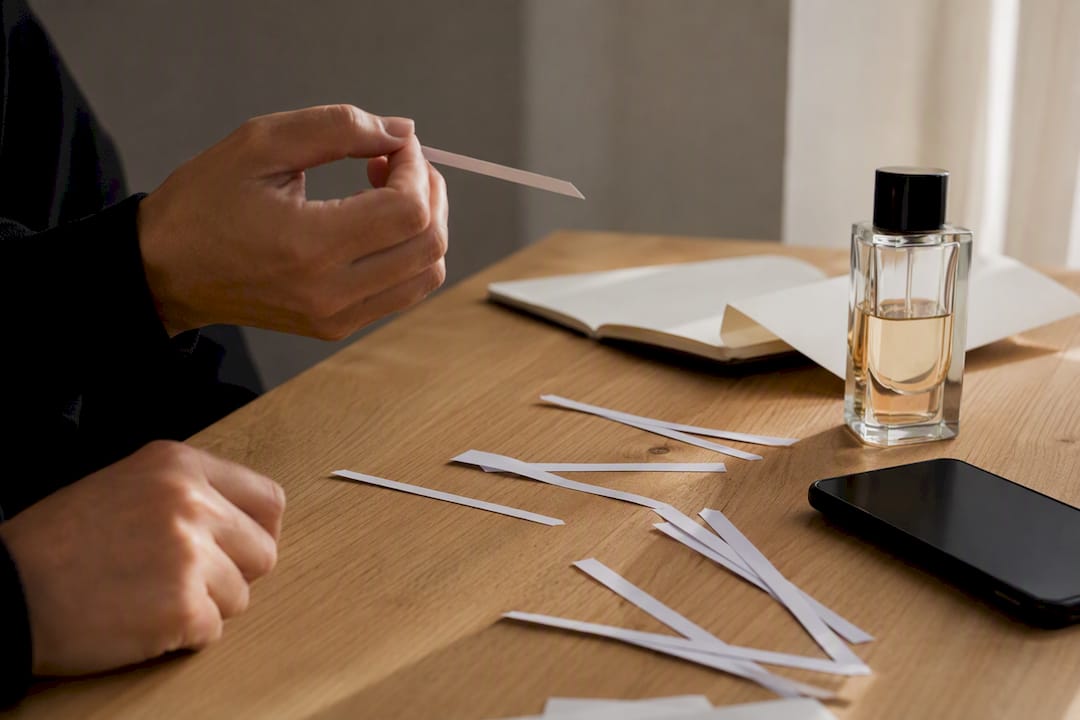
A good testing routine prevents expensive mistakes and fragrance fatigue.
- Test no more than two to three fragrances per session; otherwise your nose gets saturated.
- Spray on your wrist or the inside of your arm—never on clothing.
- Wait at least fifteen to sixty minutes before judging, so the heart and base notes can show themselves.
- In between, step outside briefly or smell coffee beans to reset your nose.
- If you order online, first choose a 30ml x4 perfume set or a comparable sample option before buying a full bottle.
Pro tip: Wear a candidate fragrance for a full day before you decide against it. Some scents that seem overwhelming at first become just right after a few hours.
When buying online, always pay attention to the concentration and the main notes in the description—this prevents disappointments later.
What Pure Parfum offers those who want to apply these terms
Pureparfum sells vegan, animal-friendly perfumes with a high concentration of perfume oil, inspired by well-known designer scents for men, women, and unisex. The range also includes scented hand creams, body wash, and care sets.
- High oil concentration for longer wear and clearer sillage
- Vegan and animal-friendly composition, without expensive packaging or marketing costs
- Thousands of positive reviews and a wide range of fragrance families
Want to immediately test what you learned in this article? A 3x100ml perfume bundle lets you experience different fragrance families side by side, without having to buy an entire collection right away.
| Point | Details |
|---|---|
| Concentration drives intensity | EDP typically lasts longer than EDT; EDT is lighter for daytime. |
| Wait for the base notes | Assess a fragrance only after fifteen to sixty minutes on your skin. |
| Sillage is composition, not dosage | The ingredients determine the scent trail, not how much you spray. |
| Test in small groups | Limit yourself to two or three fragrances per session to avoid nose saturation. |
Testing and choosing only works with the right basic knowledge
Perfume terms only have value when you connect them to a concrete testing routine: concentration determines longevity, the scent pyramid determines the order, and sillage determines the impact on others.
| Point | Details |
|---|---|
| Check concentration first | Choose EDT for daytime and EDP or extrait for evening and winter. |
| Take the scent pyramid seriously | Never judge in the first ten minutes; wait for the heart and base notes. |
| Use fragrance family as a compass | Use floral, woody, fougère, chypre, oriental, or gourmand as a quick way to categorize. |
| Sillage separate from quantity | Choose heavier base notes for more scent trail, not more sprays. |
Where most perfume guides miss the mark
Most explanations about perfume terms get stuck in dry definitions. That’s exactly where the confusion stays: you read what EDP means, but nobody tells you why you should let a fragrance sit on your skin for half an hour before forming an opinion. That step is structurally skipped, and it’s precisely the difference between a disappointing purchase and a perfume you’ll wear for years.
In my view, sillage is the most underestimated concept in the whole vocabulary. People think that spraying more makes a bigger impression, while it’s the composition itself that makes the difference. A cheap idea, executed incorrectly, remains a cheap idea. A strong base note, well dosed, carries itself.
My advice: don’t start with an expensive full bottle. Start with a small sample, let it sit on your skin for a whole day, and only then judge. Terminology is useful, but without that patient waiting step, it’s just theory.
— J