

Yes, you can take perfume on the plane, in both your carry-on and checked luggage. In the cabin, however, there is a strict limit: each container may contain a maximum of 100 ml and all liquids together must fit into one transparent, resealable bag of up to 1 liter. Duty-free bottles larger than 100 ml can also be taken, but only if they are sealed in a special bag with a receipt. Without that bag or with a broken seal, the bottle will still be refused at security screening.
In short:
- Perfume in carry-on luggage must not be larger than 100 ml per bottle, and everything must fit into one 1-liter transparent, resealable bag.
- Duty-free bottles larger than 100 ml can be taken, but only if sealed in a STEB and with a receipt—especially when transferring to other airports.
- In checked luggage, larger bottles—usually about 0.5 liter per bottle—can be taken, but they must be protected against breakage and leakage.
- It’s wise to protect your perfume even more by double-packing it and checking the closures properly to prevent leaks during the trip.
- During stops outside the EU, re-screening may take place, increasing the risk of a duty-free bottle larger than 100 ml being taken away or refused.
Table of contents
- Perfume traveling by plane: what exactly do the EU and NL rules say
- Can you take a duty-free bottle larger than 100 ml?
- Checked luggage: more flexible rules, but not without points to consider
- How to pack perfume without leaks or breakage
- Atomizer, sample or solid perfume: which travel format suits you?
- How do you use perfume properly on board?
- Checklist: what to check before you go to the airport
- Rules outside the EU: what should you watch out for?
- How have perfume brands adapted their packaging to these rules
- What if your flight has multiple layovers?
- Buy perfume at the airport or would you rather do it in advance?
- What I always do myself when packing
- Choose a travel-friendly perfume set that fits within the rules
- Sources
Perfume traveling by plane: what exactly do the EU and NL rules say
The rule is simple to remember, but it’s often applied incorrectly. Within the EU and the Netherlands, you may take liquids, including perfume, in your carry-on luggage if each container is no larger than 100 milliliters. All those little bottles together must fit into one transparent, resealable bag of up to 1 liter, usually about 20 by 20 centimeters.
The misunderstanding that most travelers fall for: it’s about the maximum amount stated on the bottle, not how much is left inside. A half-full 150 ml bottle is treated as 150 ml at the scan and therefore won’t pass the check, even if there’s only a small layer of perfume left. Customs staff check the label, not the liquid level.
When transferring to another airport, especially outside the EU, your carry-on luggage may be re-screened. Usually that’s not a problem if you stay within EU standards, but it is a moment where a damaged or no longer transparent bag can lead to questions.
| Situation | Maximum content per container | Total limit | Special note |
|---|---|---|---|
| Carry-on luggage, regular perfume | 100 ml | 1 liter in transparent bag | Maximum content on the bottle is decisive |
| Carry-on luggage, duty-free purchase | More than 100 ml allowed | No separate maximum | Only with sealed bag (STEB) and receipt |
| Checked luggage | About 0.5 liter per container | About 2 liters total as a guideline | Restriction due to flammability, not the liquid rule |
These figures are guidelines that may differ slightly by airline and country, so if in doubt, check your carrier’s conditions before you pack.
Can you take a duty-free bottle larger than 100 ml?
Yes, but only under one condition: the bottle must be sealed in a Security Tamper-Evident Bag, in practice often called a STEB. This transparent bag is sealed at the duty-free shop and must remain closed until you reach your final destination. The receipt is usually visible in the bag or provided with it, and that receipt is your proof that the purchase was made after the last security check.
Where it often goes wrong is on flights with a transfer. During transfers, a new security screening may follow, and then the STEB only counts if the seal is completely intact. A half-open corner, a torn edge, or a bag you opened yourself to “just take a sniff” is enough reason for security to confiscate the bottle.
A few practical points to remember:
- Never open the STEB before your final destination, not even to check that everything is in order.
- Keep the receipt separate or leave it visible in the bag; some airports ask for it specifically.
- When buying, ask whether the shop knows if your flight has a layover, because staff can sometimes already indicate whether that causes problems.
- Not sure whether your transfer creates a risk? Then it’s smarter to put the bottle directly in your checked luggage instead of taking the chance with the STEB.
This caution isn’t overblown fear. A €80 bottle you have to throw away at the gate because the seal isn’t intact anymore is an expensive learning moment that could have been completely avoided with a bit of planning.
Checked luggage: more flexible rules, but not without points to consider
In many cases, larger perfume bottles simply belong in checked luggage, where the cabin liquid rule doesn’t apply. Still, that’s not a free pass to pack anything you want. As a practical guideline, many sources suggest about 0.5 liter per container and 2 liters total, especially because perfume often has a high alcohol percentage and is therefore considered a flammable liquid.
The practical risks in checked luggage are different from those in the cabin. Your suitcase gets thrown around, stacked, and sometimes shaken quite a bit during transport. A glass bottle without protection doesn’t always survive that.
A few concrete measures that make the difference:
- Tighten the cap firmly and check that the spray nozzle can’t accidentally be pressed during transport.
- Wrap the bottle in clothing, a scarf, or bubble wrap, and place it in the middle of the suitcase, away from the edges.
- Use a sturdy case or a separate cover specifically for bottles, especially for expensive or favorite perfumes.
- If you’re unsure about the closure, it’s better to choose a smaller travel size than to gamble with a large bottle.
Do you have a bottle that’s just a bit too big for carry-on, but you’re wondering whether it will survive the trip in checked luggage? Then a refillable atomizer is often a smarter solution than risking leaks in your suitcase.
How to pack perfume without leaks or breakage
A few extra minutes of attention when packing can save you a suitcase that smells like perfume and a broken bottle. Follow these steps before you leave the house:
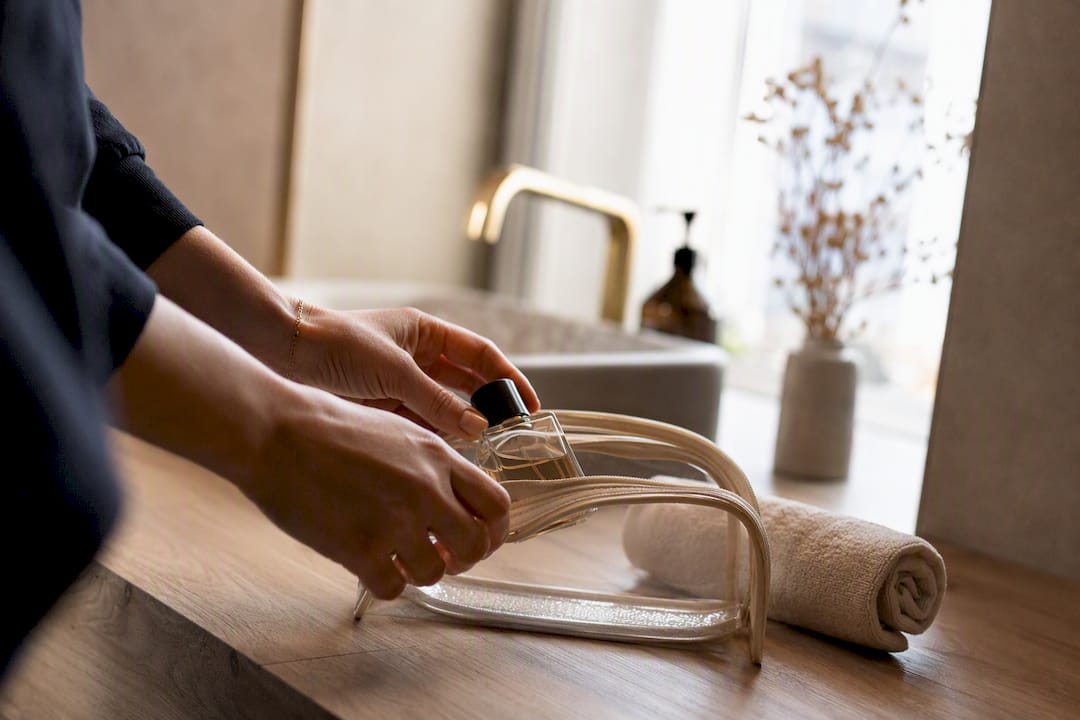
- First place the perfume bottle in a small resealable bag, even if it’s already in its original packaging.
- Wrap that bag in something soft, such as a sock, scarf, or a piece of clothing, and put everything into an extra sturdy zip bag.
- Test beforehand that the spray head and cap are properly closed by holding the bottle gently upside down above a sink.
- Put your 1-liter bag with all liquids on top in your carry-on luggage, so you can grab it quickly during the security check without emptying your entire bag.
- Extra-check fragile or expensive bottles: if necessary, use a second zip bag as a buffer against sharp edges in your bag.
Pro tip: Are you filling an atomizer yourself? Leave it upside down for 24 hours before you depart. If you see droplets escaping, the closure isn’t good enough—then it’s better to choose another small bottle or an extra zip bag as a backup.
This double protection layer, the so-called double-bagging, is exactly why professional travelers rarely end up with a smelly bag. It costs an extra thirty seconds when packing and prevents hours of cleaning.
Atomizer, sample or solid perfume: which travel format suits you?
Not every trip calls for the same solution. Frequent flyers quickly develop a preference for one of these three options.
- Refillable atomizers are small, reusable bottles that you fill yourself from your large bottle at home. They weigh almost nothing, fit well within the 100 ml limit, and keep exactly the scent you’re used to—rather than switching to a different perfume for the trip.
- Solid perfumes and perfumed creams contain no free liquid and therefore, in practice, often don’t count toward the liquid limit. They’re ideal for anyone who doesn’t want to lose space in the 1-liter bag or simply prefers not to travel with glass.
- Samples and travel-size bottles that you buy separately are handy for a single short trip, but less cost-effective if you travel more often, because the cost per milliliter is often higher than with a refillable set.
For a weekend in the city, one atomizer with your favorite scent is usually enough. Going on vacation for a few weeks? Then a set of two or three small bottles is more practical, so you can switch without filling your entire 1-liter bag with just one product. By the way, a perfumed hand cream is a handy extra alongside your perfume, precisely because it doesn’t count as liquid.
How do you use perfume properly on board?
The cabin of an airplane is a small, enclosed space with limited ventilation, and not everyone likes strong scents from two meters away. That’s why, if you plan to reapply during the trip, choose light, fresh notes instead of heavy oriental or woody perfumes.
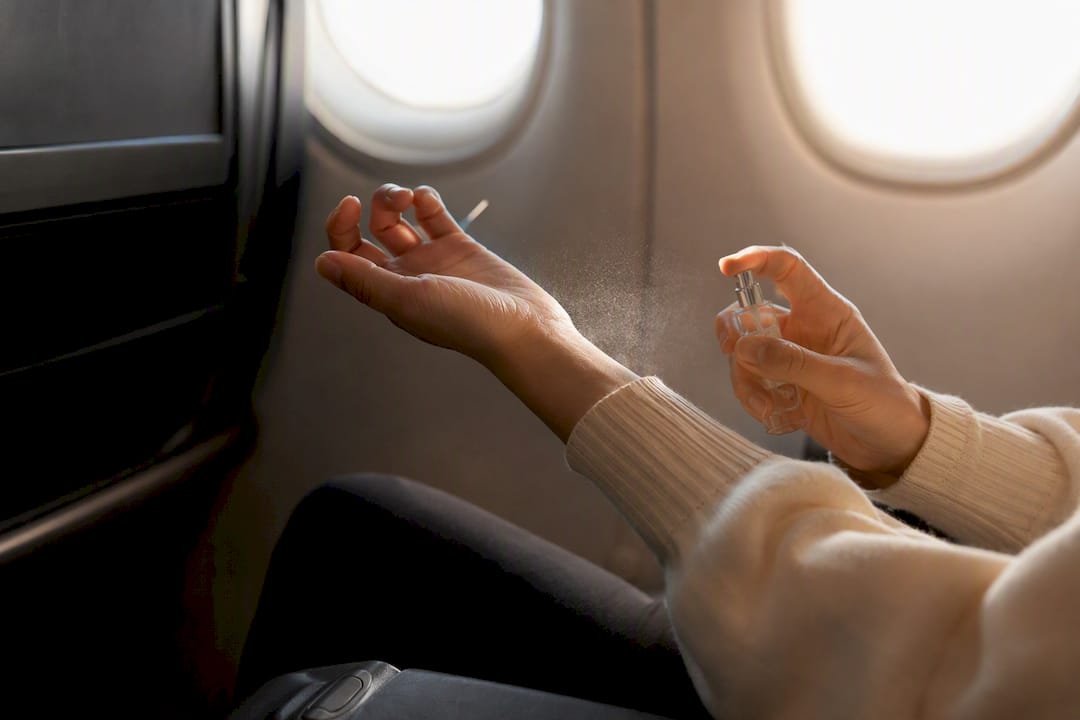
Limit yourself to a single refresh, at most two during a long flight, and try not to spray directly on your seat. A trip to the restroom or a moment when you’re already getting up is a better time to freshen up without the scent immediately spreading through the whole row.
If you know fellow passengers have fragrance allergies or breathing issues, just check whether spraying is okay. If you’re unsure, use a perfumed hand cream instead of a spray. It gives a subtler scent that doesn’t travel as far.
Checklist: what to check before you go to the airport
Go through these points while your suitcase is still on your bed or table—not when you’re already in line at security.
- Check each bottle for the stated amount, not how much is left, and keep the 100 ml limit for everything you put in your carry-on luggage.
- Distribute your liquids across the 1-liter bag and make sure the bag can still close properly; don’t use a second bag as a replacement.
- Test the closure of each bottle and pack fragile vials in an extra zip bag with some soft padding.
- If you bought something duty-free larger than 100 ml, check that the STEB seal is intact and keep the receipt separate or visible.
- Not sure about a bottle that’s just too big or too fragile for carry-on? Move it to your checked luggage before you check in.
These five points might take you ten minutes, but they prevent most of the most annoying surprises at the security desk.
Rules outside the EU: what should you watch out for?
Outside the EU, similar liquid rules apply, but not always identically. The United States, Canada, Australia, and most countries in Asia also use a limit of about 100 ml per container with a total 1-liter bag—an approach that largely goes back to international aviation agreements. Still, there are differences in how strictly this is enforced and what exceptions apply to duty-free purchases.
In some countries outside the EU, during a layover or when transferring to a domestic flight, a new security screening is carried out, applying local rules instead of the rules of your departure country. A STEB sealed in Amsterdam isn’t automatically recognized as valid everywhere outside the EU, especially if your destination country applies a stricter line.
For travelers flying from the Netherlands to a non-EU destination on a direct flight, there’s little change in practice: the departure rules apply and you don’t have to go through security again on the way. With a layover in a third country, that’s different, and it’s wise to check in advance which liquid rules apply at that specific airport. Travel agencies and airlines usually mention this on their website under baggage conditions.
How have perfume brands adapted their packaging to these rules
The liquid restrictions introduced after 2006 have clearly changed the perfume industry. Where brands used to sell mainly large, decorative 100 ml or larger bottles, the range of small formats has grown significantly in recent years. Travel-size bottles of 10 to 30 ml are no longer a marketing gimmick, but a direct response to what travelers can actually take with them.
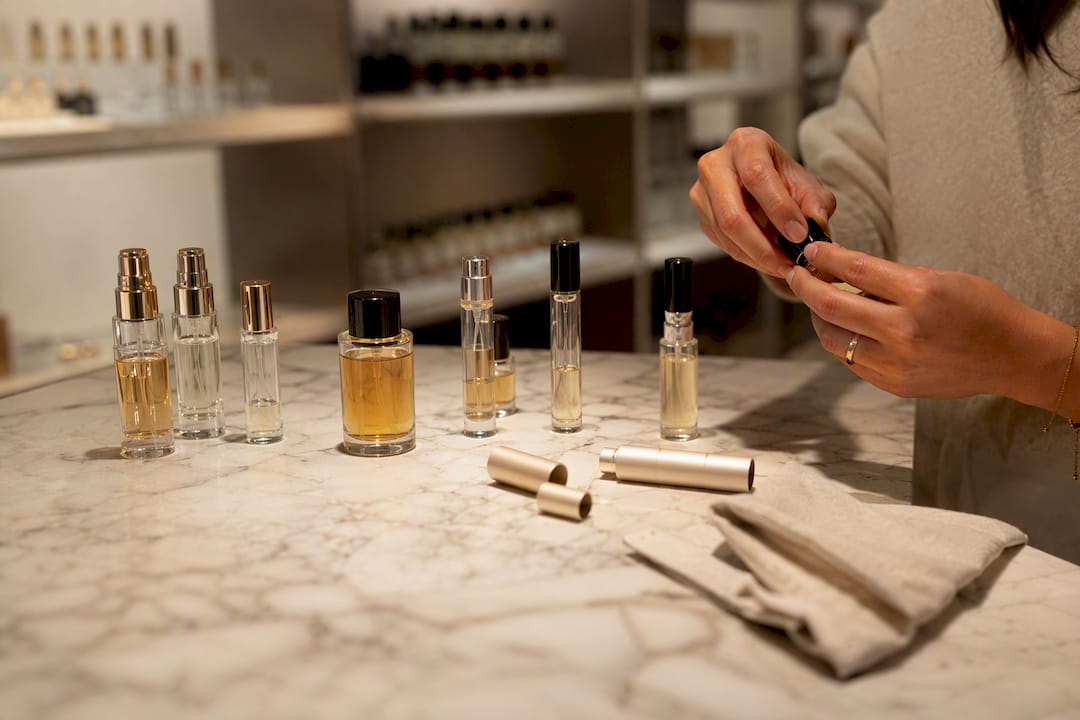
Refillable atomizers have also become more common as a result. More and more brands sell refillable bottles alongside their standard bottle, because travelers want to be able to take their favorite scent without having to miss out on a more expensive large bottle or throw it away at security.
The duty-free sector, in turn, has standardized the STEB procedure, so a purchase at virtually any major airport is sealed in a similar way. That makes it more predictable for travelers, although vulnerability during layovers remains a recurring point of uncertainty.
For brands focused on affordability, such as smaller independent labels, this has also been an opportunity: a compact set of multiple scents in travel format meets a different need than one large, expensive bottle that mostly stays at home.
What if your flight has multiple layovers?
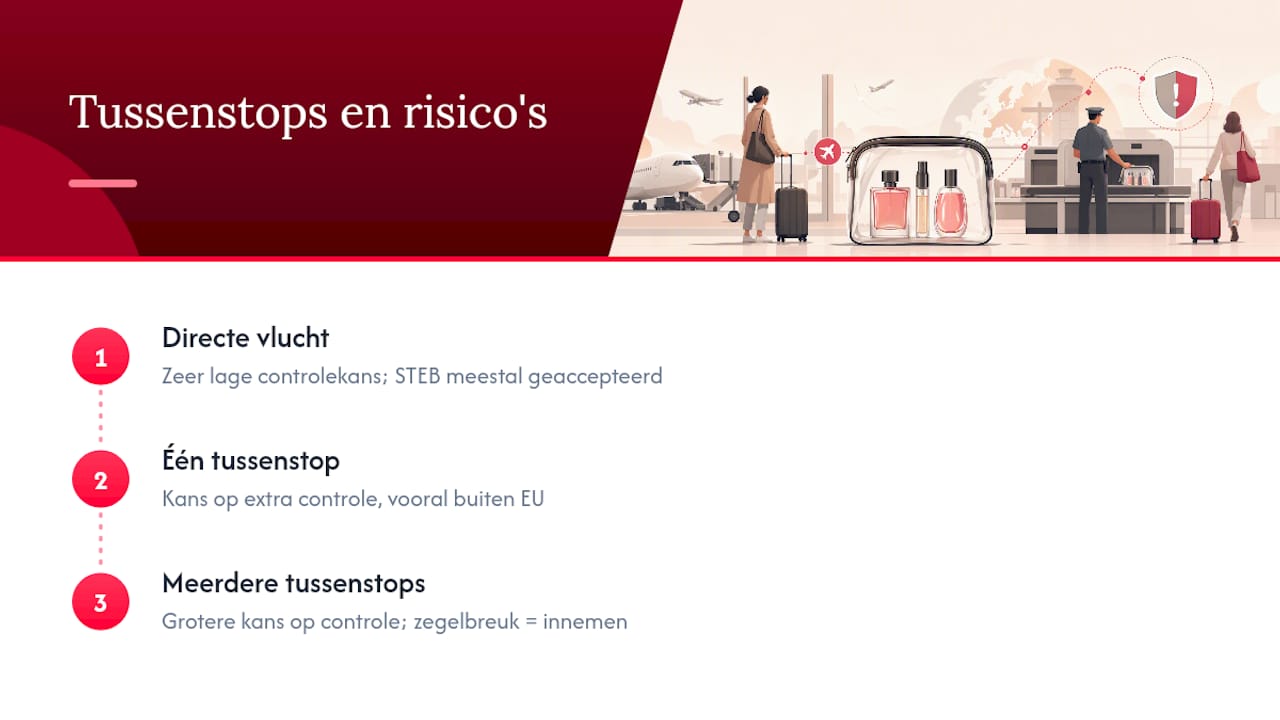
In theory, every layover is a new moment when your carry-on luggage could be checked again—especially if you have to switch planes and pass through a new gate with its own security. Within the EU, this is usually a formality because the same rules apply everywhere, but on a route with a layover outside the EU, the situation can differ per airport.
The biggest risk isn’t with your regular travel-size bottles, which fit within the standard rules everywhere. The risk is with duty-free purchases larger than 100 ml. A STEB you bought in Amsterdam and that remains intact is usually accepted at most connecting airports, but there are exceptions where staff still want to see the bag or even open it for additional checks. Once that seal is broken, the exception no longer applies and the bottle can be confiscated, even if you just bought it legally.
If you travel with two or more layovers in different countries, the chance of such an extra check is simply higher than on a direct flight. For an expensive bottle, it’s therefore often wiser to put it in checked luggage instead of relying on a STEB that you’ll have to justify again at every gate. If you have doubts about a specific route, the airline often provides clarity about the security procedures at the layover.
Buy perfume at the airport or would you rather do it in advance?
Duty-free shops at airports often sell well-known brands at a slightly lower price than in regular stores, because there’s no tax. The issue is the STEB requirement for larger bottles and the uncertainty during layovers that comes with it, plus the fact that at an airport you have little time to calmly compare or test.
Of course, you pay the regular price including tax, but you save time and stress when packing.
For travelers who are mainly looking for a compact travel format within the 100 ml limit, buying in advance is often the more practical route. You choose a set of 20 ml or 30 ml bottles yourself, test at home whether the closure works properly, and then just walk on at the airport without any hassle with sealed bags. Duty-free remains attractive for anyone who deliberately wants to get a large, expensive bottle and is willing to accept the STEB procedure as part of the deal.
What I always do myself when packing
After enough mishaps with leaking bottles in my toiletry bag, I now automatically choose two small travel formats plus one refillable atomizer for my favorite scent. That always fits within the 1-liter bag, and I never have to gamble on whether a large bottle will survive the trip.
I only buy duty-free if I’m sure my flight doesn’t have a layover. If I’m unsure, I simply put the bottle in my checked luggage, packed well, and save myself the discussion at the gate. That choice has never let me down.
— J
Choose a travel-friendly perfume set that fits within the rules
If you’d rather not pack and sort through a large bottle every time, you’ll benefit from a set that’s already divided into the right sizes. Pureparfum sells vegan perfumes with a high concentration of perfume oil at a price that matches what you actually pay for the scent—not for the packaging or surrounding marketing.
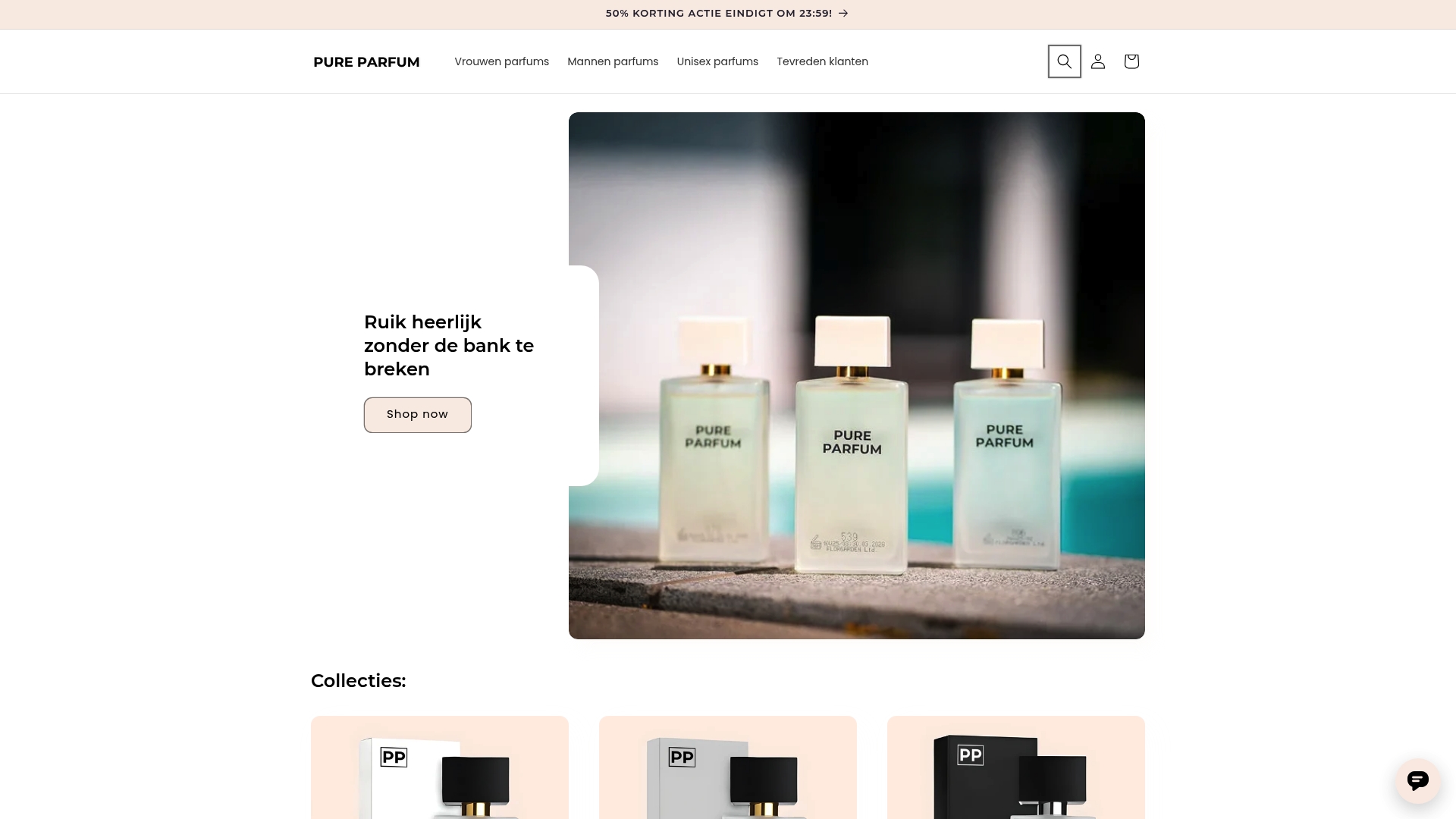
The 20ml x5 perfume set is exactly tailored to the 100 ml rule: five bottles, each well under the limit, and together still compact enough for your 1-liter bag. If you’d rather travel with fewer bottles but a bit more content, then the 30ml x4 set or the 50ml x3 set fits better for a longer vacation. If you want to take one scent in a larger format in your checked luggage, then the 100ml x3 set is an option. Check out the travel sets and choose the size that fits your next trip.
Sources
The rules in this article are based on the official guidelines from the Dutch government (Rijksoverheid) and practical explanations from Kieskeurig and Glowmagazine. For solid personal care products in carry-on luggage, SoapFully offers extra background.
- Rijksoverheid — What can I take in my carry-on luggage on the plane?
- Kieskeurig — Perfume in carry-on luggage: what’s allowed and what isn’t (2026)
- Glowmagazine — Taking perfume on the plane: everything you need to know