


You read a perfume's ingredient list from top to bottom. At the top is what it contains most of, usually alcohol. Next comes ‘parfum’, the collective term for the entire fragrance composition, and often water. At the bottom are substances below 1%: fragrance allergens such as Limonene and Linalool, which must be listed separately, and sometimes colorants with a CI number. If you know what each line means, you can see in a few seconds what to pay attention to. That is especially important if your skin is sensitive to fragrance substances.
Briefly summarized
- Order = quantity. Ingredients are listed by weight, from most to least. Anything under 1% may appear at the end in any order.
- ‘Parfum’ is one word for the entire fragrance. The composition does not need to be written out in full. Well-known fragrance allergens must be listed separately above a certain threshold.
- The allergen list has grown longer. The number of fragrance allergens that must be listed separately in the EU is increasing from 26 to 82.
- Ingredients are not fragrance notes. Top, heart and base notes describe how a fragrance develops on your skin. The INCI list says what is chemically in the bottle.
- Vegan does not appear in the INCI list. You can tell that from what the brand says about its fragrances.
Table of contents
- This is how an ingredient list is structured
- A perfume label, line by line
- What the word ‘parfum’ does and does not tell you
- Recognizing allergens on the label
- Ingredients versus top, heart and base notes
- Vegan, scent strength and shelf life: where to read that
- How we look at a perfume label
- A scent you know, without the price tag
- Frequently asked questions
- Sources
This is how an ingredient list is structured
Every cosmetic product sold in the EU, including perfume, has an ingredient list. It starts with the word ‘Ingrediënten’ or ‘Ingredients’. The names are INCI names: an international naming system that gives the same substance the same name in the Netherlands, France and Poland. That is why you read ‘Aqua’ instead of ‘water’, and ‘Alcohol denat.’ instead of ‘denatured alcohol’.
Three rules determine how to read such a list:
- Descending order by weight. According to the European Cosmetics Regulation (EC) No. 1223/2009, the list is arranged in descending order by weight at the time the ingredient is added. So the first ingredient is present in the largest amount.
- No order applies below 1%. Substances below 1% may be listed after the substances above 1% in any order. So you cannot say that Linalool occurs more than Coumarin just because it appears earlier in the list.
- Parfum is a collective term. Fragrance compositions and their raw materials are designated by ‘parfum’ or ‘aroma’.
The Dutch Cosmetic Association explains that the order is intended to show consumers what a product contains most of: the more there is, the earlier it appears on the list. In perfume, that first ingredient is almost always alcohol, and there is a good reason for that.
A perfume label, line by line
An eau de parfum ingredient list often looks something like this:
Alcohol Denat., Parfum (Fragrance), Aqua (Water), Limonene, Linalool, Coumarin, Citronellol, Geraniol, CI 14700, CI 19140.
This is what each line means:
| On the label | What it is | Why it is included |
|---|---|---|
| Alcohol Denat. | Denatured ethanol, made undrinkable | Dissolves the perfume oils, evaporates quickly, and carries the scent |
| Parfum / Fragrance | The fragrance composition as a whole | This is the scent itself: natural and synthetic fragrance substances together |
| Aqua | Water | Balances the ratio between alcohol and oil |
| Limonene, Linalool, Coumarin, etc. | Fragrance substances that must be listed separately | They are part of the fragrance and are listed separately because of allergy risk |
| CI + number | Colorant | Gives the liquid its color |
Alcohol at the top
Alcohol being listed first is not a sign of a cheap formula. It is simply how perfume works. According to COSMILE Europe, ethanol is used in perfumes at up to about 80% to dissolve the perfume oils. The substance itself is odorless and evaporates quickly. From about 15 to 20%, alcohol also acts as a full preservative. Fragrantica describes ethanol as the traditional solvent in perfumery since the Middle Ages. Because it evaporates quickly, it brings the top notes to the fore as soon as you spray it.
Parfum in second place
Directly after alcohol, you will almost always see ‘Parfum’ or ‘Fragrance’. This is where the scent is. The higher the concentration of perfume oil, the more of the bottle consists of fragrance and the less of solvent. Want to know how names like eau de toilette, eau de parfum and extrait relate to one another? Then read our overview of explained perfume terms.
Aqua and the rest
Water is present in smaller amounts in a perfume and regulates the balance between alcohol and oil. Colorants can be recognized by the letters CI, short for Colour Index, followed by a number. Waarzitwatin.nl explains how to recognize colorants in personal care products on the label. If you do not see a CI number, the color of the liquid comes from the perfume oils themselves.
What the word ‘parfum’ does and does not tell you
A fragrance can consist of dozens to hundreds of raw materials. That is why EU rules allow the entire composition to be listed under one name. This protects perfumers' formulas. What ‘parfum’ does tell you: the product contains a fragrance composition, and its position in the list says something about the quantity relative to the other ingredients.
What it does not tell you: exactly which fragrance substances are in it and which of them are natural or synthetic. For most people, that does not matter, because you choose a perfume for the scent and not the formula. If you are sensitive to certain fragrance substances, the part after ‘parfum’ is the most important part of the label. That is where the substances that must be listed separately appear.
Personal care products with fragrance, such as hand cream or body lotion, follow the same rules. You read their list in the same way. However, ‘parfum’ is usually lower down, because the base consists of water, oils and caring ingredients.
Recognizing allergens on the label
After ‘parfum’ you often see a series of names that look like chemistry: Limonene, Linalool, Citronellol, Geraniol, Citral, Coumarin, Eugenol, Benzyl Benzoate, Benzyl Salicylate, Hexyl Cinnamal. These are not extra additives. They are parts of the fragrance composition itself that must be named separately because they can cause contact allergy in some people. Many of them occur naturally in nature. Limonene, for example, is found in citrus peel and Linalool in lavender.
The thresholds
In the EU, a fragrance allergen must be listed separately on the label if its concentration in the finished product exceeds a threshold. According to Regulation (EU) 2023/1545, that is:
- 0.001% in leave-on products, such as perfume, body lotion and hand cream;
- 0.01% in rinse-off products, such as shower gel and body wash.
That low threshold for leave-on products explains why a perfume label often has a long row of allergens. A fragrance quickly contains several above 0.001%.
From 26 to 82 allergens

For a long time, the number was 26 fragrance allergens. With Regulation (EU) 2023/1545 of 26 July 2023, that list was expanded. According to the Allergy Center, the transition period ended on 31 July 2026, after which manufacturers must separately list 56 additional fragrance allergens, bringing the total to 82. According to the text of the regulation, products already on the market before that date may still be sold until 31 July 2028. So if you see two labels for the same type of product in a store with a different number of allergens, that may be due to the transition arrangement. The formula does not necessarily have to be different.
How to read the list if you are sensitive
- Know what you react to. If you have had eczema or itching after a fragrance product, go to your doctor. They can refer you to a dermatologist for a patch test. This can determine which substance you are allergic to.
- Look for that name literally on the label. The allergens are listed by their INCI name, usually after ‘parfum’.
- Also check your other products. The same substance may be in your perfume, hand cream and shower gel. That is how it can build up.
- Read ‘fragrance-free’ carefully. A scent can also come from essential oils. In that case, they are listed under their own name on the label, and their allergens must be listed too.
One more important point: the threshold determines when a substance must appear on the label. It is not a limit below which someone with an allergy is guaranteed not to have symptoms. If you have a confirmed allergy, discuss with your dermatologist which concentrations you should avoid. You can read more about how fragrance and skin interact in our article on allergens in perfume.
Ingredients versus top, heart and base notes
Many people look on the label for ‘bergamot’ or ‘vanilla’ and cannot find them anywhere. That is correct: fragrance notes are not listed in the ingredient list. The INCI list is a legal list of substances. The fragrance pyramid describes how a perfume smells and how the scent develops over time.
According to Fashionchick, you smell the top notes immediately after spraying, and they disappear the fastest. The heart notes emerge once the top notes fade, and the base notes last the longest.
| Layer | When you smell it | Typical notes |
|---|---|---|
| Top notes | The first few minutes | Citrus, bergamot, fresh herbs |
| Heart notes | After that, the heart of the fragrance | Flowers such as rose and jasmine, spices |
| Base notes | Hours later, on your skin and clothes | Wood, amber, musk, vanilla |
There is a connection between the two, though. A fragrance with lots of citrus in the top notes often has Limonene or Citral on the label. A fragrance with tonka or hay in the base often contains Coumarin. In this way, you can use the label as a second way to understand a fragrance. Still, it is only a clue. The same allergen can be found in very different fragrances.
Want to know which notes really last all day? Then read our overview of long-lasting fragrance notes. How your skin holds onto base notes is explained in perfume and skin type.
Vegan, scent strength and shelf life: where to read that
The INCI list answers the question of which substances are in the product and what your skin may notice. It does not answer three questions buyers often have. For those, you look elsewhere.
Is a perfume vegan? Because the fragrance composition may be listed under ‘parfum’, you cannot tell from the list whether it contains raw materials of animal origin. In the past, animal-derived substances were used in perfumery, such as musk from deer and ambergris from sperm whales. If you want to be sure your fragrance is vegan, rely on what the brand says about its fragrances. With us, all fragrances are vegan and cruelty-free.
Does a perfume last a long time? That depends mainly on the concentration of perfume oil and on the base notes. The order on the label helps a little, because ‘parfum’ is always in second place. The product description says more about concentration and fragrance family. How to get more from each spray is explained in our guide on perfume application points.

How long does a bottle stay good? On the packaging you will often find an open jar symbol with a number, such as 36M. That is the period after opening. Store your perfume cool, dark and tightly closed. You can read more about that in perfume shelf life.
How we look at a perfume label
When you read an ingredient list, you see what a perfume actually is: alcohol, perfume oil, a little water and the fragrance substances that the law requires to be named separately. What you do not see is what you often pay most for in a store: the advertising campaign, the heavy glass bottle and the luxury box.
At Pure Parfum, we care about what is in the bottle. We do not spend money on expensive marketing and packaging. What we save that way, we put into the fragrance. Our perfumes are inspired by well-known designer fragrances and have a high concentration of perfume oil. They are developed for a scent that lasts a long time.
Two things you cannot read from an INCI list, we think are especially important. All fragrances are vegan, and our products are cruelty-free. You cannot see that on the label, so we simply tell you.
J
A scent you know, without the price tag
When you look at the label of your favorite designer fragrance and mostly see alcohol, parfum and a row of allergens, you now know that the scent itself is the most important ingredient. At Pure Parfum, you will find fragrances inspired by well-known designer perfumes. They have a high concentration of perfume oil and are vegan, without the costs of marketing and luxury packaging. Thousands of customers before you have left a positive review.
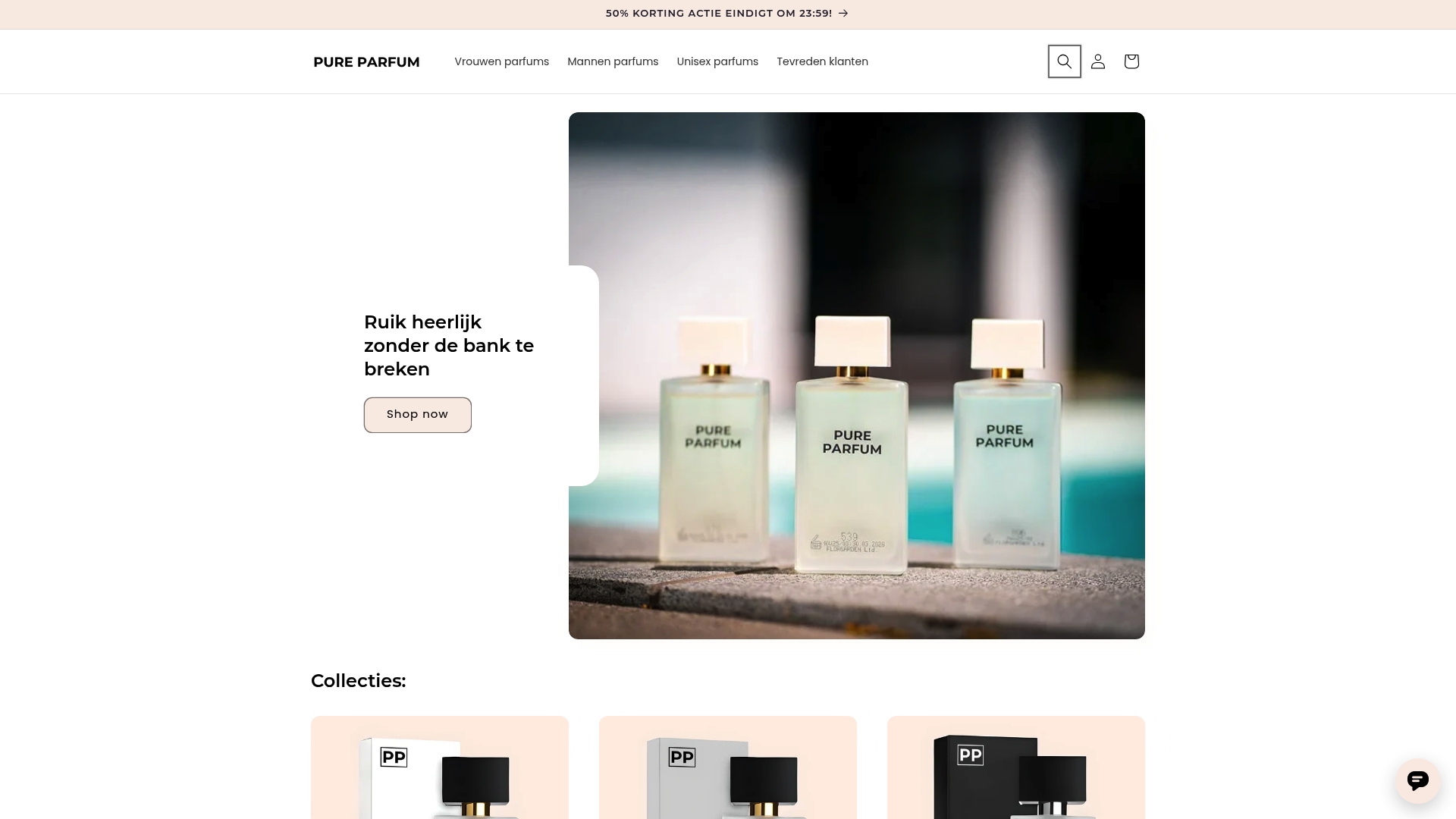
Check out the women's perfumes, men's perfumes or unisex perfumes. Want your scent to continue into your body care too? In our Body Care collection you will find scented hand cream, body lotion and body wash. Still undecided between a few fragrance families? With our sample set of 5 x 20 ml, you can discover which fragrance profile suits you.
Frequently asked questions
Why is alcohol listed first in perfume?
Ingredients are listed by weight, and alcohol is the solvent in which the perfume oils are dissolved. It can make up about 80% of a perfume. Alcohol evaporates quickly, allowing the scent to develop on your skin. It also helps preserve the product.
Does Limonene or Linalool on the label mean a perfume is bad?
No. They are fragrance substances that are part of the composition and are also found in citrus and lavender. They are listed separately on the label so people with a confirmed allergy can recognize them. If you do not have an allergy, they are simply part of the scent.
Why are bergamot or vanilla not in the ingredient list?
Fragrance notes describe how a perfume smells, not what substances it is made of. All fragrance substances together fall under ‘parfum’. Only the legally designated allergens are listed separately if they exceed the threshold. That is why you find the fragrance pyramid in the product description and not on the label.
Why does my new bottle have more allergens on the label than the old one?
Since 31 July 2026, new products in the EU must separately list up to 82 fragrance allergens, whereas before there were 26. Products already on the market before then may still be sold with the old label until 31 July 2028. A longer list usually means the label was updated, not that the fragrance changed.
Sources
- Regulation (EC) No. 1223/2009, Chapter VI: labeling
- Regulation (EU) 2023/1545 on the labeling of fragrance allergens
- Regulation (EU) 2023/1545, full text (pdf)
- NCV: What does the label tell you?
- COSMILE Europe: Alcohol Denat.
- Fragrantica: What are Perfumes Made of?
- Allergy Center: From 26 to 82 fragrance allergens on cosmetic labels
- Waarzitwatin.nl: Colorants in personal care products
- Fashionchick: The structure of a perfume, the fragrance pyramid