


Short answer: usually not necessary. Keeping perfume in the refrigerator is not a must for a normal living room or bedroom, because stability matters more than absolute cold. With persistent heat, and without a cool storage spot at home, the refrigerator can help temporarily. In that case, never put the bottle in the door and keep it away from food.
In short:
- A stable, cool, and dark place without temperature fluctuations is better than the refrigerator for storing perfume.
- Refrigerator storage is only suitable in extreme heat or when there is no cool storage available, and then especially in the inner section—not in the door.
- Light, air, and heat speed up the deterioration of fragrance compounds, while temperature swings make the decline happen faster.
- Always store perfume upright, away from direct sunlight, in a closed cabinet, and not next to heating or damp areas for optimal shelf life.
- Using smaller bottles and storing them in their original boxes reduces oxidation and slows down quality loss.
Table of contents
- Why temperature, light, and moisture affect the scent of perfume
- What do perfume experts and reliable sources say?
- Where should you store your perfume best at home?
- When is the refrigerator a sensible choice?
- The biggest mistakes and how to recognize damaged perfume
- What a perfume seller recommends about storage
- Practical sets for storing perfume smartly
- Sources
Why temperature, light, and moisture affect the scent of perfume
Perfume is largely made up of alcohol and fragrance compounds dissolved in oils. Heat speeds up the evaporation of that alcohol and accelerates the oxidation of fragrance molecules, causing the scent to “turn” from fresh to musty or sharp more quickly. Oxygen and UV light do about the same thing: they break down the delicate structure of top notes, so a perfume loses its character sooner.
Direct sunlight is the biggest enemy. A window frame or windowsill may seem harmless, but UV radiation affects colorants and fragrance molecules faster than you might think. Moisture plays a subtler role: it can damage caps and spray nozzles, allowing air to enter and the contents to oxidize faster.
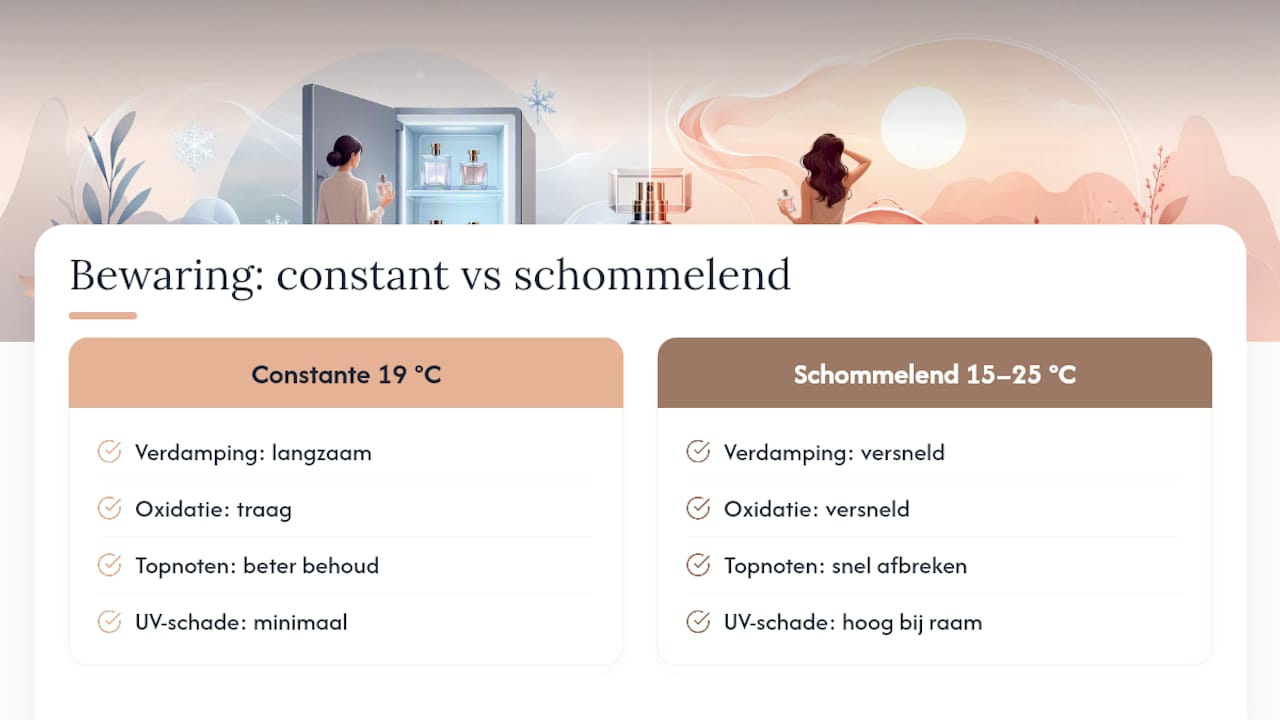
The real problem is not cold or heat itself, but fluctuation. A bottle that goes up and down between 15 and 25 degrees all day wears out faster than one that stays constantly at 19 degrees. That’s why a cool, dark, and stable place shows up in almost every piece of advice: it’s not the temperature itself, but its consistency that determines how long a fragrance stays intact.
What do perfume experts and reliable sources say?
Perfume expert Mona Kattan prefers to store her own collection in a cellar rather than in the refrigerator, precisely because a cellar offers a more stable temperature and humidity than a kitchen appliance that keeps turning on and off. That preference underlines the stability principle: cool and dark works, but only if the environment doesn’t constantly change.
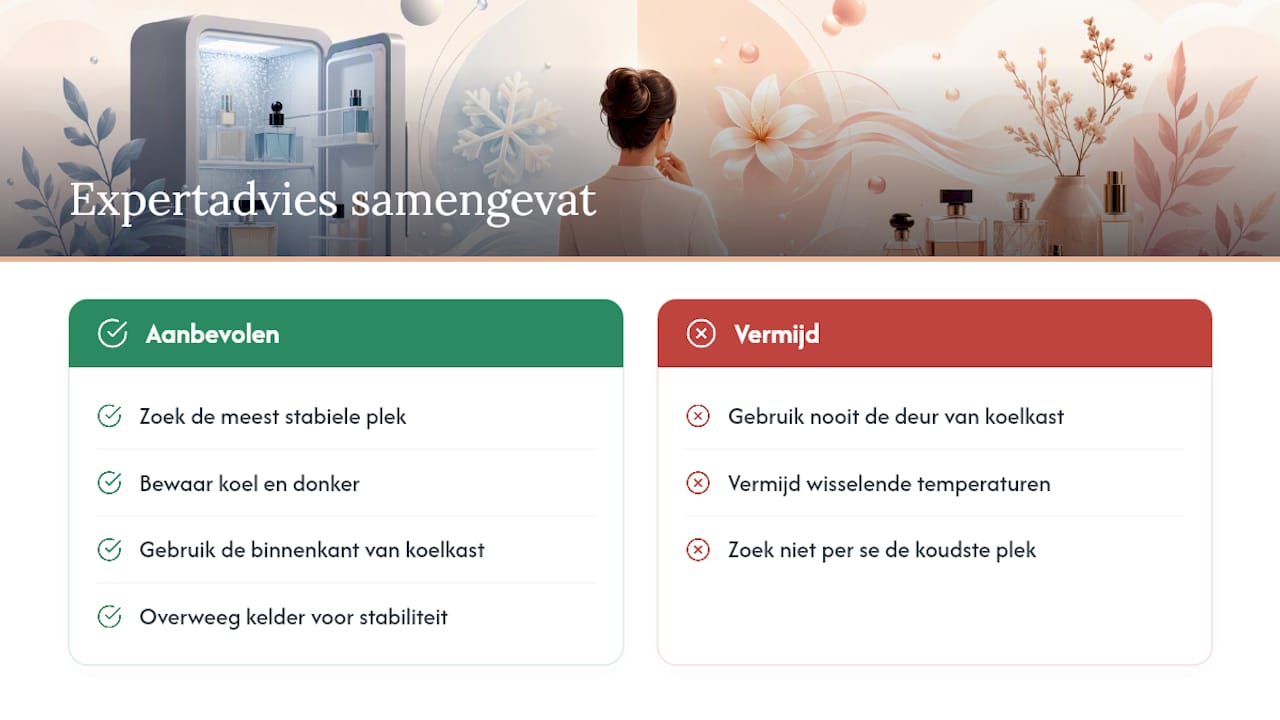
Recent beauty articles reach a similar conclusion. The refrigerator is not a requirement, but an option in specific cases. If you do use it, choose the inner part of the appliance and avoid the door, because that’s where the temperature fluctuates the most due to repeated opening and closing.
The common thread in almost every expert recommendation is the same: don’t look for the coldest spot—look for the most stable one. That principle is more useful than any rule of thumb about degrees.
Where should you store your perfume best at home?
For everyday use, you don’t need a refrigerator. A dark drawer, a closed cabinet shelf, or a bedroom cabinet does exactly what perfume needs: shade, an even temperature, and no drafts.
The ideal temperature range is around 17 to 20 degrees, roughly the temperature you’ll find in an average Dutch bedroom. Within that range, the alcohol and fragrance oils stay stable enough to preserve their original scent profile for months, sometimes years. A cellar works for the same reason, as long as it isn’t too damp.
A few concrete rules make the difference between a bottle that still smells fresh after a year and one that fades or turns flat:
- Always store the bottle upright, so the liquid doesn’t keep sitting for weeks against the cap or spray mechanism.
- Close the cap tightly right after use, because air is the fastest route to oxidation.
- Keep the bottle out of direct sunlight, even if it’s “just for a moment” on the windowsill.
- Avoid areas with high humidity, such as the bathroom or a damp cellar without ventilation.
- Don’t store perfume next to the heater, a lamp, or a south-facing window.
Pro tip: Store your favorite perfume in its original box. The box acts as an extra buffer against light and small temperature fluctuations, especially for bottles with a light-sensitive color.
When is the refrigerator a sensible choice?
There are situations where the refrigerator suddenly makes sense. Think of a heatwave without air conditioning, a home without a cool cabinet or cellar, or temporarily putting away an expensive, rare bottle that you won’t use for months. In those cases, the inner part of the refrigerator can be a reasonable emergency solution, as long as you follow a few steps.
- Place the bottle in the inner section of the refrigerator—never in the door compartments, where the temperature fluctuates with every opening.
- Pack the bottle in an airtight box or a sturdy bag, so food odors don’t seep into the liquid and condensation can’t build up.
- Never let the bottle end up in the freezer. Extreme cold can cause the oil-and-alcohol mixture to separate.
- Take the perfume out about half an hour before use and let it come to room temperature before you spray.
This way you prevent your bottle from picking up fragrance compounds from cheese, onion, or leftovers, and you stop a clammy glass from causing the spray nozzle to clog. A sealable box or zip bag is a simple but effective tool.
Pro tip: Use a separate, small cooler for your perfume collection when you travel often or don’t have space in the main refrigerator. This keeps the temperature more stable than in a refrigerator that’s constantly opened for food.
The biggest mistakes and how to recognize damaged perfume
The bathroom remains the most common mistake. Heat and steam from showering create exactly the fluctuations that make perfume age faster. Other classic errors: putting the bottle in the freezer, leaving it in the refrigerator door, leaving the cap open often, or storing it next to strongly scented products like laundry detergent.
You can recognize an affected perfume by a few clear signs:
- The liquid is darker or cloudier than it was when you bought it.
- The scent smells musty, sour, or overly sharp instead of matching the original profile.
- The intensity has clearly decreased, even if you spray the same amount as before.
Not sure? Test a small amount on your skin before using the rest, or store leftovers in a smaller test bottle so you reduce the risk of losing an entire bottle.
What a perfume seller recommends about storage
From the store, we see a simple pattern: the smaller the opened bottle, the less air and light the contents have to endure between two use moments. A set of smaller bottles, instead of one large bottle you keep open for months, naturally limits that exposure.
A higher concentration of perfume oil also helps. Formulas with more oil and less dilution are slightly less sensitive to quality loss than lighter variants, simply because there is proportionally less volatile alcohol present. Collectors who want to play it safe often choose compact sets as a practical addition to their storage routine.
— J
Practical sets for storing perfume smartly
Large bottles that you keep open for months are precisely the bottles most exposed to light, air, and temperature changes. Compact sets are available made from fragrances with a high oil concentration, so you can use multiple scents without leaving one large bottle open for weeks at a time.
The 3x100ml Perfume bundle lets you alternate between three scents, so each bottle is opened less often and therefore gets less exposure. If you travel often or want to start with smaller sizes, the 30ml x4 Perfume Set is a handy alternative that fits easily in a drawer or bag without having to store a half-empty liter bottle. For those who prefer a bit more content per scent without the downsides of one large bottle, the 50ml x3 Perfume Set is a good middle ground. Check out the sets and choose the layout that fits your storage spot and usage rhythm.
Sources
This article used beauty editorial content and perfume experts who specifically focused on storage advice. Beau Monde and Marie Claire provided expert quotes, Douglas provided the recommended temperature range, and RTL Nieuws provided the practical refrigerator instructions.
- Fact or fiction: can you really store your perfume better in the refrigerator? | Beau Monde
- On this spot, you shouldn’t store perfume (and almost everyone …) | RTL
- Can we store perfume best in the refrigerator? | Marie Claire