


Apply perfume to pulse points: wrists, neck, behind the ears, and the décolletage work best because the warmth there activates the scent. Do this preferably right after showering, on a still slightly damp skin, and use 1 to 3 sprays depending on the concentration. More is rarely better: over-spraying saturates your nose and disrupts the balance the perfumer intended.
In short:
- For optimal scent diffusion, spray your perfume on warm pulse points while keeping at least 12 centimeters of distance.
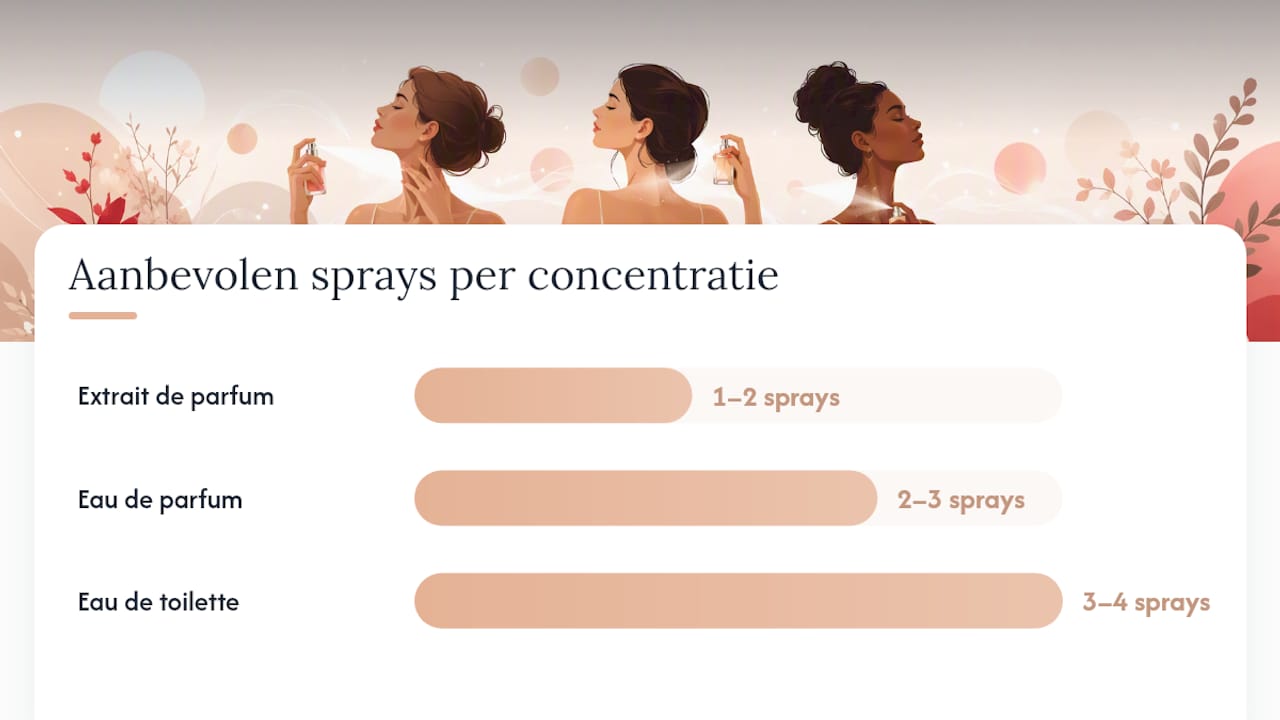
- With a higher concentration of perfume oil, 1 to 2 sprays are enough, while eau de toilette can be sprayed 3 to 4 times.
- Applying perfume to damp skin right after showering ensures longer-lasting, better scent performance.
- Never spray on delicate fabrics or in your hair; use alternatives such as spraying onto a brush or the inside of clothing.
- Don’t rub after spraying, because it damages the fragile top notes and disrupts the scent balance.
Table of contents
- Perfume application points: the complete list of pulse points
- How many sprays and which technique works best?
- Skin preparation: the step most people skip
- Perfume on clothing and hair: can you, and how do you do it safely?
- Common mistakes in fragrance etiquette
- My favorite combination for an evening that lingers
- Discreet, affordable, and ready for reapplication
- Sources
Perfume application points: the complete list of pulse points
Pulse points are places where blood vessels sit close to the skin. That extra warmth helps fragrance molecules evaporate faster, which is why perfume comes to life most clearly there. That’s exactly why perfumers and beauty editors like Glamour have been naming these spots as recommended zones for decades.
The best-known and most effective application points are:
- Wrists: easy to reach and ideal for checking how a scent develops.
- Neck: warmth and movement spread the fragrance at breathing height, perfect for close conversations.
- Behind the ears: subtle but consistently present—great for a discreet base scent at the office.
- Collarbones: capture warmth and work excellently under a blouse or shirt.
- Décolletage: creates a soft sillage that spreads as soon as you move—ideal for going out in the evening.
- Inner elbows: an underrated spot that holds scent without you constantly smelling it yourself.
- Knee creases: warm up when walking and let the scent gradually rise.
- Navel: warm and often covered by clothing, so the scent releases like a natural diffuser rather than immediately standing out.
For intimate moments, the décolletage and navel work best because they give off a soft, slowly releasing scent without being overpowering. For the office, you may prefer behind the ears and the inner elbows: subtle, but noticeable when someone comes closer. In the evening, you can be a bit freer with spraying on the neck and collarbones—spots that spread well in a busy space.
When spraying, keep 12 to 18 centimeters of distance between the bottle and your skin; that’s also what wikiHow recommends. At that distance, the liquid lands as a fine mist rather than a concentrated puddle, which improves how evenly a scent unfolds later.
How many sprays and which technique works best?
How many sprays you need depends entirely on the concentration of perfume oil in your bottle:
- Extrait de parfum (highest concentration): 1 to 2 sprays are more than enough.
- Eau de parfum: expect 2 to 3 sprays for a noticeable, long-lasting scent.
- Eau de toilette: due to the lower concentration, you can spray here more often—3 to 4 times.
These guidelines match wikiHow’s practical dosage advice, which uses the same distance and spray frequency per concentration type.
Pro tip: don’t skip the classic cloud-and-walk-through trick: spray once into the air in front of you and walk through it. That way you get an even, airy layer without overdoing it in one spot.
For targeted scent on specific pulse points, direct application works better than the mist method—especially for the décolletage or wrists. What you should never do: rub your wrists against each other after spraying. Perfumers warn that rubbing breaks the fragile top notes due to friction and heat, which disrupts the first impression of a scent—Glamour confirms this too. You can pat with your fingers, but don’t rub. Reapplying halfway through the day is completely normal, especially with eau de toilette, because factors like temperature and skin moisture strongly affect longevity.
Skin preparation: the step most people skip
A hydrated skin holds fragrance molecules significantly longer than dry skin, because moisture slows down evaporation. That’s why you should apply perfume as soon as possible after showering, on skin that still feels slightly damp.
The ideal routine looks like this:
- Shower and pat your skin dry without rubbing it completely.
- Apply an unperfumed body lotion to the pulse points, so your perfume scent doesn’t compete with another fragrance.
- Wait a few minutes for the lotion to absorb.
- Spray your perfume on the same spots.
For small, extra-dry areas like wrists or elbows, a thin layer of petroleum jelly can serve as a base. It creates a kind of barrier where fragrance molecules cling longer. Layering with a matching body lotion works best when you consciously stick to one fragrance line. If you prefer mixing different perfumes, it’s smarter to spray them on different areas rather than stacking them on top of each other—otherwise the final scent profile gets distorted.
Perfume on clothing and hair: can it, and how do you do it safely?
Textiles and hair hold onto scent longer than skin, simply because fibers release fragrance molecules more slowly than pores. That’s why a scarf after an evening out sometimes still smells like your perfume for days.
However, direct spraying isn’t always a good idea:
- Delicate fabrics like silk can get stains or discolor due to alcohol in the perfume.
- Spraying directly into your hair can dry it out, because the alcohol pulls moisture from hair fibers—Marie Claire warns.
- A safer alternative is to spray onto a hairbrush and then run it through your hair, or use a special hair mist with a lower alcohol percentage.
- If you still want to perfume clothing, spray the inside and keep enough distance to prevent stains.
Common mistakes in fragrance etiquette
Most fragrance complaints don’t come from the wrong perfume, but from applying it incorrectly. Watch out for these points:
- Never rub after spraying; just let the perfume dry on your skin.
- Adjust to the setting: in a small office or elevator, less is always better; outside or at a big party you can be a bit more generous.
- Avoid the face and eyes completely, and be extra careful if you have sensitive skin that may react to alcohol.
- Keep your bottle cool and dark, never in the bathroom—steam and temperature fluctuations break down the scent composition faster, as also advised by Meilleur Parfum.
- Spray again when needed, especially with eau de toilette, instead of starting off too heavily all at once.
My favorite combination for an evening that lingers
For going out in the evening, I always combine the décolletage with the neck and wrists: warm enough to wear, subtle enough not to overpower. My daily checklist is simple. First wash and moisturize your skin, then spray 2 to 3 times on pulse points, and if you have a long day, bring a small bottle for on the go. Consistency in those three steps does more for how long your scent lasts than any expensive brand.
— J
Discreet, affordable, and ready for reapplication
Want to keep those pulse points activated all day without constantly buying a new full bottle? Many affordable fragrance brands work with different concentrations of perfume oil, which affects how long the scent stays on your skin with fewer sprays. All fragrances are vegan and cruelty-free, without the inflated marketing costs you pay back with traditional perfume houses.
For reapplication at lunchtime or while traveling, a 30ml x4 perfume set is more practical than one large bottle: you always have a size on hand that fits in any bag. Want to test different scents right away on your own pulse points? Then check out the 3x100ml perfume bundle and start today with the combination that best suits you.
Sources
If you want to go deeper into dosage, skin preparation, and practical application, these sources are a great next step:
- Applying perfume (wikiHow)
- How to apply perfume correctly — Glamour
- Why you shouldn’t spray perfume in your hair — Marie Claire
- Comment mettre du parfum : les secrets d’une application parfaite