


Iso E Super is a synthetic fragrance ingredient that gives perfumes a soft, woody “halo”: a haze of scent that clings to the skin without being a clear, recognizable note. The molecule has been produced since the 1970s by IFF, and precisely because it works so subtly, not everyone smells it as strongly.
- Function: enhances diffusion and fixation in a composition
- Scent profile: dry, woody, amber-like, almost skin-like
- Specialty: part of the population experiences a form of smell blindness to this specific molecule
Iso E Super counts as one of the most used aroma chemicals in modern perfumery, precisely because it’s so unobtrusive while doing so much.
Key insights
Iso E Super works like a diffusive, skin-like woody note that gives perfumes radiance, but due to isomer differences, not every nose perceives it with the same intensity.
| Point | Details |
|---|---|
| Definition | Iso E Super® is a synthetic terpenoid from producer IFF, used as a woody radiance booster. |
| Scent experience varies | About 20 to 25% of people experience a form of smell blindness to this specific molecule. |
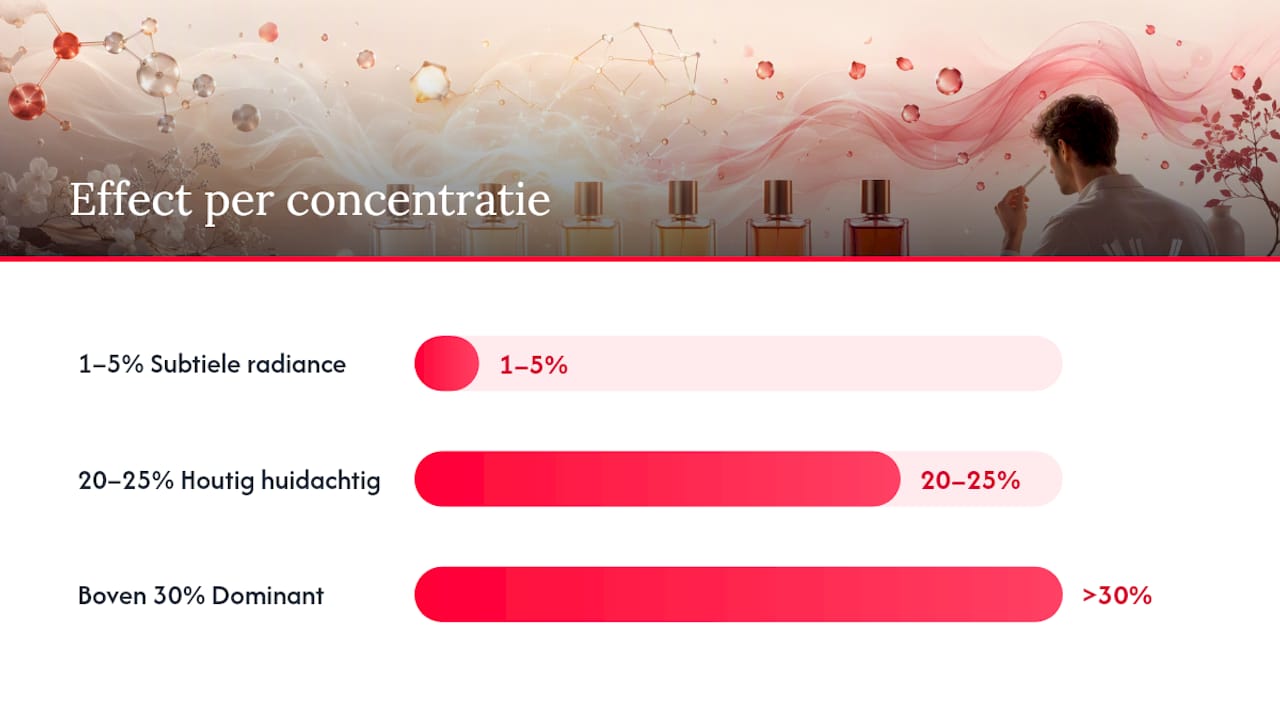
| Dosage steers character | Low concentrations subtly enhance; concentrations above 30% dominate the entire composition. |
| Safety | IFRA restricts use due to sensitizing properties; test new perfumes first on a small scale. |
| Test it yourself | Pureparfum offers bundles such as the 3x100ml perfume bundle so you can compare woody-amber-like profiles on your own skin. |
Table of contents
- What exactly is Iso E Super?
- How does Iso E Super smell, and why doesn’t everyone smell it?
- What role does Iso E Super play in a perfume composition?
- How is Iso E Super made, and which isomers matter?
- What does IFRA say about Iso E Super, and what should you watch out for?
- In which well-known perfumes does Iso E Super stand out the most?
- How do you test yourself whether you smell Iso E Super?
- Is Iso E Super actually a pheromone?
- Test different scent profiles yourself with a perfume bundle
- Sources
- Frequently asked questions
What exactly is Iso E Super?
Iso E Super® is the trade name that producer IFF uses for a synthetic compound from the terpenoid family, chemically known as 1-(1,2,3,4,5,6,7,8-octahydro-2,3,8,8-tetramethyl-2-naphtalenyl)ethan-1-on. IFF describes it as a “smooth, woody, amber” note with a velvety sensation, and positions it as an excellent floralizer and performance ingredient.
The ingredient is not only found in fine perfumery. You can also find it in:
- Eau de parfum and eau de toilette, as a base or as a diffusion component
- Body lotions and shower gels with a long-lasting scent trail
- Laundry detergents and household products, where scent longevity matters
| Feature | Given |
|---|---|
| Trade name | Iso E Super® |
| Producer | IFF (International Flavors & Fragrances) |
| Chemical family | Synthetic terpenoid |
| Physical form | Colorless to light-yellow liquid |
How does Iso E Super smell, and why doesn’t everyone smell it?
The scent is hard to capture in a single word. Perfumers describe it as soft, woody, amber-like, and skin-like, with a velvety texture that you feel more than you smell. Wikiparfum calls it a radiance booster: it strengthens other notes without stepping to the front.
This “invisible” character has an explanation. Iso E Super consists of a mixture of isomers, and not every nose receptor reacts to it with the same strength. Première Peau reports that about 20 to 25% of people experience anosmia for this specific molecule: they barely smell it or only after a while, while others feel it hanging immediately as a clear cloud around them.
- Soft, woody, amber-like, skin-like, velvety
- Detection threshold varies greatly from nose to nose
- Skin chemistry influences how strongly it unfolds
Pro tip: Always test Iso E Super on your own skin and not just on a scent strip. Your skin oil and temperature help determine how the molecule unfolds, and that difference is greater for this fragrance ingredient than for most others.
What role does Iso E Super play in a perfume composition?
Within a formula, Iso E Super rarely acts as the main star. It works as a diffusion enhancer, gives a composition a “ring” or radiance effect around the wearer, and extends the longevity of more volatile top notes. Perfumers often call it indispensable for modern diffusion, precisely because compositions without this kind of aroma chemical often feel flat, as shown in interviews collected by The Perfume Society.

Dosage strongly determines how the scent behaves:
| Concentration | Effect in the composition |
|---|---|
| 1 to 5% | Subtle radiance, supports other notes without being recognizable on its own |
| 20 to 25% | Clearly woody, skin-like character, often the base of “skin scent” perfumes |
| Above 30% | Dominates the composition, as in some minimalist, single-molecule fragrances |
In the base, Iso E Super pairs well with ambroxan for extra amber depth, with sandalwood for a creamier woody profile, with white musk notes for a cleaner finish, and with citrus accents to make the opening feel lighter. Formulators rarely use it alone: it’s a connecting element, not a soloist.
How is Iso E Super made, and which isomers matter?
Iso E Super is created via a Diels-Alder reaction from a myrcene derivative, a synthetic route that goes back to terpene chemistry. The final product is never a single pure substance, but a mixture of isomers, and that mixture largely determines how the scent behaves.
A scientific review describes Iso E Super® as a textbook example of a successful synthetic terpenoid. Of the isomers found in the commercial blend, a small portion—often referred to as the gamma isomer or under the brand name Arborone—contributes the largest share of the perceived fragrance intensity. The alpha and beta variants are less odor-carrying but help determine the texture.
- Synthesis via Diels-Alder from terpene derivatives
- Mixture of multiple isomers, not a single pure compound
- A small isomer fraction accounts for most of the perceived scent
This uneven distribution also explains why qualities such as Iso E Super Plus or variants like Georgywood smell slightly different: the ratio between isomers shifts, and with it the intensity your nose picks up.
What does IFRA say about Iso E Super, and what should you watch out for?
Iso E Super is not separate from regulations. The International Fragrance Association (IFRA) restricts the use of this fragrance ingredient in certain product categories due to possible sensitizing properties, as The Perfume Society reports. That doesn’t mean the substance is dangerous in normal use, but it does mean formulators must adhere to maximum concentrations depending on the type of product and skin exposure.
For people with sensitive skin, that’s a practical point to keep in mind:
- Check the ingredient list if you’re unsure about previous skin reactions
- Test a new perfume first on a small area of skin, for example the inside of your wrist
- If in doubt, wait 24 hours before using a scent on a larger scale
At normal, IFRA-compliant concentrations in commercial perfumes, the risk of a reaction is small, but not zero. People with a known fragrance allergy or eczema would do well to test new products on a small scale first, regardless of which fragrance ingredient is in them.
In which well-known perfumes does Iso E Super stand out the most?
The clearest illustration of what Iso E Super can do on its own is a perfume that leans almost entirely on this one molecule. Such minimalist, single-molecule fragrances show the exact “flickering” effect: some wearers smell an intense, woody cloud, while others smell almost nothing.
In more well-known designer and niche compositions, the substance also plays a recognizable role—each time as a building block, not as the only note:
- A well-known men’s fresh scent builds part of its signature dryness on Iso E Super
- A woody-oriental composition uses it as the base for a sensual, skin-like finish
- Various unisex fragrances with a cedar-like, musky character rely heavily on this molecule for their radiance effect
- A well-known French travel fragrance combines it with grapefruit and cedar for a fresh-woody signature profile
These examples mainly show how dosage steers perception: high concentrations give a pronounced, almost abstract woody scent, while low concentrations work more unobtrusively as an enhancer.
How do you test yourself whether you smell Iso E Super?
You don’t need a laboratory to find out how your nose reacts to this molecule. A few simple steps already give a clear picture.
- Spray a fragrance with a known high Iso E Super content on your wrist, not on a strip.
- Wait two to three minutes until the top notes have evaporated.
- Smell first up close, then at about thirty centimeters away: the “flickering” effect is exactly in that difference.
- Note whether the scent stays present, disappears, or becomes stronger as you smell farther away.
- Repeat with a second, contrasting fragrance to keep your reference point sharp.
Pro tip: Build in breaks of a few minutes between two sniff tests. Your olfactory system gets saturated quickly, and that especially distorts your judgment with a subtle substance like this.
Is Iso E Super actually a pheromone?
No. There is no solid scientific evidence that Iso E Super is a pheromone in a biological sense, despite persistent online claims about this topic. Experts point out that the substance has strong olfactory effects, but no proven biological pheromone function—just as Fragrantica describes.
The confusion is understandable. The skin-like, warm character of the molecule, combined with unpredictable perception between different noses, fuels the idea that something invisible and biological is going on. The real explanation is chemistry: isomer composition, individual odor thresholds, and skin interaction fully explain the effect without needing a pheromone mechanism.
- No proven pheromone effect, but a strong olfactory effect
- Perception differences come from isomer chemistry, not biological signals
- The “invisible” character is partly why it attracts myth-making
A brief consideration
If you truly want to know how Iso E Super works on your own skin, don’t read reviews—test it yourself. A sample gives more insight in a few days than ten descriptions, precisely because skin chemistry is so personal. If you want to combine that with a broader exploration of scent profiles, Pureparfum offers a practical, affordable way to do so.
Test different scent profiles yourself with a perfume bundle
Want to discover whether your skin reacts strongly or barely to a woody-amber-like profile such as Iso E Super? Then you need multiple fragrances to compare, not just one standalone bottle. Pureparfum sells vegan, animal-friendly perfumes with a high concentration of perfume oil at an affordable price, so you can experiment without a high purchase barrier.
The 3x100ml perfume bundle is a logical choice for that: three full-fledged scents side by side give you an immediate frame of reference to determine which woody or amber-like notes work on your skin. For those who prefer to test smaller first, the 30ml x4 perfume set offers four concentrations to compare without immediately buying a large bottle. Keep in mind that skin chemistry varies a lot: what gives one person a subtle haze may smell much more pronounced on someone else. View the range and order the bundle that fits your testing needs.
Sources
- Iso E Super — IFF ingredients compendium
- Iso E Super - The Perfume Society
- Synthetic terpenoids in the world of fragrances: Iso E Super® is the showcase - ScienceDirect
- Iso E Super: the molecule you can’t smell | Première Peau
- Iso E Super – scent profile & best perfumes
Frequently asked questions
What exactly is Iso E Super? Iso E Super is a synthetic terpenoid from producer IFF, used in perfumery as a woody, amber-like radiance booster.
Why don’t I smell Iso E Super in some perfumes?
Is Iso E Super safe for the skin? At IFRA-compliant concentrations in commercial perfumes, the risk of reactions is small, though testing on a small area of skin is still sensible for sensitive skin.
In which perfumes is there a lot of Iso E Super? Various minimalist single-molecule fragrances and multiple woody, musky designer compositions use the substance as a dominant or supporting note.
Is Iso E Super the same as a pheromone? No, there is no evidence for a biological pheromone effect. The strong perceptual effects come from isomer chemistry, not from pheromones.