


First, identify your fragrance family, then test 2 to 4 scents with samples: that gives you a reliable first impression within a single day. Choose consciously between eau de toilette and eau de parfum, because the concentration determines how long and how intensely your fragrance lingers. A 20-milliliter trial set, such as the vegan 20ml x5 perfume set from Pureparfum, is an affordable way to discover what works without risk.
In short:
- Choosing the right fragrance family helps you quickly determine which perfumes match your personality and preferences.
- Developing a fragrance profile on your skin requires testing at different times and making notes in a scent logbook.
- Concentrations such as eau de parfum and eau de toilette differ in duration and intensity, making them suitable for different occasions.
- Season and time of day influence how a fragrance is experienced, which is why lighter scents are ideal for summer and heavier ones for winter.
- Samples and discovery sets offer a smart way to discover and compare your favorite scent at home without risk.
Table of contents
- Which fragrance families exist and how do you recognize them?
- How does a perfume develop on your skin?
- How do you test perfume without getting scent fatigue?
- How do you determine your personal fragrance profile?
- Which perfume concentration fits your use?
- Where can you get samples and reliable discovery sets?
- What role do season and time of day play in your fragrance choice?
- How do you take allergies and sensitive skin into account?
- How do you store perfume so the scent lasts?
- Why a scent logbook is your best tool
- Start your search with a discovery set from Pure Parfum
- Sources
Which fragrance families exist and how do you recognize them?
For decades, perfume houses and drugstores have grouped fragrances into the same families, and that classification is your fastest route to a fragrance profile that matches your personality. Once you know the family, you can browse within a few minutes to see which bottles are worth it and which you can skip.
- Floral: jasmine and rose take the lead—romantic and refined, popular with anyone looking for a classic, feminine scent.
- Fresh and citrus: bergamot and lemon provide energy, ideal for warm days or daytime at work.
- Fruity and gourmand: vanilla and caramel make the fragrance playful and tempting—often a favorite with a younger audience.
- Spicy and oriental: cinnamon and amber bring warmth and sensuality, strongly present and suitable for the evening.
- Woody, fougère, and chypre: sandalwood, vetiver, and patchouli create a mature, serious look that often lasts longer.
Most people feel at home in one or two families. Are you torn between floral and fruity? Start with samples from both directions before you narrow down to specific scents.
How does a perfume develop on your skin?
A perfume is not a fixed whole, but a scent that changes in phases—and that’s exactly why you should never rely on the first impression. The top notes you smell in the store are already gone within a quarter of an hour.
- Top notes: the first impression, often citrus or light spices, evaporate within 10 to 15 minutes.
- Heart notes: the real character of the fragrance, noticeable after 30 to 60 minutes, usually floral or spicy.
- Base notes: the depth and longevity, noticeable after 3 to 6 hours, often woody, musky, or vanilla.
A good assessment requires notes at multiple moments: right away, after half an hour, and after a few hours—so you learn to recognize your top, heart, and base notes separately. Skin chemistry plays a big role: a dry or oilier skin type affects how quickly notes evaporate, meaning the same fragrance can smell different on you and on a friend. That’s why you should always test on your own skin, never just on a card.
How do you test perfume without getting scent fatigue?
Your nose gets tired faster than you think, and that distorts every judgment after the fourth fragrance. Follow these steps for a reliable test:
- Make sure you have a neutral environment: no strong coffee, food, or other perfume beforehand, and ideally fresh air.
- Smell a blotter first to get an initial impression, then test the scents that appeal to you on your skin.
- Limit yourself to a maximum of 3 to 4 fragrances per session, because after that your nose can no longer distinguish differences as well.
- Write down your impression right away, repeat it after 30 to 60 minutes, and again after a few hours.
Pro tip: Keep a small scent logbook with date, brand, and your impression per phase. After a few weeks, you’ll see a pattern in which notes keep coming back—and that pattern is your true fragrance profile.
Combine this with discovery sets so you can test at home, at your own pace, without the time pressure of a store visit.
How do you determine your personal fragrance profile?
A quick self-scan will take you far, as long as you combine it with real skin tests. Ask yourself these questions:
- Which notes attract you: fresh, sweet, spicy, or woody?
- Do you wear the fragrance during the day at work, or mainly in the evening?
- Do you want to stand out or stay subtle?
- Do you prefer a fresh budget, or do you go for something more luxurious?
- Who are you choosing it for: yourself, as a gift, or for a special occasion?
Translate your answers into two or three fragrance families that overlap. For example, if you want something fresh and subtle, you’ll probably land on citrus or light woody notes. Shopping quizzes like the Fragrance Finder by ICI Paris XL are a handy starting point, but they often give broad suggestions. Use the result as a filter, not as a final verdict, and always confirm with a real skin test before you buy.
Which perfume concentration fits your use?
The concentration of perfume oil determines how long and how intensely a fragrance lingers, and that difference is bigger than many people think.
- Perfume or extrait: the highest concentration; it often lasts 8 hours or longer, suitable for special occasions.
- Eau de parfum (EdP): a good middle ground, ideal for everyday wear with long-lasting scent.
- Eau de toilette (EdT): lighter and fresher, perfect for warm days or the office.
- Cologne: the most subtle variant, suitable for a short, fresh boost.
For a daily occasion, spray a few times on pulse points such as your wrists and neck; for the evening, you may consider an extra spray on clothing. In summer, lighter, citrus, or aquatic compositions are more practical, while heavier, richer fragrances in winter evaporate more slowly due to the lower temperature—so they come into their own better.
Where can you get samples and reliable discovery sets?
In physical stores, simply ask for samples or decants: most sellers give them for free or for a few euros. Online, you’ll often find more extensive discovery sets with multiple fragrances in small bottles—ideal for testing calmly at home.
- Always ask for samples before considering a large bottle.
- Order a discovery set if you want to compare multiple fragrances at once.
- Check the return and sample policy of a webshop before you order.
- Choose small formats intentionally: a trial set with blotters and skin tests prevents a disappointing purchase of 50 to 100 milliliters.
Webshops that are affiliated with an industry organization or carry a certification mark often offer clearer terms for samples and returns. That’s not a guarantee, but it is a useful checkpoint before you leave your personal details and money somewhere.
What role do season and time of day play in your fragrance choice?
A scent that feels perfect in December can suddenly feel heavy and oppressive in July. Temperature and humidity affect how quickly fragrance molecules evaporate, and that changes the entire experience of a perfume.
In winter, you can wear richer, spicy, or woody compositions without them becoming overpowering, because the cold slows down diffusion. In summer, it’s exactly the opposite: warmth intensifies every fragrance, so a heavy oriental bottle that was subtle in January can stand out after just a few meters in August. Lighter, fresh, or citrus-like fragrances are then a safer choice.
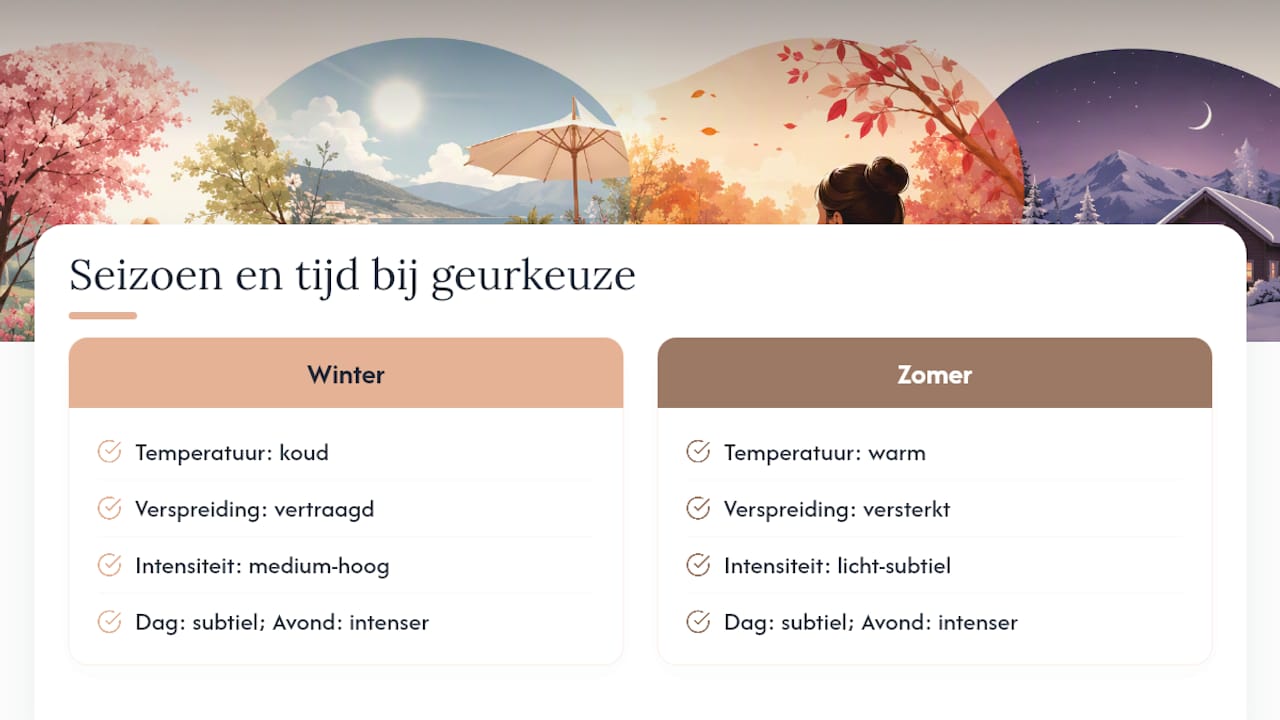
Time of day also matters, regardless of the season. During the day, at the office, or during lunch, a subtler scent fits better than in the evening during dinner or going out, where you can confidently use something more intense and spicier. That’s why many people build a small wardrobe: a fresh scent for daytime, something warmer for the evening, and a separate option for the summer months. That may sound excessive for those just starting out, but once your own fragrance family is established, it’s simply a matter of two or three bottles side by side in the closet.
How do you take allergies and sensitive skin into account?
Perfume consists of dozens to hundreds of aromatic substances, and some of them can cause irritation, redness, or itching in sensitive skin. If you’ve reacted to cosmetics or fragrance ingredients before, it’s best never to test a new bottle blindly on your skin.
In that case, test first on a small area of skin—such as the inside of your wrist—and wait at least 24 hours before wearing the scent more broadly. If your skin stays calm, you can proceed with confidence to a normal test with a blotter and skin contact. When in doubt, a dermatologically tested product or a fragrance with a more limited list of ingredients is a safer choice than a heavily composed oriental blend.
People with very sensitive skin often consciously choose a lower concentration, such as eau de toilette instead of extrait, simply because less perfume oil ends up on the skin per spray. Also, if you’ve had reactions more often, it’s better to spray on clothing rather than directly on your skin. If you’re seriously unsure, consult a dermatologist before using a new fragrance for a long time, especially if you have existing eczema or a known perfume allergy.
How do you store perfume so the scent lasts?
A perfume bottle lasts for years, as long as you treat it well. Light, heat, and humidity are the biggest enemies of fragrance molecules, and yet most bottles are simply kept on the bathroom windowsill.
Store your perfume in a dark, cool place, such as a cabinet or drawer, away from the bathroom mirror where steam and temperature fluctuations break down the composition faster. Keep the cap tightly closed at all times to limit oxidation from air, and avoid unnecessary shaking, because it speeds up contact between fragrance ingredients and oxygen.
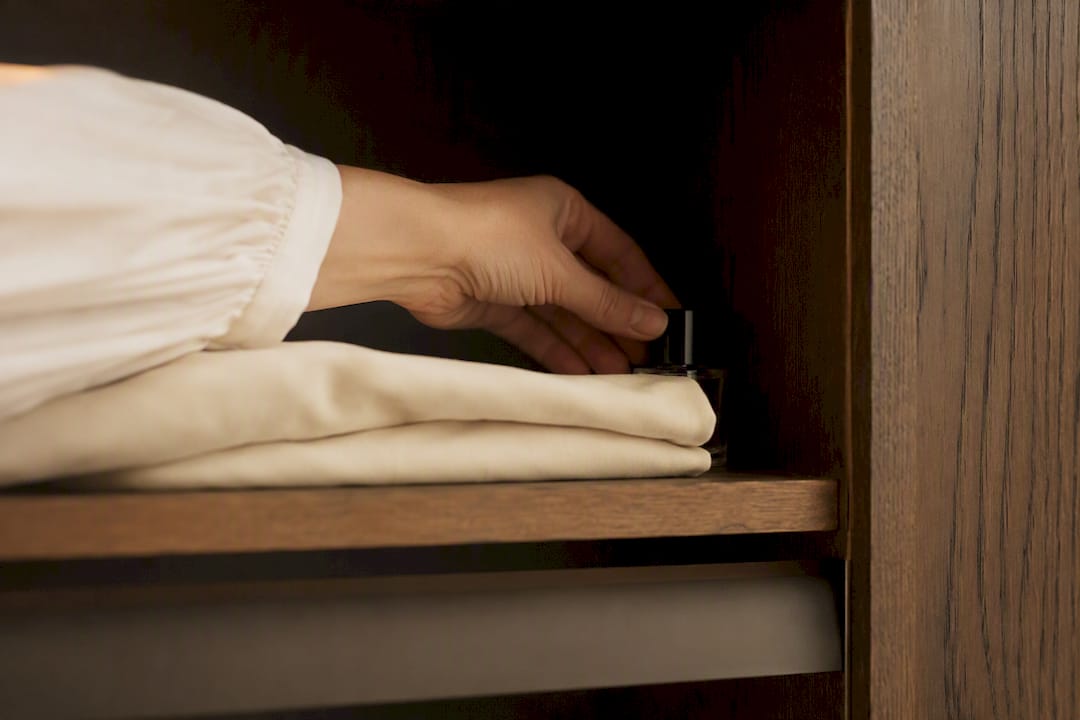
An unopened bottle typically stays stable for years, but once you open it, the clock starts ticking—subtly. If you notice that the top notes disappear faster than before, or that the liquid’s color becomes darker, that’s a sign the fragrance is slowly changing. That’s why you should use perfume actively instead of leaving it unused for years: fragrance is meant to be worn, not collected.
Why a scent logbook is your best tool
Anyone seriously looking for their fragrance profile often underestimates how many impressions you forget again after a few weeks. I keep seeing the same pattern: people test enthusiastically ten fragrances in two weeks, and a month later they can’t remember what each scent actually did on their skin.
A simple logbook with date, brand, and your impression at three moments prevents that. After a few weeks, you’ll naturally see which notes keep coming back—and that is your true fragrance profile, not the answer a quiz gave you. Consistency in testing ultimately leads to a signature scent you never doubt again.
— J
Start your search with a discovery set from Pure Parfum
Hesitating between ten fragrances and buying a costly 100-milliliter bottle each time just to find out it doesn’t click—that’s exactly the problem a discovery set solves. Pure Parfum makes vegan, animal-friendly perfumes with a higher oil concentration than many other affordable scents, inspired by well-known designer fragrances. At a price that doesn’t include the markup for expensive packaging and marketing.
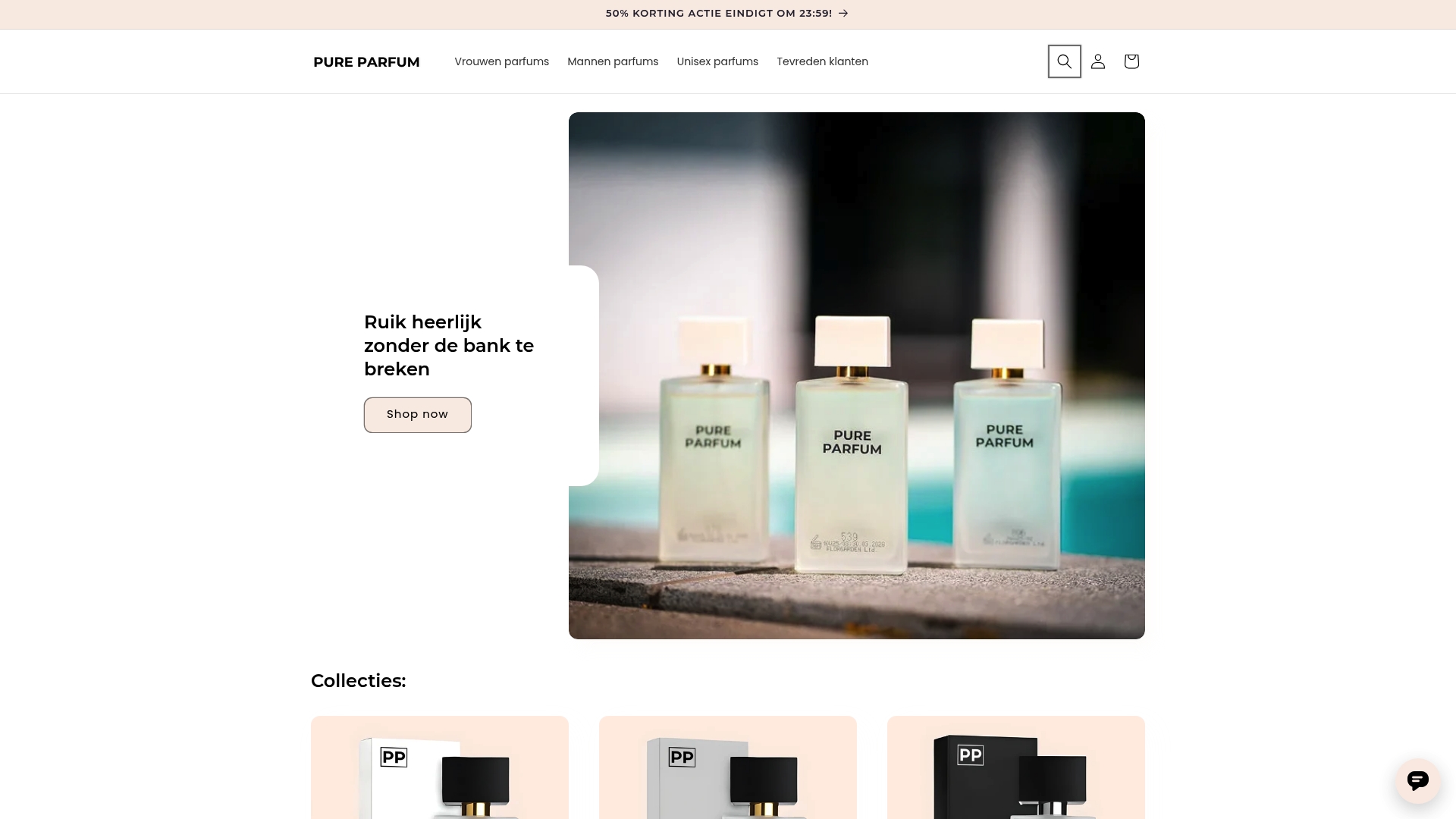
Don’t start with a large bottle, but with the 20ml x5 perfume set: five small bottles that let you confirm your fragrance family at your own pace, at home, without store pressure. If you want to bring a few favorites home right after the testing phase, the 30ml x4 perfume set is the logical next step. Thousands of positive reviews confirm that the combination of vegan composition and long-lasting scent resonates with a broad audience. View the full range at Pure Parfum and order your first trial set today.
Sources
Want to go deeper before you buy? Etos’ fragrance guide clearly explains fragrance families, while Parfumdeal.nl offers an extensive testing protocol. For extra inspiration and fragrance notes, you can consult the Fragrantica perfume finder, although your own skin test will always be the final word.