

Yes, fine fragrances can sometimes deliver measurable benefits, but not always enough to justify the price difference. The biggest gap is in the drydown: the final, longest phase of a fragrance, where more expensive formulas often stay more complex and stable. During the opening phase of 0 to 2 hours, good budget options and luxury bottles often smell surprisingly similar. Check the label for “Eau de Parfum”, smell the base notes, and always test on your skin before paying more than you need.
In short:
- In the first few hours, budget and luxury bottles often seem almost the same, unless you pay attention to base notes and the dry phase that can stay complex for a long time.
- The difference between expensive perfumes and budget versions lies mainly in the amount of perfume oil and the origin of the ingredients, not in the brand name on the bottle.
- Blind tests show that in the early hours the difference is small, but in the drydown phase it becomes clearer, especially with fragrances that have long-lasting base notes.
- A higher price is usually justified by rare natural ingredients, special bottles, and marketing costs—not by the scent itself.
- For everyday wear, a good budget EDP is usually enough, while luxury perfumes truly last longer when worn for many hours.
Table of contents
- Technical difference: concentration, ingredients, and why the scent changes
- Longevity and projection in practice: what blind tests show
- What you pay for with expensive perfumes: a transparent cost breakdown
- Guidance: when to splurge and when to save
- How to test and choose a good budget perfume (and make your expensive one last longer)
- The influence of brand name and exclusivity on price and perception
- Psychological aspects of expensive vs. cheap perfumes
- Environment and ethics: how sustainability affects the price of perfume
- Author perspective and brand positioning: how Pure Parfum looks at value for money
- More fragrance value for your money with perfume bundles
- Sources
- Frequently asked questions
Technical difference: concentration, ingredients, and why the scent changes
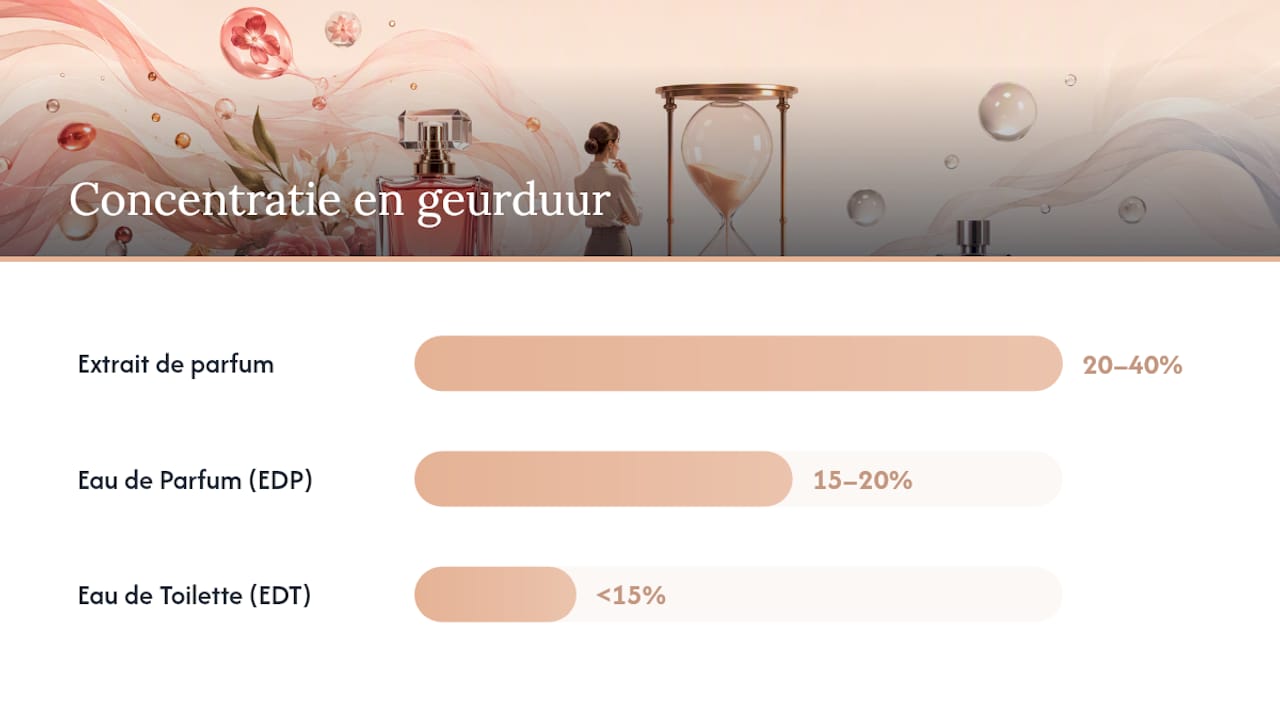
The difference between an expensive perfume and a budget version starts with the concentration of perfume oil, not with the brand on the bottle. Extrait de parfum typically contains 20 to 40% perfume oil, Eau de Parfum (EDP) is between 15 and 20%, and Eau de Toilette (EDT) usually stays below 15%. More oil means more fragrance molecules per spray, resulting in a more intense scent that lasts longer on the skin.
The second factor is the origin of the ingredients. Natural absolutes, such as rose oil from Bulgaria or oud from Cambodia, are expensive to obtain and unstable in quality from one harvest to the next. Synthetic molecules are more consistent, cheaper, and often just as intensely aromatic, but they sometimes lack the layering you naturally get from a natural extract. That’s not necessarily a disadvantage: many of the best-known iconic fragrances—such as Hypnotic Poison and Shalimar—combine natural and synthetic building blocks to achieve a complex drydown that evolves over hours.
A complex drydown is created by multiple scent layers that evaporate one after another. Top notes disappear within 15 to 30 minutes, heart notes dominate the first few hours, and base notes such as musk, amber, and patchouli determine what remains after 4 to 6 hours. The more long-lasting base notes a formula contains, the longer—and more interesting—the fragrance unfolds.
When assessing a bottle, look for these signals:
- Concentration indication: EDP or extrait usually means more oil than EDT or cologne.
- Price per milliliter: a low price for a large bottle can indicate a lower oil percentage, not automatically worse ingredients.
- Base notes on the packaging: amber, musk, vetiver, and patchouli usually last longer than citrus or herbal top notes.
- Brand origin versus production: some budget brands have their perfumes made in the same factories as luxury houses, using similar base formulas.
Longevity and projection in practice: what blind tests show
Blind tests confirm a pattern many fragrance lovers already suspect: in the first hours, the difference is small, but later it gets bigger. In comparative tests between originals and dupes, it was found that three out of the five tested dupes were hardly distinguishable from the expensive original in the first two to three hours. Only in the drydown phase, when the base notes take over, did the difference increase.
A concrete example makes this tangible. In a skin test, a supermarket dupe costing €12 lasted 6 hours and 15 minutes, compared with 7 hours for the luxury original at €110. A difference of 45 minutes over a total wear time of several hours is almost unnoticed in practice.
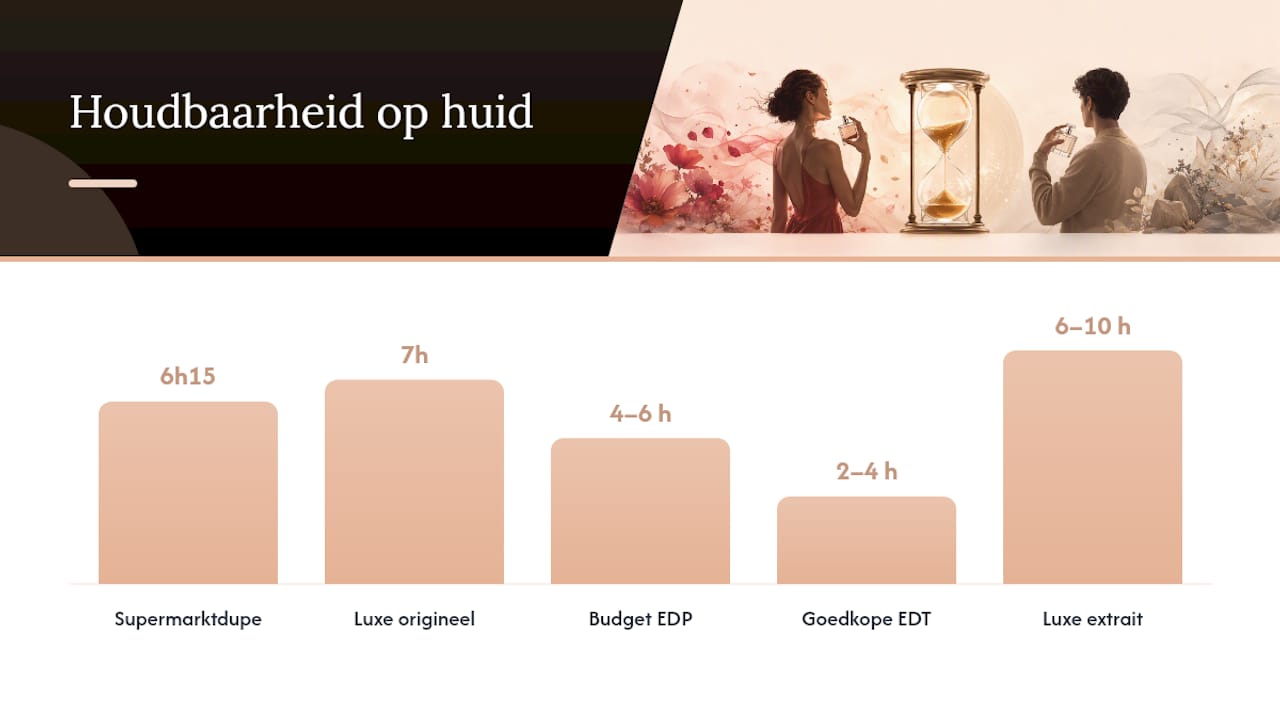
What can you expect in terms of hours? A good budget EDP typically lasts 4 to 6 hours on the skin. A cheap EDT often fades after 2 to 4 hours. A luxury extrait or a high-quality EDP can last 6 to 10 hours, with sillage softening over time but remaining present.
Three factors influence this result more strongly than the brand on the bottle:
- Skin type: oily skin holds fragrance molecules longer than dry skin, which makes perfume evaporate faster.
- Environmental factors: warmth and humidity strengthen sillage, while dry cold significantly weakens projection.
- Application method: spraying on moisturized skin or clothing keeps the scent longer than spraying on dry, clean skin.
An editorial analysis by Libelle confirms that longevity is not automatically tied to price, and that test method and expectation are at least as defining as the formula itself. For everyday use, in the office, or during a normal day, most people won’t notice the difference between a good EDP at €20 and a luxury bottle at €150. On a long night out, when you’re 8 hours away without reapplying, that extra longevity really matters.
What you pay for with expensive perfumes: a transparent cost breakdown
The price of a perfume consists of more than just fragrance oil. Journalistic analyses show that marketing and packaging often determine a larger part of the price than the ingredients themselves. With major luxury brands, a significant portion of the budget goes to advertising campaigns, famous ambassadors, and photo shoots—not to the liquid in the bottle.
The cost breakdown roughly looks like this:
- Ingredients and concentration: rare natural absolutes and a higher oil percentage cost more to produce than synthetic, cheaper alternatives.
- Packaging and bottle: a heavy glass bottle with a metal cap and a luxury box can swallow up dozens of euros of the cost—without adding anything to the scent.
- Marketing and distribution: campaigns, store displays in perfumeries, and middlemen drive the sales price up significantly compared with production costs.
- R&D and the perfumer: putting together a new formula takes months to years of work by a specialized nose, and that creative labor is passed on.
A higher price is justified when it’s actually in the bottle: an extrait with an exceptionally high oil percentage, a limited edition made with rare natural absolutes, or a fragrance designed by a renowned perfumer with a unique signature. Analyses of dupes and their production model show that budget brands often use the same or similar fragrance molecules, but save on exactly the cost items that have nothing to do with the scent itself.
Guidance: when to splurge and when to save
The right choice doesn’t depend on your budget alone, but on the situation in which you’ll wear the fragrance. For everyday use, at work, or while running errands, a reliable budget EDP is often exactly enough. For a signature scent you’ll associate with who you are for years, or for a special occasion like a wedding or gala, it’s worth investing a bit more in a formula with a longer drydown and more depth.
Ask yourself these questions before you buy:
- Do you spray it on your skin, not on a card? Paper testers give a distorted picture; the fragrance reacts differently with your skin chemistry than with cardboard.
- Do you wait at least 30 minutes before deciding? Top notes disappear quickly and tell you little about how the fragrance develops later.
- Do you check the base notes on the packaging or website? Amber, musk, and patchouli often indicate a longer, more stable drydown than citrus or herbal notes alone.
- Do you wear it all day, not just in the store? A fragrance that smells great in the shop can feel completely different after three hours on your own skin.
Pro tip: Keep your test bottles and samples in a small box with the date on it. After a week, you’ll know exactly which fragrance truly suits your skin, instead of relying on your first impression in the store.
A smart mix strategy works best for most price-conscious lovers: use affordable dupes for everyday wear and reserve one or two originals for special moments. In the long run, you save significantly without sacrificing fragrance enjoyment, because you spray the more expensive bottle less often and it lasts longer.
How to test and choose a good budget perfume (and make your expensive one last longer)
A good testing routine starts with one spray on your wrist or the inside of your elbow—never multiple sprays at once. Wait at least 30 minutes before forming an opinion, because the first impression comes from fleeting top notes that don’t tell you anything about the final drydown. Only compare after a few hours with a second fragrance on your other arm.
When buying, always check the concentration indication: EDP is preferable to EDT if longevity matters, even within the budget segment. Also look at the base notes listed on the label or product page. Musk, amber, vanilla, and woody accords usually last longer than light floral or citrus notes.
To help expensive perfumes last longer, these techniques can help:
- Layer on moisturized skin: an unfragranced body lotion holds scent molecules better than dry skin.
- Spray on clothing and hair: fabric and hair often hold fragrance longer than skin, though it can stain light fabrics.
- Store bottles dark and cool: light and heat break down fragrance molecules faster, which can affect the quality of a costly bottle.
Pro tip: If you’re unsure, buy a smaller bottle or a sample set first instead of the full size. This way you can test several fragrances within the same budget and prevent leaving an expensive bottle half-empty because you don’t like the scent after all.
The influence of brand name and exclusivity on price and perception
A well-known logo on the box can increase the price by dozens of percent without changing the formula. Exclusivity works as a separate selling point: limited editions, niche houses, and limited batches intentionally play on scarcity—making consumers willing to pay more, regardless of what’s actually inside the bottle.
That also explains why two perfumes with similar base notes and concentration can be priced completely differently. A major fashion house charges for the name, the retail experience, and the campaign with a famous face. A smaller or lesser-known brand has to compete on price, even if the fragrance quality is comparable or sometimes even better tailored to a specific target audience.
For price-conscious buyers, this is exactly where the savings can be made: fragrance value isn’t tied to the logo’s fame. Brands that deliberately don’t spend money on celebrities, expensive shop windows, or glossy campaigns can pass those savings directly on to a higher concentration of perfume oil inside the bottle.
Psychological aspects of expensive vs. cheap perfumes
An expensive perfume almost always carries a status story, regardless of how objectively the scent performs. The feeling of a heavy bottle in your hand, a recognizable logo, and the association with a well-known ambassador influence how you experience the fragrance even before you smell it.
Research into consumer behavior around luxury products consistently shows that price colors the perception of quality: people often judge the same fragrance more positively when they know it’s more expensive. The effect works the other way around too. If someone knows a fragrance comes from the supermarket, they’re unconsciously inclined to judge it more critically, even if a blind test shows no real difference.
For price-conscious lovers, this is a useful realization. The pleasure of a luxury bottle on your dresser is real and can be part of your choice, but it’s a different kind of value than fragrance quality. If you clearly distinguish between “I enjoy the ritual and the brand” and “this scent objectively smells better,” you can make more conscious—and usually cheaper—choices without losing the enjoyment.
Environment and ethics: how sustainability affects the price of perfume
Sustainability and animal testing play an increasingly large role in how perfume prices are determined, in two directions at the same time. Natural, ethically harvested ingredients like fair-trade vanilla or sustainably sourced sandalwood are often more expensive than synthetic alternatives, which drives up the price of some premium fragrances.
At the same time, more and more brands deliberately choose vegan and animal-friendly formulas without necessarily making the price higher. Synthetic musk- and amber-like molecules replace animal-derived ingredients such as civet or ambergris, creating both ethical and financial benefits: no animal suffering and often a lower cost than the rare natural variant.
For environmentally conscious buyers, this is relevant when judging a price tag. A higher price doesn’t automatically say anything about sustainability, and a low price doesn’t automatically mean a compromise on ethics. More affordable brands increasingly combine vegan, animal-friendly recipes with a sharp price—precisely because they save on packaging and marketing rather than on the ingredients themselves.
Author perspective and brand positioning: how Pure Parfum looks at value for money
The assumption that price and fragrance quality are linearly connected doesn’t hold up on closer inspection. Blind tests repeatedly show that the real difference lies in the details: drydown, concentration, and the care taken in the formula—not the logo on the box. Pure Parfum is built on exactly that insight: vegan, animal-friendly perfumes at affordable prices, without the costs of expensive marketing and unnecessary packaging. This choice isn’t a compromise on quality, but a deliberate cut in cost items that add nothing to the fragrance itself. Anyone who tests critically instead of buying by name discovers that the biggest fragrance value often sits where you least expect it: in the bottle, not in the box around it.
— J
More fragrance value for your money with perfume bundles
Want to try multiple fragrances without always paying a full price? Pure Parfum works with bundles designed specifically for that: more bottles, more variety, and a sharper price per milliliter than a standalone bottle from a designer brand. The 3x100ml perfume bundle is ideal if you want larger bottles for everyday use, while the 30ml x4 set gives you the space to test four fragrances side by side before you commit to your favorite.
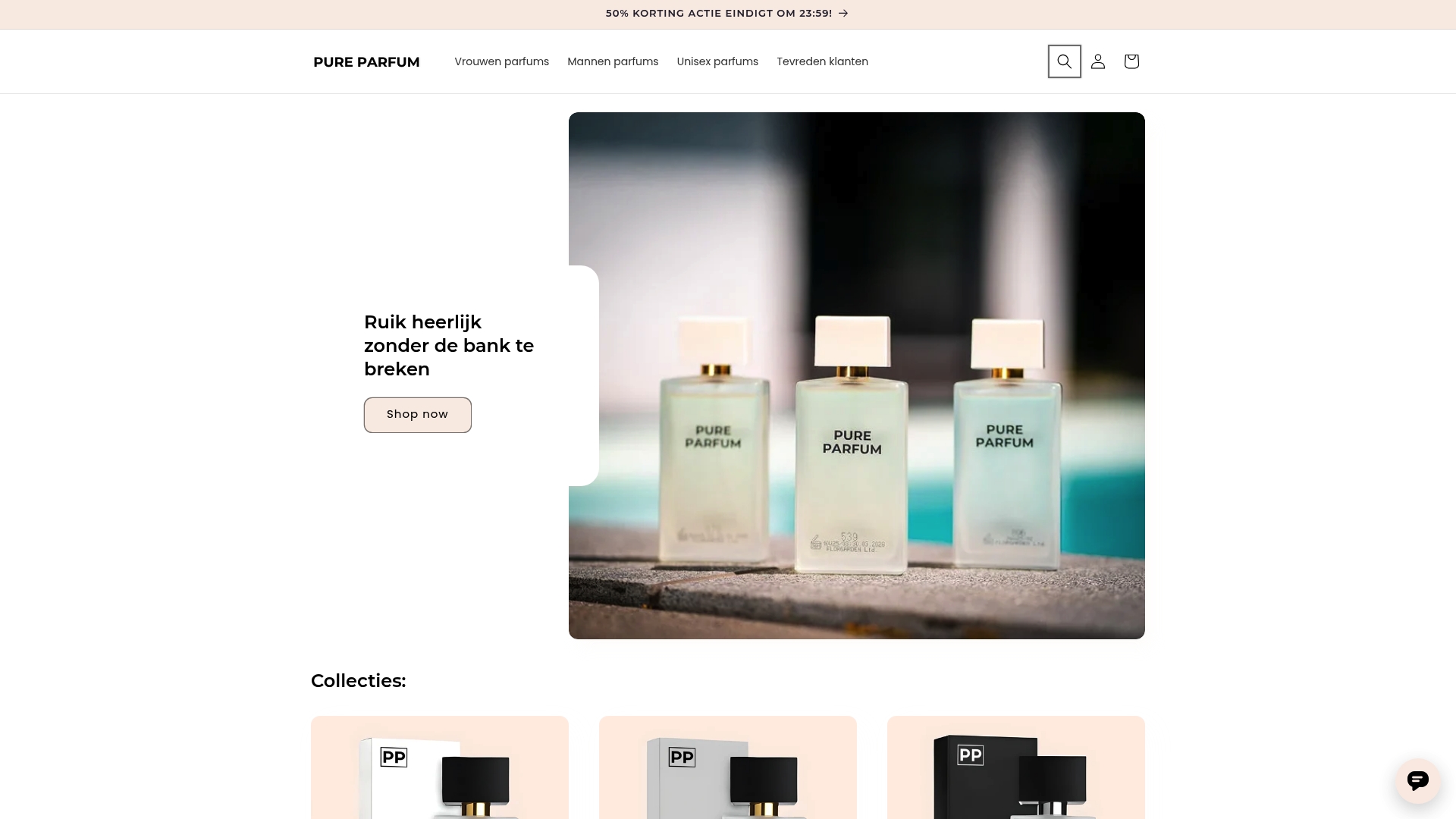
Each Pure Parfum fragrance is made with a higher concentration of perfume oil than many budget brands, without the cost of a heavy flacon, a glossy campaign, or a famous face on the ad. That saving goes directly to what’s in the bottle—not to what’s around it. Curious how that smells in practice and how long it lasts on your own skin? Check out the 100ml x3 perfume set and order your first set today to test the difference for yourself.
Sources
For anyone who wants to verify the claims in this article themselves, these sources are the starting point. The blind test of five dupes versus originals shows concretely where scent differences come from. The supermarket test on testsdeproduits.fr provides hard hour-by-hour figures for a budget option versus a luxury bottle. Margriet explains the cost breakdown behind a perfume price clearly, and Elle illustrates with iconic fragrances what a complex drydown means in practice. For background on marketing costs in the beauty sector, 121 Group’s insight is a useful addition.
- Original vs dupe : la difference se sent-elle vraiment ? Mes 5 tests a l aveugle (2026)
- Ce parfum à 12€ de supermarché est het sosie parfait d’un best-seller… (test à l’aveugle)
- Dít is het verschil tussen goedkope en dure parfum — Margriet
- Beste vrouwenparfums aller tijden — Elle
Frequently asked questions
What exactly is the difference between an expensive perfume and a budget perfume?
The biggest difference is in the concentration of perfume oil and the complexity of the drydown—not in the opening scent. Blind tests show that good budget options in the first hours are often hardly distinguishable from expensive originals, while more expensive formulas retain more depth later on.
Does expensive perfume really last longer than cheap perfume?
Sometimes, but the difference is smaller than you’d expect: in a test, a €12 supermarket dupe lasted 6 hours and 15 minutes, compared with 7 hours for a luxury variant at €110. For everyday wear, you often don’t notice that difference.
Which fragrance lasts the longest on the skin?
Perfumes with a high concentration (extrait or EDP) and base notes such as musk, amber, or patchouli typically last the longest, regardless of price segment. A good EDP often lasts 6 to 10 hours, while a light EDT fades after 2 to 4 hours.
What is the most popular men’s fragrance at the moment?
There is no single “top 1” men’s fragrance that is everywhere considered the absolute winner, and claims about this differ greatly by source and by year. Instead, look at fragrance families that are broadly popular, such as woody and fresh aromatic compositions, and test them yourself on your skin.
Can a budget perfume really be just as good as an expensive one?
Yes, especially for everyday wear: journalistic analyses show that price often covers marketing and packaging, not just fragrance quality. Some brands intentionally allocate their budget to a higher oil content instead of expensive packaging, which can increase fragrance value per euro.