


Cruelty-free and vegan sound as if they mean the same thing, but they are about different things. Cruelty-free means that a product and its ingredients have not been tested on animals. Vegan means that it contains no animal ingredients. In perfume, that distinction matters a lot, because scent ingredients used to have animal origins: musk, castoreum, beeswax. If you want a fragrance that is truly animal-friendly, choose a perfume whose composition is fully vegan and made without animal testing. At Pure Parfum, all fragrances are vegan and animal-friendly. Below you can read exactly what both claims mean, where they overlap, and how to read a label.
In short
- Cruelty-free means: not tested on animals. It says nothing about what is in the bottle.
- Vegan means: no ingredients of animal origin, such as musk, castoreum, honey, or lanolin.
- A perfume can be one without being the other. If you want both, look for a perfume that meets both criteria.
- In the EU, since 11 March 2013, animal testing for cosmetics, including perfume, has been banned. There is no legal definition of “cruelty-free.”
- Certifications each check something different: one logo covers animal testing, another covers ingredients.
Table of contents
- What does cruelty-free mean?
- What does vegan mean in perfume?
- The difference in one overview
- Can a perfume be one without the other?
- What European rules do and do not regulate
- Certifications: what each logo checks
- How to read a perfume label in four steps
- What vegan and cruelty-free do not promise
- Vegan perfume from Pure Parfum
- Our view on cruelty-free and vegan
- Frequently asked questions
- Sources
What does cruelty-free mean?
Cruelty-free literally means “without cruelty.” In cosmetics and perfume, it refers to one thing: cruelty-free means not tested on animals, and it does not automatically say anything about animal ingredients. So a cruelty-free perfume can still contain beeswax or honey.
On top of that, the term is not a protected one. The U.S. regulator FDA notes that “cruelty-free” and “not tested on animals” do not have a legal definition. A brand may mean only the finished product with the claim, while a supplier or outside laboratory may have tested individual raw materials on animals. In Europe too, the term has no legal definition under EU and UK cosmetic rules: the claim must be true and supportable, but what “cruelty-free” covers exactly is determined by the brand itself.
For perfume, that means: the claim is about testing, and it helps to know whether that promise covers the whole chain or only the final step. You can also read how to recognize this in our guide to perfume without animal testing.

What does vegan mean in perfume?
Vegan is about composition. The Dutch Vegan Society explains that most vegans understand vegan cosmetics as products without animal ingredients, not tested on animals, and made without the use of animals in production or distribution. In that strict sense, vegan also includes cruelty-free. In practice, brands often use the word only for ingredients, which is why it is useful to look at both terms separately.
Animal ingredients that can be found in fragrance and care products
Perfume has a long history with animal raw materials. The best known are:
- Musk: originally from a gland of the musk deer. Read more in our article about perfume without animal musk.
- Castoreum: a secretion from the beaver, used for a leathery, warm note.
- Civet and ambergris: from the civet and the sperm whale, classic in oriental and amber scents.
In the broader world of cosmetics, such as body lotion and hand cream, the Dutch Vegan Society lists honey, carmine, cholesterol, collagen, keratin, stearic acid, tallow, beeswax, shellac, elastin, glycerine, lanolin, silk, and propolis as substances that can be animal-derived. Some, such as glycerine and stearic acid, also exist in plant-based or synthetic forms. The name on the label does not tell you where the substance came from.
Why “parfum” on the label tells you little
On an ingredient list, you often only see the word “parfum” or “fragrance.” Behind it may be a mixture of dozens of substances. According to the Dutch Vegan Society, this can also contain animal substances such as castoreum, and the origin of ingredients does not have to be listed on the label. That is why the brand’s promise about the complete composition is so important. If you want to know how to read the rest of the list, check our explanation of reading perfume ingredients.
The difference in one overview
| Cruelty-free | Vegan | |
|---|---|---|
| What is it about? | Animal testing | Ingredients |
| What does it exclude? | Testing the product or raw materials on animals | Animal-derived substances |
| Legally defined? | No, no legal definition | No, no legal definition |
| Example of what is allowed | Perfume with beeswax or honey | Depending on the definition used by the brand |
| Well-known certifications | Leaping Bunny, PETA logo | Vegan Trademark, V-Label, PETA vegan logo |
| What the buyer gains | Certainty about testing | Certainty about what you put on your skin |
The key point: cruelty-free describes the absence of animal testing, vegan the composition. The claims sometimes overlap, but they are not the same.
Can a perfume be one without the other?
Yes, in both directions.
Cruelty-free, but not vegan. Suppose a brand tests nothing on animals and carries a cruelty-free logo. The fragrance contains natural beeswax for a honey-like accent, or the matching body lotion contains lanolin from sheep’s wool. No animal was tested, but animal substances were used. That product is cruelty-free, not vegan.
Vegan, but not cruelty-free. Conversely, a formula can be entirely plant-based and synthetic while the brand sells the product in countries where animal testing is required or allowed. The ingredients are then vegan, but the product may have been tested somewhere in the world.

That is why independent explainers recommend looking for separate proof for both vegan and cruelty-free: one logo does not necessarily cover both. If you want a perfume that is right on both counts, choose a brand that keeps the composition vegan and works in an animal-friendly way.
What European rules do and do not regulate
Anyone buying perfume in the Netherlands benefits from strict European legislation. Perfume falls under the European Cosmetics Regulation (EC) No. 1223/2009. Since 11 March 2013, the EU has had a full ban on testing cosmetic finished products and ingredients on animals, and also on placing on the market cosmetics that have undergone such banned tests.
That is a big step, but the Dutch organization Proefdiervrij points to two limits:
- Substances with multiple uses. A raw material also used in, for example, cleaning products or industrial products may be tested under different rules. See the explanation at cosmetics and animal testing.
- Sales outside Europe. A product that has not been tested on animals in Europe may still be subject to local testing requirements elsewhere.
The EU law also does not regulate animal ingredients. Musk, beeswax, or lanolin are perfectly allowed in European cosmetics. So if you want vegan perfume, you need the brand’s choice as well as the law.
Certifications: what each logo checks
Certifications make the difference visible, but only if you know what they check. The Dutch Vegan Society maintains an overview of vegan certifications. The most important for perfume and care products:
| Certification | Checks | What it does not say |
|---|---|---|
| Leaping Bunny | No animal testing by the brand and suppliers | Whether it contains animal ingredients |
| PETA (cruelty-free) | No animal testing | Whether the product is vegan |
| PETA (vegan) | No animal testing and no animal ingredients | |
| Vegan Trademark | No animal ingredients or by-products, no relevant animal testing | |
| V-Label | Vegan composition, independently verified |
Leaping Bunny
The Leaping Bunny logo appears on cosmetics and cleaning products and excludes animal testing on ingredients and products. According to the Leaping Bunny programme rules, the brand and its suppliers may not conduct or commission animal testing after a fixed cut-off date. The brand must monitor its suppliers and accept independent audits. For cosmetics, that cut-off date is 11 March 2013, the day the European ban fully came into force. This approach, where an independent party checks the whole chain instead of just the finished product, is also known in other sectors, such as GOTS-certified clothing.
Vegan Trademark and V-Label
The Vegan Trademark from The Vegan Society requires that there are no animal ingredients or by-products in the final product or supply chain, and that relevant animal testing has not been carried out by or on behalf of the company. In the Netherlands, the V-Label is managed by the Dutch Vegetarian Society, under the supervision of V-Label International, with independent checks and public criteria.
Read more about the difference between these logos in our articles about vegan certifications in cosmetics and checking cruelty-free certifications.
How to read a perfume label in four steps
You do not have to be a chemist to assess a perfume. With these four steps, you can quickly know where you stand.
- Look at the claim. Does it say “cruelty-free,” “vegan,” or both? Remember that cruelty-free is only about testing. If you are looking for a fragrance without animal substances, “vegan” is the word that matters.
- Recognize the logo. A bunny with stars is different from a vegan sunflower or a V. Use the table above to see what the logo covers. Respect voor Dieren advises looking up a certification in the public database of the certification body as well.
- Read the ingredients list. Look out for names such as lanolin, beeswax (cera alba), carmine (CI 75470), honey (mel), and silk. If it only says “parfum,” then the brand’s promise about the fragrance composition is your guide. That is not only true for perfume: fragrance in hair care products is often listed under one umbrella term too.
- Choose a brand that makes both promises. The simplest route is a brand that keeps the composition vegan and works in an animal-friendly way. Then you do not have to puzzle over every bottle.
Terms like eau de parfum, extrait, or “perfume oil” mean something else again: how strong a fragrance is. We explain those terms in explained perfume terms.
What vegan and cruelty-free do not promise
Vegan and cruelty-free are about animals. They do not say that a fragrance is “natural.” A vegan perfume can contain synthetic ingredients, while a natural perfume may contain animal substances. That is not a drawback: modern synthetic fragrance ingredients make it possible to create warm, animal-like accents such as musk without involving an animal.
“Natural” is also no guarantee of harmlessness: the safety of an ingredient depends on dosage and context. If you have sensitive skin or are allergic to certain fragrance substances, read the allergens on the label and test a new fragrance first on a small patch of skin. If you have a skin reaction, your doctor or dermatologist is the right person to consult. What is on the label and how to read it can be found in our article about allergens in perfume. If you also want to know which other substances you can avoid, read about perfume without phthalates.
Vegan perfume from Pure Parfum
Looking for a perfume where you do not have to choose between animal-friendly and a fragrance that stands out? At Pure Parfum, all fragrances are vegan and animal-friendly. Our perfumes are inspired by well-known designer fragrances, with a high concentration of perfume oil for a scent that lasts a long time. Because we do not spend money on expensive marketing and luxury packaging, you pay for the fragrance itself and not the box.
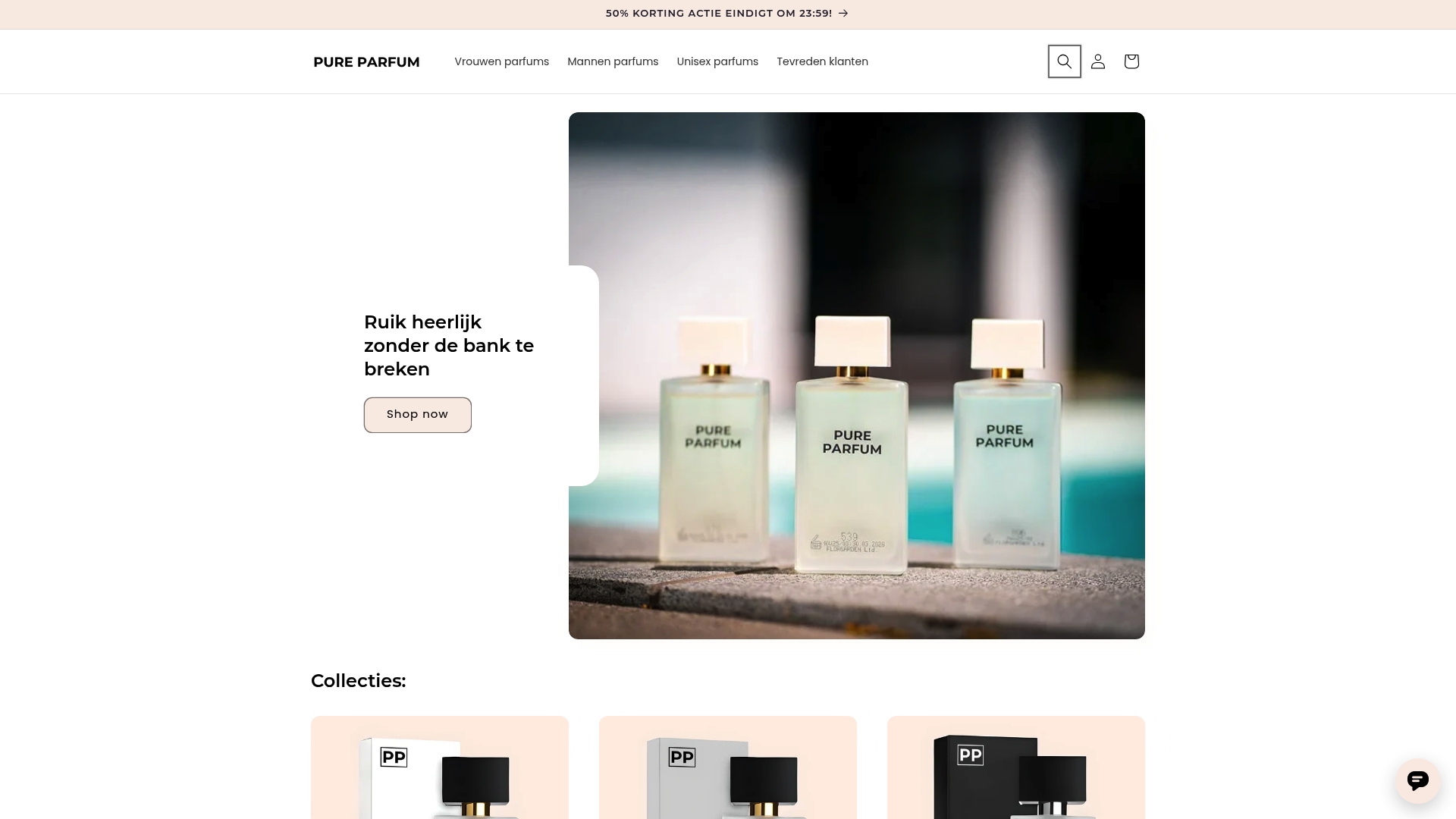
You can choose from women’s perfumes, men’s perfumes, and unisex perfumes. If you want to extend your scent into your care routine, our Body Care collection offers scented hand creams, body lotion, and body wash.
Our view on cruelty-free and vegan
We believe that as a perfume lover, you should not have to choose between a fragrance you love and a choice you can stand behind. That is why all our fragrances are vegan and we work in an animal-friendly way. For us, that is not an extra; it is the starting point.
The difference between cruelty-free and vegan shows why one claim is not enough. A fragrance that has not been tested on animals but still contains animal raw materials feels like only half a promise to many of our customers. Especially in perfume, where musk and castoreum were once standard, a vegan composition is a conscious choice.
Animal-friendly does not have to be expensive either. Expensive bottles and big ad campaigns do not make a fragrance better. By leaving out those costs, we can create perfumes inspired by well-known designer fragrances, with plenty of perfume oil, at a price that remains affordable. Thousands of positive reviews show that this choice resonates.
J
Frequently asked questions
What exactly does cruelty-free mean?
Cruelty-free means that a product and its ingredients have not been tested on animals. The term has no legal definition, so a brand decides for itself how far the promise goes. A certification such as Leaping Bunny also checks suppliers.
Is vegan perfume automatically cruelty-free?
Not always. Vegan is about ingredients, cruelty-free about animal testing. In the strict definition of veganism, both go together, but brands sometimes use the word vegan only for the composition. A brand that makes its fragrances vegan and works in an animal-friendly way covers both.
Is all perfume in the Netherlands animal-testing-free?
Since 11 March 2013, cosmetics, including perfume, may not be tested on animals in the EU, and products that have undergone such tests may not be sold. There are exceptions for substances also used outside cosmetics and for sales outside Europe. The law says nothing about animal ingredients.
Which animal ingredients are sometimes found in perfume?
Classic examples are musk, castoreum, civet, and ambergris. In care products you may also encounter beeswax, honey, lanolin, and carmine. Many modern perfumes use synthetic alternatives that provide the same warm notes without animal origin.
Why does the ingredients list only say “parfum”?
The fragrance composition may be listed under one umbrella term. That means you cannot see which individual fragrance substances are inside or where they come from. If you want to be sure the fragrance is vegan, choose a brand that promises this for all its fragrances.
Sources
The Green List: difference between vegan and cruelty-free FDA: “Cruelty Free”/“Not Tested on Animals” Cosmetics Business: certified formulation in beauty products Dutch Vegan Society: cosmetics Dutch Vegan Society: list of vegan certifications EUR-Lex: Regulation (EC) No 1223/2009 MDPI Cosmetics: Overview of Cosmetic Regulatory Frameworks around the World Proefdiervrij: cosmetics and animal testing Keurmerkenwijzer: Leaping Bunny Leaping Bunny Programme Guidelines (2020) The Vegan Society: Cruelty-Free vs Vegan Vegetariërsbond: V-Label Respect voor Dieren: recognizing cruelty-free cosmetics Bezzia: what are vegan perfumes