


Reliable cruelty-free certification marks ensure that a brand and its suppliers do not test on animals, and that an independent organization checks this periodically. Well-known initiatives such as Leaping Bunny and PETA’s Beauty Without Bunnies are the most prominent examples. Note: cruelty-free is not the same as vegan, so a product without animal testing may still contain animal-derived ingredients.
In short:
- Only labels from recognized organizations such as Leaping Bunny and PETA provide reliable verification of the absence of animal testing.
- Most strict certification schemes require periodic independent audits and a set cut-off date for animal testing.
- A cruelty-free label does not automatically say anything about the absence of animal ingredients; that requires a separate vegan certification.
- Vague claims, missing certificate links, and the lack of a fixed inspection procedure point to less reliable or misleading labels.
- Always check the registered databases, request written proof, and take regional regulations into account when evaluating claims.
Table of contents
- What does cruelty-free mean, and what does vegan mean?
- Which certification marks are the most reliable?
- How do you check a cruelty-free claim yourself?
- Which pitfalls make a claim less reliable?
- Where do you find these labels: cosmetics versus cleaning products
- Six questions before you buy a cruelty-free product
- Why cruelty-free and vegan are not marketing tricks with us
- Discover cruelty-free perfumes at Pure Parfum
- Sources
What does cruelty-free mean, and what does vegan mean?
Cruelty-free refers to the process: the brand and its suppliers do not test their products on animals. Vegan refers to the contents: it means there are no animal-derived ingredients.
This distinction confuses many people, and rightly so. A cruelty-free lipstick can contain beeswax or carmine (a red colorant made from insects) and still pass the Leaping Bunny approval. Conversely, there are vegan products that have never been checked for animal testing by an independent organization. Puur Biologisch describes this difference well: one is about animal welfare during development, the other is about what’s in the package.
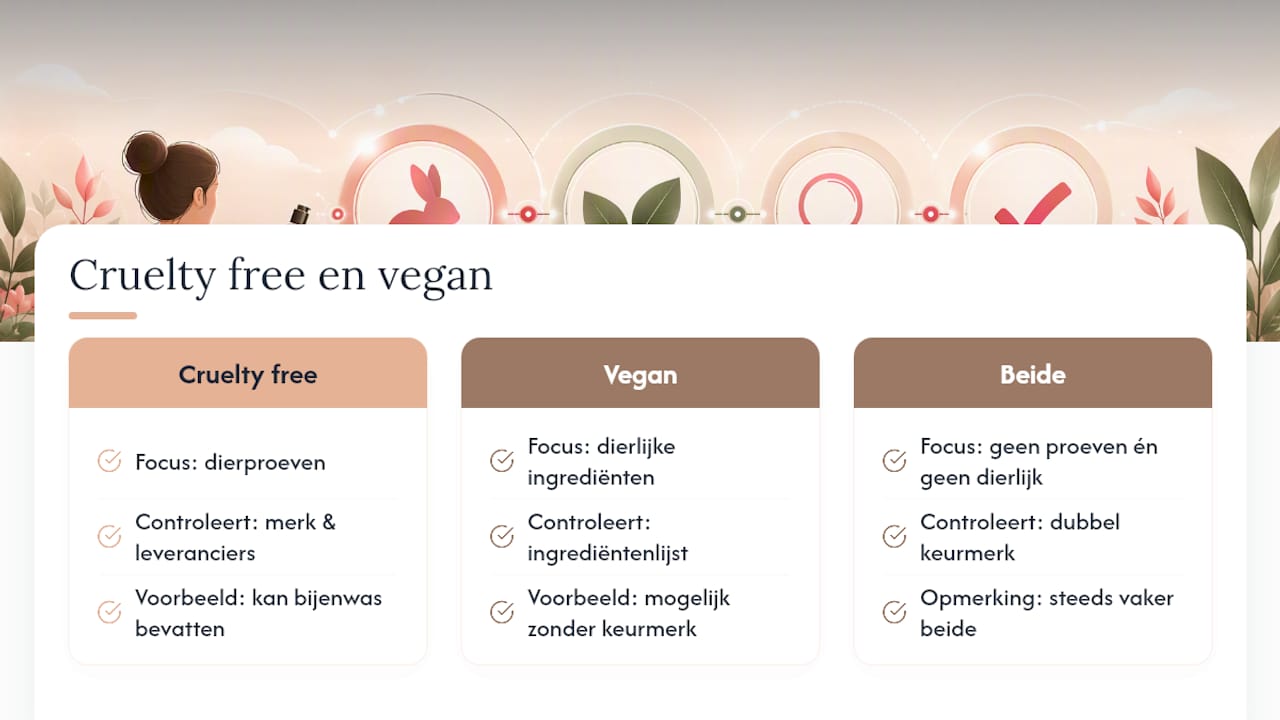
Do you want to exclude both animal testing and animal-derived components? Then look for a double label: a cruelty-free certification mark plus a separate vegan certification. More and more brands offer both at the same time, because consumers often ask this question.
Which certification marks are the most reliable?
Not every cruelty-free label carries the same weight. The difference lies in who performs the checks, how often, and whether suppliers are included.
Leaping Bunny (Cruelty Free International) is considered one of the strictest standards. The certification requires a fixed cut-off date after which no animal testing may be carried out by the brand or its suppliers. Companies must contractually commit this across their entire supply chain, and independent auditors check it periodically.
PETA’s Beauty Without Bunnies works differently. Brands apply themselves and declare that they, and their suppliers, do not test on animals. The list is large and easy to search, but the protocol requires fewer mandatory independent audits than Leaping Bunny. That makes PETA’s database valuable as a starting point, but not always the final step in your research.
For cleaning products, in the Netherlands you often look at Milieu Centraal, which separately assesses the Leaping Bunny logo for:
- animal welfare (is it actually not tested)
- transparency (is the process traceable)
- reliability (is there independent verification)
This three-part check is exactly what you should verify yourself for every brand advertising a cruelty-free claim.
How do you check a cruelty-free claim yourself?
A logo on a bottle means nothing without verification. Four steps give you certainty within ten minutes.
- Look up the brand in public databases. Both Leaping Bunny and PETA maintain searchable lists of approved brands.
- Check the cut-off date and supplier monitoring. Is there a year mentioned after which no animal testing took place, and is this checked with suppliers?
- Request written proof. A serious brand can link to its certificate page without hesitation.
- Look at the markets where the brand sells. Some countries had mandatory animal testing for cosmetics until recently, which raises questions about the practical scope of a claim.
Pro tip: Don’t rule out a brand immediately if it isn’t in the Leaping Bunny database. Smaller brands sometimes choose the PETA list because it’s cheaper and easier to access. Then simply ask for proof of supplier monitoring.
According to Respect for Animals, this kind of verification via public databases is much more reliable than trusting packaging text alone.
Which pitfalls make a claim less reliable?
“Cruelty-free” is not a legally protected term. Any brand may put it on packaging without an independent party ever having checked it.
There’s a second complication: EU sales do not automatically guarantee that no ingredient has ever been tested on animals. Chemical regulations such as REACH may require animal testing in specific cases for safety data, and differences in regulations between countries create loopholes in practice. PETA Prime explicitly points to this as a reason to look beyond a single simple label.
Watch for these signs of a weak or misleading claim:
- no mention of a cut-off date
- no link to a verifiable database or certificate page
- vague wording like “we don’t test on animals” without details about suppliers
- a logo designed by the brand itself, without a link to a recognized organization
Where do you find these labels: cosmetics versus cleaning products
For cosmetics and perfume, you usually see cruelty-free logos directly on the packaging, often next to a vegan symbol, and in the product description on the brand’s webshop.
For cleaning products, it’s different. There, Milieu Centraal specifically lists the Leaping Bunny logo as a certification mark for products that have not been tested on animals, separate from other sustainable certification marks related to environmental impact. The practical difference: for cosmetics, you mainly focus on the animal-testing status of the formula; for cleaning products, the biodegradability of the ingredients often also plays a role. Treat these two checks separately, even if a brand promises both.
Six questions before you buy a cruelty-free product
Go through this list before you check out, both in-store and online:
- Is the brand listed in an independent database such as Leaping Bunny or PETA?
- Is there a specific cut-off date and supplier monitoring mentioned?
- If you also want vegan, check the ingredient list for animal-derived components such as beeswax or carmine.
- In which countries does the brand sell, and are there exceptions to animal-testing bans there?
- Can the brand link to a certificate page or an audit report?
- Does the answer remain vague? Then send a written question to customer service yourself.
Why cruelty-free and vegan are not marketing tricks with us
We make perfumes without animal-derived ingredients and without animal testing—not because it looks good on a label, but because it’s simply possible without compromising on fragrance quality. The high concentration of perfume oil in our bottles ensures a long-lasting scent experience, and that has nothing to do with whether a formula was tested on an animal or not.
In our view, the discussion about certification marks is mainly a discussion about transparency. A brand that refuses to explain how it checks its suppliers effectively gives you no answer—and that should be a red flag. See for yourself how we position our hand cream and body wash: no detours, no expensive packaging—just a product that fits what you’re looking for.
— J
Discover cruelty-free perfumes at Pure Parfum
At Pureparfum, you don’t pay for a name on a bottle or for expensive marketing—you pay for fragrance oil. Our perfumes are vegan and animal-friendly, and they’re made with a high concentration of perfume oil for a long-lasting scent experience.
Not sure whether to choose individual bottles or a set? The 3x100ml perfume bundle gives you three scents to discover without paying the full price three times. Want to match your hand care to your scent choice too? Then take a look at our scented hand cream. Check out the bundle, choose your scents, and order today via our webshop.