


Amber in perfumery is neither a mineral nor an animal product, but a fragrance accord: a warm, sweet-resinous combination that gives perfumes depth and longevity. Perfumers build this accord with labdanum, benzoin, and vanilla, often reinforced with the synthetic molecule Ambroxan. Ambergris (from the sperm whale) and fossil amber are completely different substances that have very little to do with this scent profile.
In short:
- The amber accord consists of resins, vanilla, and synthetic molecules, while ambergris and fossil amber are completely different substances with no comparable scent.
- Amber smells warm, sweet-resinous with woody and spicy notes, and acts as a base and fixative that makes the fragrance linger on the skin for a long time.
- In perfumes, amber is mainly used in oriental, evening, and gourmand fragrances; it adds depth and helps prevent the scent from fading quickly.
- Identifying amber on a test strip or on skin requires patience and comparing the base notes after about half an hour, with a warm, resinous sensation.
- Modern perfumes with amber are often vegan and animal-friendly, and a sample set helps you discover the subtle differences between light and rich amber bases.
Table of contents
- What does amber scent really mean? Accord versus ambergris versus amberstone
- What does amber smell like? The notes that determine the character
- Composition of the classic amber accord
- Where do you come across amber in perfumes?
- How do you recognize amber yourself on a test strip or on skin?
- What amber symbolizes beyond the perfume bottle
- Why Pure Parfum is a logical place to discover amber
- When amber is the right choice
- Experience amber yourself: which set suits you?
- Sources
What does amber scent really mean? Accord versus ambergris versus amberstone
If you search for “amber scent meaning,” you’ll quickly come across three different things that happen to share the same word. The amber accord is a composition that perfumers developed from the nineteenth century by combining natural resins with sweeteners, with labdanum and benzoin as the backbone. There is no plant or mineral that literally is called “amber” and smells like this.
Ambergris is something completely different: a rare secretion from the intestines of the sperm whale, which used to be used as a fixative but is now largely replaced by synthetic alternatives). Fossil amber, the petrified resin you see in jewelry, gives off no scent under normal circumstances.
Three terms, three completely different sources:
- Amber accord: a composed blend of resins, vanilla, and synthetics.
- Ambergris: a rare animal raw material from the sperm whale, hardly used anymore.
- Fossil amber: petrified tree resin with no inherent scent, purely decorative.
So perfumers use “amber” as a label for a type of fragrance, not for a specific ingredient.
What does amber smell like? The notes that determine the character
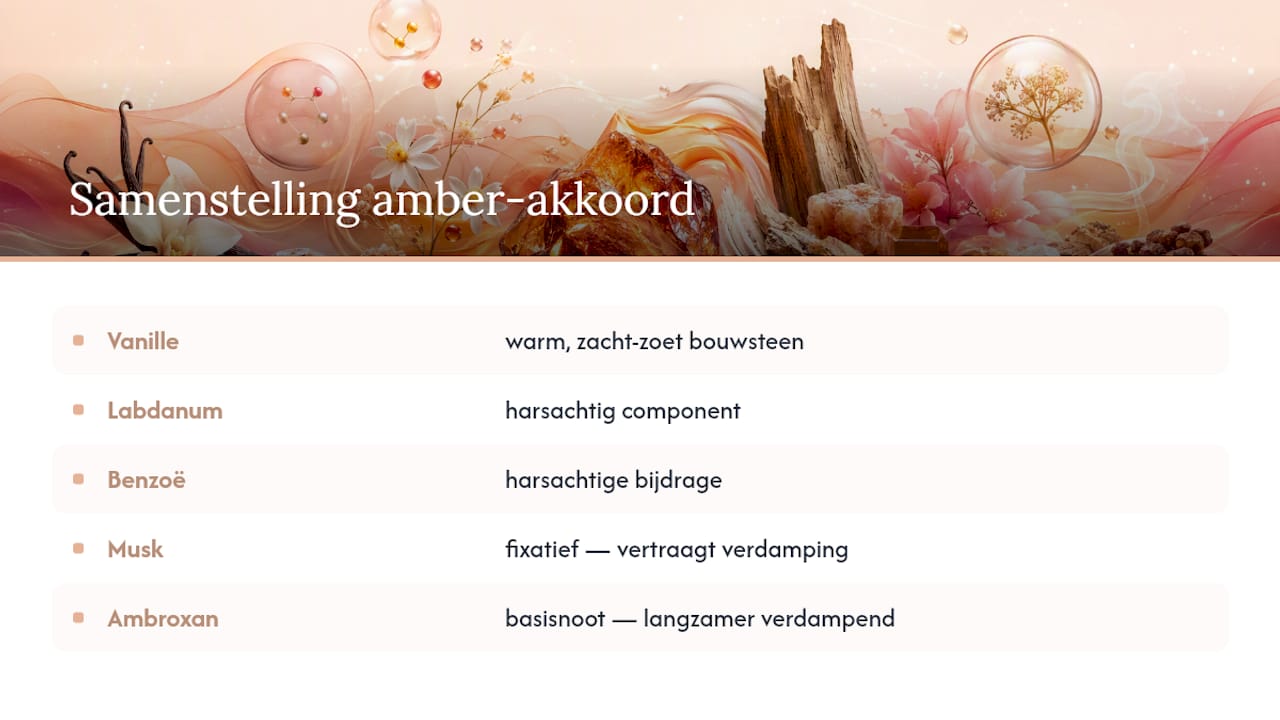
Amber smells warm, soft-sweet, and resinous, often with a spicy or woody undertone. It’s not a sharp or fresh scent, but rather one that falls over you like a blanket. Typical building blocks are vanilla, labdanum, benzoin, musk, and Ambroxan, each contributing its own share to the overall picture.
What sets amber apart from a simple vanilla fragrance is its role in the composition. Amber functions as a base note and fixative, which means that the resinous molecules evaporate more slowly than lighter top notes like citrus or green leaves. As a result, amber slows down the entire evaporation process of a perfume and keeps the scent on the skin much longer than a composition without this base.
That’s why many evening perfumes and oriental-leaning scents are built around amber: the fixing effect creates a long-lasting trail, sometimes noticeable well into the late evening. Without a strong base note, a perfume often disappears after just a few hours.
Composition of the classic amber accord
The classic amber accord consists of a handful of raw materials that complement each other. Labdanum, obtained from the cistus plant, forms the resinous backbone: without labdanum, an amber accord loses its typical depth and quickly starts to smell like a flat vanilla fragrance. Benzoin adds a sweeter, balsamic layer, while vanilla makes the composition rounder and more accessible.
Modern perfumers often round out this trio with synthetic molecules such as Ambroxan. This isn’t done out of laziness, but for two practical reasons: consistency between bottles and an ethical alternative to raw materials that are scarce or animal-derived.
What each component contributes specifically:
- Labdanum: resinous depth and a slightly animal, warm undertone.
- Benzoin: balsamic sweetness, often with a vanilla-like scent.
- Vanilla: softness and approachability, smoothing out the sharper resin notes.
- Ambroxan: stability, longer wear, and a cleaner, more modern finish.
Where do you come across amber in perfumes?
Amber shows up in many more fragrance families than you might expect. In oriental and evening perfumes it’s often the main role, but in fresh or floral compositions it works as a softener that adds more roundness without making it heavier.
Three situations where amber stands out the most:
- Cold weather and evening hours: the warm, resinous core then comes into its own best, because skin temperature and ambient temperature influence scent release.
- Oriental and gourmand compositions: amber often forms the base here, on which spices, woods, and sweet notes are layered.
- Fresh or floral perfumes: a small dose of amber prevents the fragrance from feeling too flat or “too clean,” and immediately gives a more luxurious feel.
That’s why amber isn’t used only to smell sultry. It’s often the invisible hand that gives a composition more depth, without you as a wearer being able to pinpoint exactly why the scent feels so full.
How do you recognize amber yourself on a test strip or on skin?
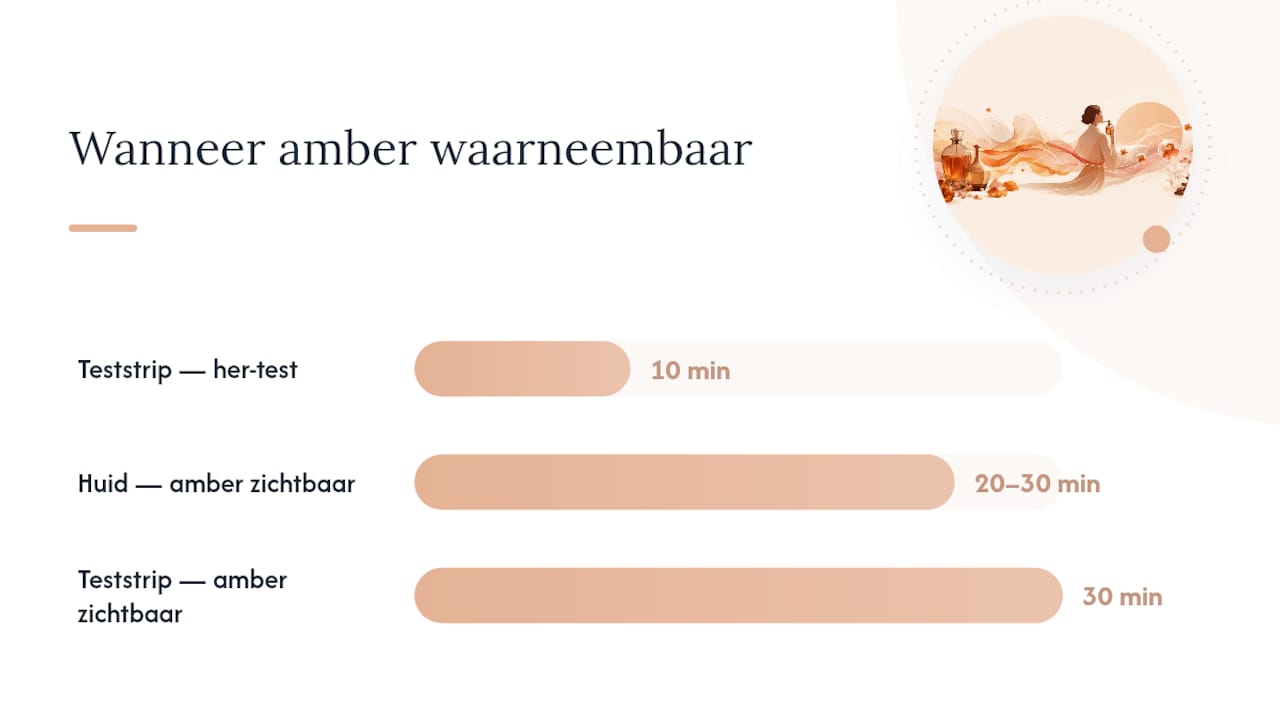
A simple sniff test tells you more than you might think. Spray the perfume onto a test strip, let it dry for a minute or ten, then smell again: the first fresh or spicy top notes disappear, and what remains after half an hour is often the amber base.
Repeat the same test on your skin, because amber reacts differently there than on paper due to body heat and skin oils. Look for an enveloping, warm sensation with vanilla-like or resinous tones in the base phase—usually only clearly noticeable after 20 to 30 minutes.
- Spray on a strip, let it dry, smell after 10 and after 30 minutes.
- Repeat on the skin and compare the difference in warmth and sweetness.
- Check whether the scent feels more “rich and resinous” or “only sweet”: pure vanilla isn’t automatically amber.
Pro tip: Compare two perfumes side by side on different wrists. That way you immediately feel the difference between a light amber base and a rich, resinous structure.
What amber symbolizes beyond the perfume bottle
Amber has long been associated with warmth, comfort, and luxury—something perfumers consciously use as a mood-setter in a composition. Traditional amber blocks, such as those burned in certain cultures, are however not the same as the amber accord in perfume.
Amber blocks often contain other ingredients and react differently on the skin than the finely tuned amber accords perfumers create. So don’t expect the same scent when you switch from a block to a perfume bottle.
Why Pure Parfum is a logical place to discover amber
Pure perfumes with a higher concentration of perfume oil generally last longer on the skin. Many modern perfumes are formulated to be vegan and animal-friendly, with amber usually made without animal-derived ambergris.
For anyone who wants to explore amber without immediately buying an expensive bottle, it’s practical to choose an affordable option that provides the warm, resinous base—without sacrificing scent intensity.
When amber is the right choice
Amber works best when you’re looking for warmth, comfort, or a scent that survives evenings and cold months. If you’re still unsure, a sample set is the smartest first step: you compare multiple amber-like variations without buying a full bottle right away. Once you’ve found the right base note, you can then buy more targeted.
— J
Experience amber yourself: which set suits you?
You truly learn amber by smelling it, not by reading about it. Some perfumes are vegan, animal-friendly, and made with a higher concentration of perfume oil, which means the warm, resinous base of amber can be felt on the skin longer than with some other alternatives.
Want to lay a few amber-like variations side by side right away? The 30ml x4 Parfum Set is made for that: four fragrances, one order—more than enough to feel the difference between a light and a rich amber base. Prefer to start small and try each scent better? Then the 20ml x5 Parfum Set is an approachable option to compare five variations without making a big investment right away. If you’ve already found your favorite and want it in a full bottle, check out the full range at Pure Parfum and order the fragrance that best matches your amber experience.
Sources
For those who want to dive deeper into the subject: Wikiparfum explains the technical role of amber as a base note, Monique van der Vloed covers the difference with amber blocks, Wikipedia describes ambergris from the sperm whale, and Parfumado looks at the historical development of the accord.